
Oriental shoot fly
Atherigona orientalis
Description
How to identify
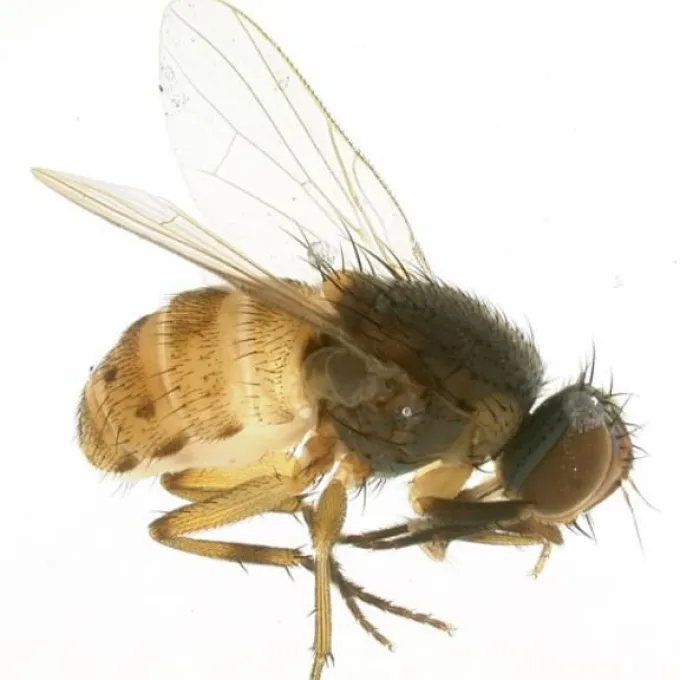
The oriental shoot fly (Atherigona orientalis) belongs to the Muscidae family of the order Diptera. These are small insects, with adults typically featuring a greyish-yellow body and distinct dark markings on the abdomen.
Larvae of this species are legless, creamy-white in color, and measure approximately 6 to 8 mm in length. They are highly specialized for feeding within plant tissue, which protects them from environmental exposure.
The life cycle varies based on climate conditions. In tropical and warm environments, the pest can complete its development from egg to adult in less than three weeks.
Female flies lay eggs singly or in small batches on the undersides of leaves or near the growing points of host plants. High reproductive rates contribute to rapid population explosions.
Pupation occurs either within the infested plant part or in the soil near the host plant, allowing the insect to thrive in diverse agricultural settings.
What it damages
This fly is a significant polyphagous pest that attacks a wide array of crops, including tomatoes, peppers, eggplants, beans, and various cucurbits.
Damage is most severe during the seedling and early vegetative stages, where the destruction of the apical bud leads to stunted growth or total plant loss.
In commercial vegetable production, larvae bore into stems and petioles, causing wilting and making the plant unsuitable for sale or healthy maturation.
The pest also survives on common weeds, meaning that surrounding vegetation often acts as a nursery for the flies to move onto valuable crops.
Economic damage is caused not only by direct tissue consumption but also by the secondary pathogen entry facilitated by larval feeding holes.
Signs of infestation
The primary sign of an Atherigona orientalis infestation is the wilting of the terminal shoots and young leaves, often mistaken for a lack of water or fungal wilt.
Small entry holes or tunnels may be visible on the stem surface. If the stem is opened, white larvae are often found burrowing through the central vascular tissue.
Affected plants often display chlorosis, tissue necrosis, and in severe cases, the entire stem becomes hollowed out due to larval feeding.
Seedlings may fail to establish properly, showing signs of "dead heart" where the central shoot dies prematurely, followed by lateral branching.
In greenhouses, the presence of these flies can be confirmed by using yellow sticky cards, which help detect the initial adult population influx.
Control measures
Chemical control involving systemic insecticides is the most effective approach, as the chemical must travel into the plant tissues to reach the internal larvae.
Cultural management is crucial: affected plants should be promptly pulled out and disposed of to eliminate the developing larvae before they pupate and emerge as adults.
Installing fine-mesh screening on greenhouse vents prevents adult flies from entering and laying eggs on young transplants.
Sanitation practices, such as removing weeds around the perimeter of the field, effectively reduce the alternative hosts available for the flies.
Monitoring populations via pheromone or visual traps allows growers to apply treatments at the optimal timing, preventing the next generation from reaching high density.
Taxonomy
- Latin name
- Atherigona orientalis
- Order
- Diptera (flies)
- Family
- Muscidae
- EPPO code
- ATHEOR
Discussion
No discussions yet — be the first.