
Sorghum shoot fly
Atherigona reversura
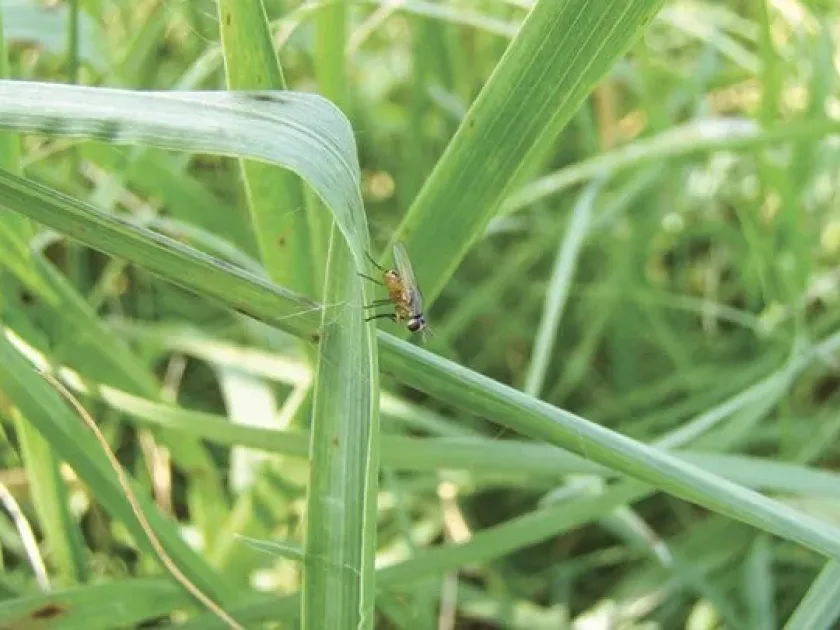
Description
How to identify
The sorghum shoot fly (Atherigona reversura) is a dipterous insect belonging to the family Muscidae. It is recognized as a significant pest of sorghum and several other cereal grasses, widely distributed in regions where these crops are grown.
Adult flies are small, measuring roughly 3-5 mm in length. Their body coloration is generally greyish-yellow with distinct dark markings on the abdomen. The wings are transparent with a venation pattern typical of the Muscidae family.
The larva, which is the destructive stage, is a legless, creamy-white maggot reaching about 6-8 mm. It thrives by feeding on the internal tissues of young shoots, particularly targeting the apical meristem.
Pupae are barrel-shaped and dark brown in color. They are usually found within the damaged stems or in the upper layers of the soil, ensuring the survival of the population until favorable conditions for emergence occur.
Identification often requires careful inspection. Because Atherigona reversura shares morphological similarities with other shoot fly species, specialized entomological identification is sometimes necessary for accurate monitoring.
What it damages
The primary crop affected by this pest is sorghum. The most severe damage typically occurs during the seedling stage, specifically from emergence until about 30 days after germination when the plant is most vulnerable.
While sorghum is the main host, the fly can occasionally infest related grass species, including pearl millet and maize, especially if they are growing in the vicinity of primary host crops.
Damage is initiated when the larva bores into the central shoot, effectively destroying the growing point. This leads to the characteristic symptom of a dying central leaf, widely referred to as the "dead heart."
The destruction of the central shoot prevents the plant from developing a normal panicle. While some plants might produce tillers as a compensatory mechanism, these are often stunted and yield little to no grain.
Economic losses arise from both reduced plant density and poor grain filling. In high-infestation years, significant portions of the crop may need to be replanted if the damage is widespread early in the season.
When it appears
The seasonal activity of the sorghum shoot fly is heavily regulated by temperature and rainfall patterns. The flies become active as the temperatures rise in the spring, which often coincides with the planting season.
Multiple generations can occur throughout the growing season, provided there is a continuous supply of young host plants. The ability to complete a lifecycle in a short period enables rapid population expansion.
Overwintering takes place mainly in the pupal stage within the soil or in crop residues. This dormancy allows the species to survive harsh seasonal gaps and re-emerge when host crops become available.
High humidity and moderate temperatures favor the adult flies' reproductive activity. During this time, they lay eggs on the undersides of leaves, and the emerging larvae immediately move toward the leaf whorl to begin feeding.
Field monitoring using yellow sticky traps is an essential practice to detect the start of adult flight. Early detection allows for more precise application of management strategies before the damage thresholds are exceeded.
Signs of infestation
The most diagnostic sign of an infestation is the yellowing and subsequent withering of the central leaf of a young plant. This "dead heart" symptom is a clear indicator that the apical meristem has been destroyed.
If the shoot is opened, one can usually find the cream-colored larva feeding on the internal tissues. The tissue often exhibits signs of rotting due to secondary bacterial or fungal infections facilitated by the larval feeding.
Affected plants often show an atypical growth habit characterized by excessive tillering. These plants appear stunted and fail to grow as vigorously as their non-infested neighbors.
In addition to the central leaf death, one might observe small exit holes or damage galleries within the stem base, indicating the movement of the larva within the plant.
- Withered and yellowing central leaf (dead heart).
- Stunted growth and poor plant development.
- Excessive or abnormal lateral tillering.
- Presence of larvae within the stem.
Control measures
Integrated Pest Management (IPM) is crucial for managing the sorghum shoot fly. Cultural practices, such as choosing optimal planting dates to avoid the peak flight periods, form the foundation of control.
Selecting resistant or tolerant sorghum cultivars is highly effective. These cultivars are bred to either possess physical barriers to larval entry or to recover more effectively if early damage occurs.
Seed treatment with systemic insecticides provides a vital protective shield for seedlings. This method ensures that the young plants are protected during the most critical 3-4 week period post-emergence.
Good field hygiene, including the removal of stubble and destruction of volunteer crops or grassy weeds, helps to break the lifecycle of the pest by reducing overwintering sites.
Foliar insecticide applications should be used as a last resort, targeted at the adult fly stage if monitoring indicates that threshold levels have been exceeded. Applications are most effective during early morning or evening hours.
Taxonomy
- Latin name
- Atherigona reversura
- Order
- Diptera (flies)
- Family
- Muscidae
- EPPO code
- ATHERE
Discussion
No discussions yet — be the first.