

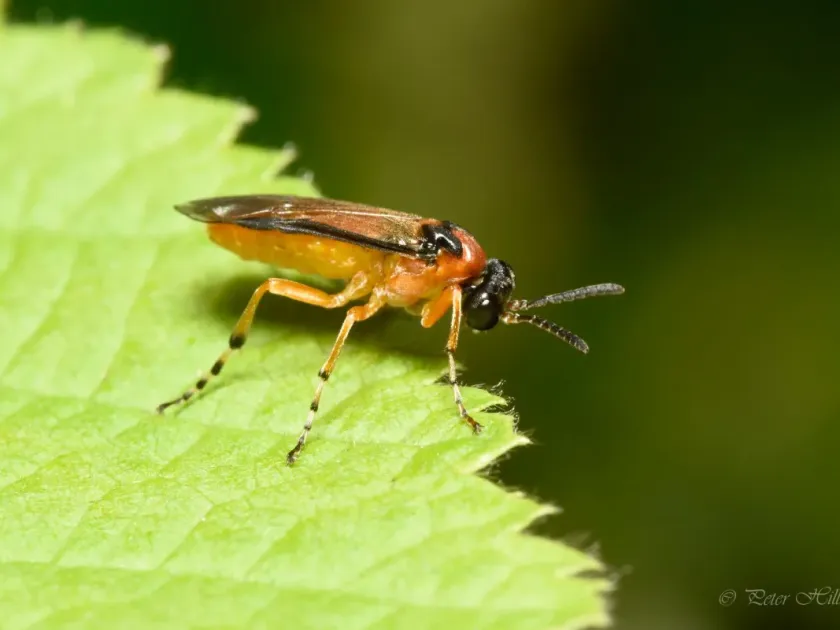
Description
How to identify
The turnip sawfly (Athalia rosae) is a member of the Tenthredinidae family within the Hymenoptera order. Adult insects are about 7–8 mm long, characterized by an orange-yellow body with a black head and distinct dark markings on the thorax.
The larvae, often referred to as false caterpillars, are distinct from butterfly caterpillars due to their ten pairs of legs. They grow up to 20–25 mm in length and display colors ranging from gray-green to almost black.
The pest overwinters in the pupal stage, encased in robust cocoons deep within the soil profile (up to 15 cm). They emerge as adults once soil temperatures rise in the spring.
The life cycle involves complete metamorphosis. Depending on regional climate patterns, Athalia rosae can complete two to three generations per growing season.
Adult sawflies feed primarily on nectar from wild plants, while females use their specialized saw-like ovipositor to insert eggs into the leaf tissue of host plants.
What it damages
The turnip sawfly targets plants in the Brassicaceae family, including canola (rapeseed), mustard, radish, and various cabbage cultivars. Host specificity makes them a significant threat to these crops.
It is the larvae stage that inflicts damage by feeding on foliage. Younger larvae perform skeletonization, consuming leaf tissue while leaving the larger veins intact.
As larvae reach their later stages of development, their appetite grows substantially. They can defoliate entire plants in a short period, leaving only stalks behind.
Heavy infestations in seedling crops are particularly devastating. Sawflies can destroy the growing point of young plants, resulting in poor stand establishment and the need for reseeding.
While mature plants are more resilient, severe damage to leaves and pods can reduce photosynthetic capacity and adversely affect final seed weight and quality.
When it appears
The first generation of adults typically emerges in late spring. This initial wave targets the earliest growth stages of canola and other cruciferous vegetables.
The second generation, occurring throughout the summer, is generally the most destructive. It often coincides with the peak growth phase or pod development of the crop.
A potential third generation may emerge in late summer, especially if moisture levels and crop availability are sufficient to support late-season development.
Environmental factors heavily influence activity. Warm, dry weather conditions accelerate the life cycle, while prolonged wet periods can lead to increased larval mortality.
Since emergence patterns are often staggered, field scouting must be consistent throughout the season to monitor for the presence of multiple larval stages.
Signs of infestation
Early symptoms include small holes or "windows" on the leaf surface, indicating that young larvae have started feeding on the leaf tissue.
A close inspection during the early morning is recommended, as larvae are more active and visible then. When disturbed, they characteristically curl into a spiral shape.
General yellowing and drying of leaf margins serve as a secondary symptom of severe infestation. Plants appear stunted and ragged due to extensive tissue loss.
The presence of fine, dark, pellet-like frass on the leaves or the surrounding soil is a clear indicator of active feeding by a large larval population.
Large patches of defoliated plants in a field usually signify a severe outbreak that requires immediate intervention to protect the crop yield.
Control measures
- Implementing deep tillage after harvest to bury and destroy overwintering cocoons.
- Managing host weeds on field margins to reduce alternative food sources for the pest.
- Utilizing appropriate crop rotation to break the cycle of infestation in specific fields.
- Monitoring fields regularly to ensure insecticide applications are timed correctly according to economic thresholds.
- Adopting biological control measures and encouraging natural predators to suppress larval populations naturally.
Content graph
Connections · Turnip sawfly
Most often together:
Marketplace
Products · 21


ASISTENT, WP
Jiangsu Institute of Ecomones Co., Ltd.
Insecticides
0
0
·
52
4 offers
19.94 €per 1 l
Buy


Break m.e., (lambda-cyhalothrin, 100 g/l)
ЗАТ Фірма Август, Росія.,селище Вурнари,
Insecticides
0
0
·
65
No offers
—
Details


Biology
Taxonomy
- Latin name
- Athalia
- Order
- Hymenoptera
- Family
- Tenthredinidae
- EPPO code
- ATALSP
Community
Discussion
No discussions yet — be the first.