
Arma custos
Arma custos
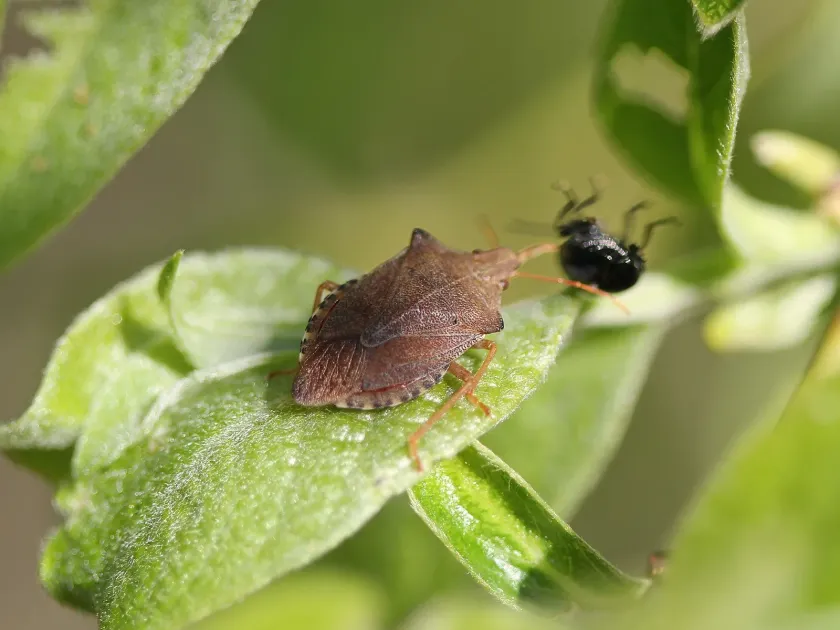
Description
How to identify
Arma custos is a predatory bug belonging to the Pentatomidae family (stink bugs). Adult specimens typically measure between 10 to 14 mm in length and exhibit colors ranging from yellowish-grey to brownish with a metallic sheen.
A distinctive feature of the imago is a sharp protrusion on the pronotum. The larvae undergo several instars, changing their appearance from orange-black in early stages to dark brown as they mature.
This species is classified under the order Hemiptera. While many members of the Pentatomidae family are phytophagous, Arma custos is primarily a predator known for hunting other insects in its ecosystem.
The biological development of this bug is closely tied to forest ecosystems and agricultural fields, where it acts as a natural regulator of insect populations. Sexual dimorphism is subtle, with females being generally larger than males.
Accurate identification in the field can be challenging due to its similarity to other stink bug species, often requiring detailed examination of the pronotum or genitalia under laboratory conditions.
What it damages
Although Arma custos is predominantly predatory, it can exhibit phytophagous behavior, causing damage to crops when its natural prey is scarce. In such conditions, the bug feeds on plant sap.
Significant damage is often reported in cereals, legumes, and vegetable crops. The bug uses its proboscis to pierce stems and leaves, injecting digestive enzymes that lead to tissue necrosis.
Symptoms include wilting of young shoots, leaf deformation, and stunted plant growth. Yield losses occur due to the depletion of nutrients that the insect extracts from the plant's vascular system.
Economic damage can be substantial during periods of high pest density throughout the growing season. Plants in their intensive growth phase and those forming reproductive organs are particularly vulnerable.
Furthermore, the puncture wounds created by the bug act as entry points for secondary pathogens, including fungi and bacteria, which can significantly decrease the market quality of the harvest.
When it appears
The life cycle of Arma custos consists of one or two generations per year, depending on the local climate. Adult bugs hibernate in leaf litter, under tree bark, or in crop residues.
Emergence from dormancy typically occurs when temperatures consistently rise above 12–15 degrees Celsius. After a period of feeding, mating begins, followed by egg-laying on the undersides of leaves.
Embryonic development lasts between 7 to 14 days. Larvae pass through five instars while feeding actively throughout the summer, which dictates the fluctuations in their population density.
Peak activity for adult bugs is usually observed in July and August, when the population reaches its highest level, posing the greatest risk to agricultural fields.
As daylight hours shorten and temperatures drop in the autumn, the insects move into sheltered sites to overwinter, successfully completing their annual development cycle.
Signs of infestation
The main indicator of pest presence is the appearance of localized chlorotic spots on leaves, which gradually turn brown and die off as the tissue necrosis progresses.
During crop inspections, one may spot clusters of barrel-shaped eggs on the underside of leaves, which is a characteristic sign for this bug family.
Finding exuviae (shed skins) of larvae on the stalks of plants is clear evidence of the pest's population development within the specific area.
A sudden loss of turgor in plant tissues in the absence of obvious defoliators is frequently a symptom of sap-sucking insect activity.
Early morning or late evening visual inspections of the crop canopy allow for the detection of adult bugs, which generally seek refuge in leaf axils during the hot daylight hours.
Control measures
Effective management of Arma custos involves agronomic practices aimed at disrupting their overwintering sites, such as deep autumn plowing to eliminate hibernating adults.
Maintaining field margins and eliminating weeds prevents the buildup of pest populations, as it removes secondary food sources during the off-season.
Chemical control should be reserved for instances where populations exceed the economic threshold, utilizing systemic insecticides targeting younger larval instars.
Biological control methods focus on protecting native parasitoids, specifically egg parasitoids, which naturally regulate the population of these bugs in sustainable farming environments.
The use of pheromone traps provides a reliable tool for monitoring population density, allowing farmers to make informed decisions about intervention and reduce overall pesticide reliance.
Taxonomy
- Latin name
- Arma custos
- Order
- Hemiptera (bugs, aphids, leafhoppers)
- Family
- Pentatomidae
- EPPO code
- ARMXCU
Discussion
No discussions yet — be the first.