
Juniper webworm
Argyresthia trifasciata
Description
How to identify
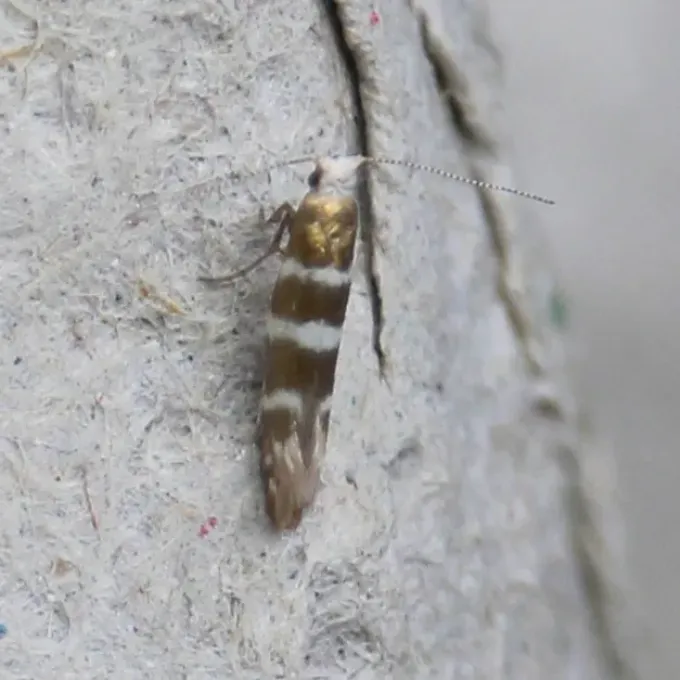
The Juniper webworm (Argyresthia trifasciata) is a small moth belonging to the Yponomeutidae family. Its wingspan typically ranges from 10 to 12 millimeters.
The forewings are ocher-brown in color, featuring three distinct light transverse bands. The hindwings are grayish and fringed, which is a characteristic feature of this species.
The larvae, or caterpillars, are about 6–8 mm long with a greenish or yellowish body and a darker head. They live inside the shoots, making them difficult to detect.
Taxonomically, this pest belongs to the order Lepidoptera and the family Yponomeutidae. It is a highly specialized insect that targets specific coniferous species.
Identification is primarily based on the visual symptoms of shoot damage rather than seeing the moth itself, which is very small and cryptic in its behavior.
What it damages
The primary hosts of this pest include various species of Juniper (Juniperus) and occasionally Thuja, all of which belong to the Cupressaceae family.
Larvae feed internally on the foliage and shoots of the plant. This mining activity disrupts the transport of water and nutrients, leading to the death of affected branches.
The primary damage is a significant loss of aesthetic value. Affected plants often look sparse, yellowed, and sickly, which ruins the appearance of ornamental plantings.
Heavy infestations can stunt the growth of the tree and make it more susceptible to secondary infections, such as fungal pathogens or bark beetles.
In nurseries, the Juniper webworm can cause severe economic losses by damaging young stock, making them unsuitable for sale due to stunted or deformed growth.
When it appears
Adult moths typically emerge in late spring or early summer. After mating, the females lay eggs directly on the foliage or the base of young shoots.
Once the larvae hatch, they bore directly into the shoot tissue. They feed throughout the summer and fall, causing internal damage that may not be immediately obvious.
The larvae overwinter inside the hollowed-out shoots, protected by the plant tissue. This allows them to survive cold temperatures during the winter months.
In the following spring, the larvae resume feeding as temperatures rise. Eventually, they pupate within the shoots before emerging as adults to start the cycle again.
Effective monitoring should focus on early spring when the larvae become active and start to cause noticeable yellowing of the foliage tips.
Signs of infestation
The most common sign of an infestation is the yellowing or browning of shoot tips in the spring. These tips often appear to be dying back individually.
Upon close inspection, small entrance holes made by the larvae can be seen on the shoots. Frass (larval excrement) may also be visible near these entry points.
If you break open a discolored shoot, you will find a hollow mine. This is a definitive diagnostic sign of the presence of the Juniper webworm larvae.
In some cases, you may see light webbing connecting the damaged needles or shoots, which the larvae use for protection and navigation on the host plant.
During the adult flight period, moths can be attracted to light at night, which can be used as a simple method to detect their presence in the landscape.
Control measures
Sanitation is a critical step in controlling this pest. Pruning and destroying infected branches in the spring helps to remove the larvae before they emerge as adults.
- Application of systemic insecticides during the early larval stage in spring.
- Use of pheromone traps to monitor adult moth activity and timing of treatments.
- Foliar sprays with contact insecticides when adult moths are active.
- Maintaining plant vigor through balanced fertilization and proper irrigation.
- Encouraging natural predators that may help keep population levels in check.
Chemical control is most effective when systemic products are used. These insecticides are absorbed by the plant, reaching the larvae hidden inside the shoots.
Careful timing is essential; treatments should coincide with the period when larvae are young and actively feeding before they have caused extensive damage.
Biological control agents, such as formulations containing Bacillus thuringiensis, can be used as a safer alternative to conventional chemical pesticides.
Taxonomy
- Latin name
- Argyresthia trifasciata
- Order
- Lepidoptera (butterflies)
- Family
- Yponomeutidae
- EPPO code
- ARGYTR
Discussion
No discussions yet — be the first.