
Arborvitae leaf miner
Argyresthia thuiella
Description
How to identify
The arborvitae leaf miner (Argyresthia thuiella) is a small moth belonging to the Yponomeutidae family, known for causing significant damage to various species of Thuja (arborvitae) and other related conifers.
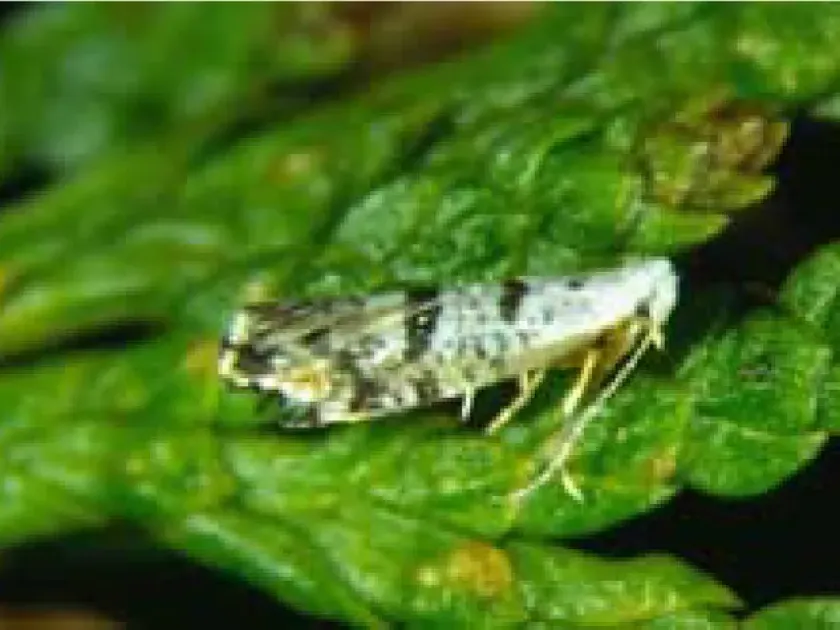
Adult moths are very small, with a wingspan of about 10 mm. Their wings feature a mottled pattern of silver, gray, and brown, providing them with excellent camouflage against the bark and foliage of their host trees.
The insect typically completes one generation per year. Female moths lay eggs on the scales of the foliage during the summer months, ensuring that the offspring have immediate access to food upon hatching.
The larvae are small, pale green or brownish caterpillars that measure only a few millimeters in length. They are endophagous, meaning they live and feed entirely inside the foliage, creating mines that are invisible from the outside.
Pupation occurs within these mines in the spring. After a short pupal stage, the adult moths emerge, ready to mate and initiate a new cycle, continuing the pressure on the host plant throughout the growing season.
What it damages
The primary hosts of this pest are arborvitae (Thuja occidentalis) and related species like Juniperus and Chamaecyparis. Ornamental hedges and manicured garden specimens are particularly prone to infestations.
Larvae consume the interior tissue of the leaf scales, disrupting the plant's ability to transport nutrients and water. This localized feeding causes the foliage to lose its vigor and turn color.
Visible damage typically manifests as yellowing, browning, or a bleached appearance of the branch tips. In severe cases, the entire outer layer of the foliage can become discolored, leading to a significant loss of aesthetic value.
Although an infestation rarely kills a healthy mature tree outright, repeated attacks over several years can cause severe dieback of branches, stunted growth, and make the tree susceptible to secondary infections.
Because the larvae are hidden within the foliage, the damage is often misidentified as drought stress or fungal diseases, delaying necessary treatment and allowing the population of moths to multiply.
When it appears
The flight period for adult moths generally occurs in June, which is the most critical time for monitoring and control. During this period, the moths are active, especially in the evenings.
The larval stage occupies the majority of the year. After hatching in summer, the caterpillars feed extensively until autumn, when they settle into the mines to overwinter safely inside the plant.
Spring activity resumes as temperatures rise. The larvae complete their feeding and enter the pupal stage, usually peaking in late April and May before the new adults begin their emergence.
The timeline of the life cycle dictates the management strategy; therefore, observing the appearance of small, fluttering moths in early summer is the most important indicator for timing insecticide applications.
By understanding the seasonal shifts, gardeners can target the moths before they lay eggs or apply treatments to kill young larvae immediately after they have hatched from the egg stage.
Signs of infestation
The most telltale sign of an infestation is the premature browning of the foliage tips in late spring. This browning often affects specific branches before spreading to the rest of the canopy.
Close inspection reveals tiny entry or exit holes on the scales where the larvae have penetrated. If the foliage is cracked open, it will reveal a hollowed-out interior, often filled with small, dark, granular frass.
The foliage feels dry and brittle to the touch and can easily be shaken off the tree. Heavily infested branches may drop their needles or scales, leaving the plant looking thin and unhealthy.
In mid-summer, the presence of a high number of moths can be verified by shaking the branches, which causes a cloud of tiny insects to take flight, clearly indicating a high pest density.
- Discoloration and browning of foliage tips.
- Small perforations in the leaf scales.
- Presence of hollow mines within the needles.
- Increased shedding of foliage when touched.
- Flights of tiny moths around the tree in June.
Control measures
Effective management requires a combination of timely insecticide use and good horticultural practices to maintain plant health and suppress pest populations.
For chemical control, systemic insecticides are the most effective because they are absorbed by the plant, targeting the larvae that feed inside the protected environment of the foliage.
Applications should be timed to coincide with the emergence of larvae (early to mid-summer) to kill them before they can create extensive damage. Contact insecticides can also be used during the adult moth flight period.
Sanitation is a vital non-chemical control measure. Gardeners should prune and remove infected branch tips as soon as they are identified, and ensure the debris is burned or disposed of far from the site to prevent re-infestation.
Maintaining the overall health of the tree through adequate watering, mulching, and proper fertilization can help the plant recover from damage and increase its natural resistance to leaf miner infestations.
Taxonomy
- Latin name
- Argyresthia thuiella
- Order
- Lepidoptera (butterflies)
- Family
- Yponomeutidae
- EPPO code
- ARGYTH
Discussion
No discussions yet — be the first.