
Mountain ash moth
Argyresthia sorbiella
Description
How to identify
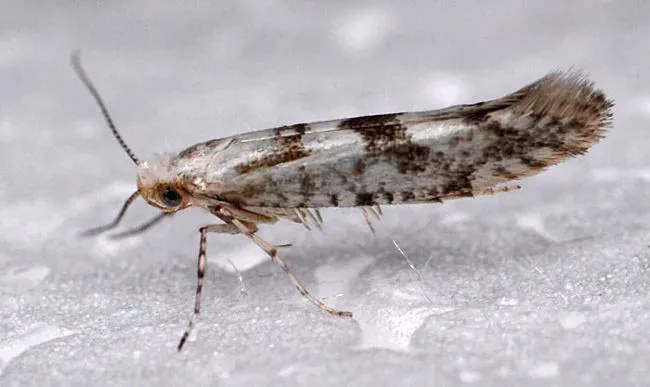
The Mountain ash moth (Argyresthia sorbiella) is a small moth belonging to the family Yponomeutidae. Adults have a wingspan ranging from 10 to 12 mm.
The forewings of the moth are typically silvery-white with subtle dark markings, which provides excellent camouflage against the bark of host trees.
The larvae are yellow-green with a brown head, usually measuring about 6–8 mm in length when mature, making them difficult to spot on foliage.
Eggs are minute and oval, typically laid by females in crevices of the bark near buds, where they remain throughout the winter months.
Pupae are enclosed in white, tough cocoons and can often be found in the soil layer beneath the tree canopy or in protected bark fissures.
What it damages
The primary host for this pest is the European mountain ash (Sorbus aucuparia). Occasionally, it may also affect other species within the Rosaceae family.
The damage is caused by the larvae, which bore into developing buds, feeding on the internal tissues and destroying the growth points of the tree.
Heavy infestations can lead to significant loss of flowers, resulting in the total destruction of the berry crop for the season.
Affected leaves often curl and die, while damaged shoots show stunted growth, weakening the tree and making it more susceptible to environmental stress.
Since the larvae feed internally, the damage often remains unnoticed until the leaves and buds begin to wither and brown.
When it appears
The insect overwinters in the egg stage on the branches of the host trees, waiting for the spring warming period to commence development.
Larval emergence typically coincides with the bud-burst phase of the mountain ash, which usually occurs during April or May in temperate climates.
The feeding phase of the larvae lasts for several weeks, after which they migrate to pupate in the soil or in sheltered sites on the trunk.
Adult moths emerge in mid-summer, typically June to July, when they mate and lay eggs for the following year's generation.
Argyresthia sorbiella is univoltine, meaning it produces only one generation per year, completing its entire life cycle within a single season.
Signs of infestation
The most common sign of infestation in spring is the failure of buds to open, often accompanied by small boreholes at the base of the bud.
Webbing created by the larvae between leaves and buds is a clear indication of an active infestation that requires attention.
Leaves that are curled into small rolls or structures are symptomatic of the larvae residing inside for protection and food.
Early browning and wilting of entire floral clusters during the blooming period strongly suggest that larvae have destroyed the flower buds.
The presence of fine, granular dark frass found near the buds is a reliable visual confirmation of larval feeding activity.
Control measures
Integrated pest management includes pruning and removing infested branches to reduce the overall population of the moth in the canopy.
Cultivating or tilling the soil beneath the trees in the autumn helps to expose and destroy pupae that are overwintering in the surface layer.
Chemical control is most effective when applied at the onset of bud development, targeting the larvae as they emerge and before they bore into the buds.
- Application of systemic insecticides for better penetration.
- Use of biological pesticides, such as Bacillus thuringiensis, for environmentally friendly management.
- Monitoring adult flight activity to time insecticide applications accurately.
Preventive care and regular orchard monitoring are essential, as once the larvae enter the buds, standard topical insecticides become less effective.
Taxonomy
- Latin name
- Argyresthia sorbiella
- Order
- Lepidoptera (butterflies)
- Family
- Yponomeutidae
- EPPO code
- ARGYSO
Discussion
No discussions yet — be the first.