
Willow leaf miner
Argyresthia pygmaeella
Description
How to identify
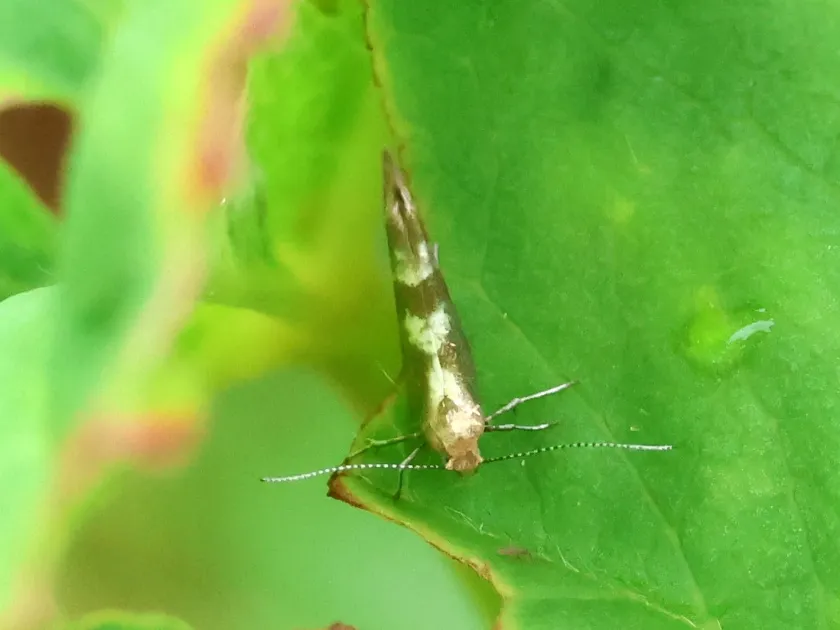
The Willow leaf miner (Argyresthia pygmaeella) is a moth species belonging to the Yponomeutidae family. It is a known pest that primarily affects various species of willow (Salix).
Adult moths are small with a wingspan of approximately 10–12 mm. Their forewings often display a grayish or metallic luster, which provides excellent camouflage against tree bark.
The larvae, or caterpillars, are the stage responsible for the damage. They are small, pale green, and live almost their entire active life sheltered within the host plant's tissues.
Pupation occurs within a tough, white, spindle-shaped cocoon, often found on the underside of leaves or in small crevices of the bark, protecting the insect during its metamorphosis.
The life cycle is closely synchronized with the willow's growth, ensuring that the offspring have immediate access to young, succulent foliage upon hatching in the spring.
What it damages
The larvae feed on the inner tissues of willow leaves, creating winding tunnels known as mines. This feeding behavior disrupts the leaf's ability to perform photosynthesis.
Beyond the leaves, the larvae may also bore into developing buds, destroying them before they can fully open, which leads to stunted shoot growth and branch deformation.
Severe infestations can result in significant defoliation, leaving the willow tree looking sickly and reducing its vigor, especially during dry or stressful summer months.
In nurseries, this pest can compromise the aesthetic appeal and commercial value of young trees, making them unsuitable for landscaping or reforestation projects.
While mature trees can usually tolerate some damage, repetitive heavy infestations can weaken the tree, making it susceptible to secondary pests and various pathogens.
When it appears
Adults emerge in early summer, typically in June or July, when they mate and lay eggs on the leaves and near the buds of host plants.
The species overwinters as young larvae or eggs tucked away in protected spots on the twigs or bark, waiting for the return of warmer weather in the spring.
Activity peaks in spring as temperatures rise, triggering the larvae to emerge from their overwintering sites to feed on the tender, expanding new growth.
The larval stage lasts for several weeks, during which the insects are protected within the leaf tissue, making them difficult to target with traditional pest control methods.
By late spring or early summer, the larvae finish their development and emerge to pupate, leaving behind characteristic damage that becomes most visible at that time.
Signs of infestation
The most distinctive sign of a Willow leaf miner infestation is the presence of winding, translucent trails on the surface of the leaves, which are the internal mines.
Yellowing, curling, and premature browning of leaves are common symptoms. In cases of high pest density, the tree may appear as if it is suffering from drought stress.
Small, silky webbing might be observed around the leaves or buds, as larvae use silk to bind leaf parts together for shelter during their final development stages.
Damaged, necrotic buds that fail to produce normal growth in the spring are clear indicators of early larval activity within the shoot tips.
Tiny dark granular spots, which are larval excrement (frass), can often be seen trapped inside the mines if the leaf is held up to the light.
Control measures
Effective management requires early intervention, ideally before the larvae have fully established themselves within the leaf tissues.
- Prune and dispose of infested branches in the spring to reduce the local population.
- Apply systemic insecticides during the bud-burst stage to target early-emerging larvae.
- Encourage beneficial insects, such as parasitic wasps, which can help regulate leaf miner numbers.
- Maintain tree health through proper watering and mulching to help the tree recover from stress.
- Monitor for adult activity using pheromone traps to time treatments accurately.
Systemic insecticides are the most effective chemical control option, as they are absorbed by the plant and reach the larvae inside the leaf mines.
Timing is crucial; treatments should be applied when larvae are just beginning to feed, as established miners are much harder to eliminate.
For sustainable control, aim to preserve natural predators and avoid broad-spectrum insecticides that could harm beneficial insects in the garden environment.
Taxonomy
- Latin name
- Argyresthia pygmaeella
- Order
- Lepidoptera (butterflies)
- Family
- Yponomeutidae
- EPPO code
- ARGYPY
Discussion
No discussions yet — be the first.