
Cherry ermine moth
Argyresthia pruniella
Description
How to identify
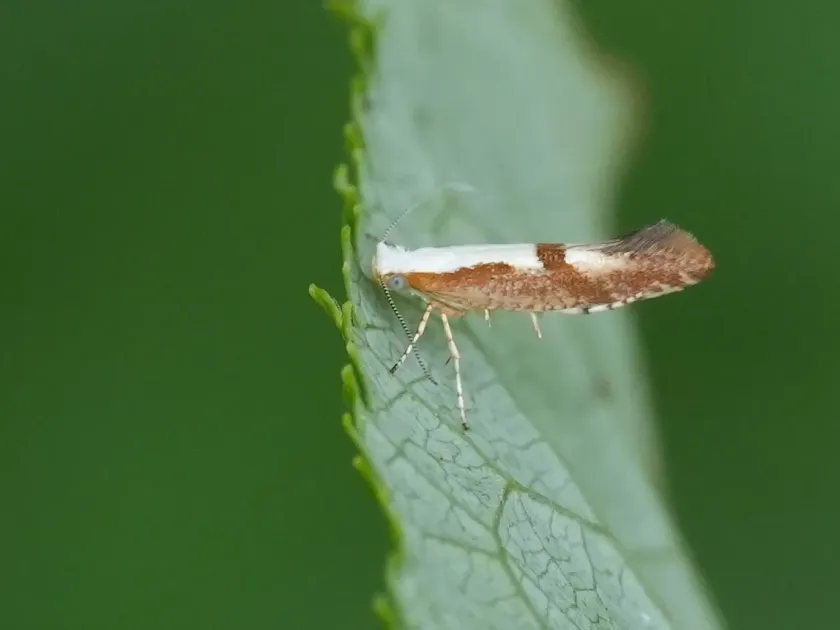
The cherry ermine moth (Argyresthia pruniella) is a small lepidopteran insect belonging to the Yponomeutidae family. Adult moths have a wingspan of approximately 10–12 mm, featuring metallic bronze or gold forewings with distinct dark markings.
The life cycle begins with tiny, yellow-tinted eggs deposited by females into crevices in the bark or near the buds of host trees, where they remain throughout the winter.
Larvae pass through several growth stages, evolving from minute, pale yellow hatchlings into larger caterpillars, which are identifiable by their dark heads and greenish bodies.
Pupation occurs within dense, white silken cocoons. These cocoons are typically found tucked away in curled leaves or within the protective cracks of the tree's bark.
This species is highly synchronized with the phenological development of stone fruit trees, making its emergence timing critical for orchard health management.
What it damages
The primary host for this pest is the cherry tree, though it frequently causes substantial damage to sweet cherry, sour cherry, plum, and other stone fruit species in the Rosaceae family.
The most severe damage is caused during the early spring when larvae bore into swelling buds, hollowing them out and destroying the fruit potential before the tree even flowers.
After depleting buds, the larvae move to the leaves, feeding on them and spinning intricate webs that create characteristic leaf clusters, which are then skeletonized.
Widespread infestations lead to premature defoliation, which severely weakens the tree, reduces its winter hardiness, and compromises the overall yield for subsequent seasons.
In high-density populations, the moth can destroy up to 90% of a tree's floral buds, posing a major economic threat to cherry production in infested regions.
When it appears
The moth overwinter as first-instar larvae under small, flat silken shields (hibernacula) that are firmly attached to the bark near the dormant buds.
In spring, as temperatures rise to 10–12°C, the larvae emerge from their winter shelters and immediately penetrate the awakening buds to begin feeding.
Feeding activity continues throughout the spring, culminating in pupation, which usually takes place in late May or early June, depending on the local climate.
Adult moths emerge in mid-summer, typically June or July, to mate and deposit eggs on the bark of twigs, setting the stage for the next generation.
Embryonic development concludes in late autumn; however, the newly formed larvae remain within the eggshell, dormant until the following spring.
Signs of infestation
A primary indicator of infestation is the presence of "blind" or shriveled buds that fail to open during the normal spring bloom period, often showing entry holes.
During the dormant season, careful inspection of branches can reveal small, inconspicuous silken shields on the bark, which protect the overwintering larvae.
As spring progresses, the appearance of curled, webbed leaves in the canopy provides clear visual evidence of active larval feeding and nest building.
The accumulation of larval frass (excrement) within the silken nests gives the foliage a dirty appearance and often invites secondary fungal colonization.
The sighting of small moths flying within the orchard canopy in the evenings during the summer months signals the period of peak egg-laying activity.
Control measures
Cultural control methods involve cleaning the tree trunks of loose, old bark during the autumn or early spring to remove the hibernacula used by the larvae.
Mechanical removal, such as pruning and burning heavily infested branches in early spring, helps reduce the overall pest population before significant damage occurs.
Biological control options include the application of Bacillus thuringiensis sprays, which are effective against young larvae before they protect themselves within leaf webs.
Chemical control usually involves the application of systemic insecticides at the green-tip or bud-burst stage to target the larvae as they emerge from their wintering sites.
- Use pheromone traps to monitor adult moth activity and timing.
- Encourage beneficial insects and predatory birds in the orchard ecosystem.
- Regularly inspect stone fruit trees for signs of early spring bud damage.
Taxonomy
- Latin name
- Argyresthia pruniella
- Order
- Lepidoptera (butterflies)
- Family
- Yponomeutidae
- EPPO code
- ARGYEP
Discussion
No discussions yet — be the first.