
Silver spruce moth
Argyresthia illuminatella
Description
How to identify
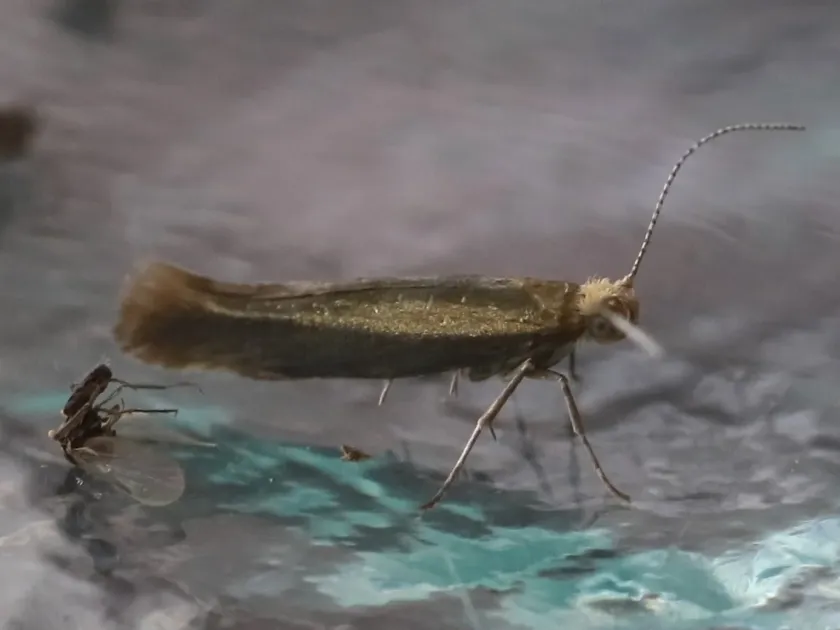
The silver spruce moth (Argyresthia illuminatella) is a small moth species belonging to the Yponomeutidae family. Adult moths typically have a wingspan of 10 to 12 millimeters and a distinct silvery or pale yellowish appearance.
The body of the moth is slender and covered with specialized scales that provide a metallic sheen. When at rest, the moth keeps its wings folded closely along its body, making it exceptionally difficult to detect against the bark or needles of a host tree.
The larvae, or caterpillars, are the active feeding stage of the insect. Growing to about 7-8 millimeters in length, they possess a pale body and a dark head capsule, designed specifically for boring into the tight spaces of conifer buds.
The pupal stage occurs within a white, silk-like cocoon constructed by the larva. These cocoons are often hidden within the cracks of the tree bark or tucked between the bud scales, providing a protective environment throughout the metamorphosis process.
As a specialist feeder, the life cycle of this moth is perfectly synced with the phenology of spruce trees, ensuring that larvae emerge exactly when the food source is most nutrient-dense.
What it damages
The primary host for this species is the Norway spruce. The damage is caused by larvae that burrow into the tree's buds early in the spring, consuming the internal tissues that would otherwise develop into new shoots.
Once a bud is hollowed out by the larva, it ceases to grow and eventually dies. This causes significant deformation of the spruce crown and reduces the tree's overall annual shoot elongation.
In forestry environments, recurring infestations lead to physiological stress in spruce trees. This weakens the host, making it more susceptible to opportunistic pathogens and secondary bark beetle attacks.
For horticultural and ornamental trees, the damage is particularly detrimental as it destroys the symmetrical shape of the spruce, requiring years for the tree to produce new, healthy growth in affected areas.
Severe infestations over several consecutive years can lead to the thinning of the canopy and the drying out of distal branches, which significantly impairs the aesthetic and structural integrity of the tree.
When it appears
Adult moths are typically active during the summer months, specifically from June to July. During this time, they mate and lay eggs on the buds of the spruce trees to prepare for the next generation.
The species overwinters primarily in the first larval instar stage. The small caterpillars remain dormant near the base of the buds or within the outer scales, surviving the winter by waiting for spring temperatures.
Spring activity begins as soon as the spruce buds start to swell. This is the most critical period for protection, as larvae move from their overwintering spots into the nutrient-rich interior of the buds.
The pupation phase concludes the larval development cycle, usually occurring in late spring. Understanding the precise timing of these biological events is crucial for successful monitoring and intervention.
Since the species completes only one generation per year, the populations remain relatively stable, but they can build up over time if the environmental conditions remain favorable for overwintering success.
Signs of infestation
The most reliable sign of an infestation is the failure of certain buds to flush in the spring. These buds appear shriveled, discolored, and empty when opened for inspection.
Fine webbing around the buds is a classic indicator. The larvae use this silk to secure the bud scales and protect themselves from predators and harsh weather conditions during their development.
Brown, dust-like frass (excrement) can often be found on the needles directly beneath the infested buds. The presence of this fine powder is a strong indicator of active feeding by the moth larvae.
As the feeding continues, the bud may take on a grayish-brown hue, clearly contrasting with the healthy, vibrant green needles surrounding it, making it easier to spot during a visual inspection.
When infestation levels are high, the ends of the branches appear "stunted" or "bald" because the apical meristem (the growing tip) has been destroyed, preventing the branch from extending further.
Control measures
Chemical control involving systemic insecticides is most effective when applied at the very onset of spring bud swell, before the larvae successfully tunnel deep into the bud tissue.
Integrated Pest Management (IPM) practices recommend using selective insecticides that minimize impact on beneficial insects, such as parasitoid wasps that naturally keep moth populations in check.
In small-scale landscapes or ornamental gardens, manually pruning and destroying affected buds or branches is a highly effective way to eliminate the pest before the next life cycle begins.
Biological controls, including the use of entomopathogenic fungi, are being researched as a sustainable alternative to chemical sprays for managing larger forest populations of this moth.
- Prevention: Maintain tree vigor through proper irrigation and balanced fertilization to ensure the spruce can better withstand minor pest pressure.
- Monitoring: Utilize pheromone-baited traps throughout June to detect adult moth flight, allowing for precise timing of any necessary intervention.
- Sanitation: Always collect and destroy (burn or deep bury) infested plant material to prevent the adult moths from emerging and re-infesting the area next year.
Taxonomy
- Latin name
- Argyresthia illuminatella
- Order
- Lepidoptera (butterflies)
- Family
- Yponomeutidae
- EPPO code
- ARGYIL
Discussion
No discussions yet — be the first.