
Alder moth
Argyresthia goedartella
Description
How to identify
The Alder moth (Argyresthia goedartella) is a small moth belonging to the family Yponomeutidae within the order Lepidoptera, featuring a wingspan of approximately 10 to 14 millimeters.
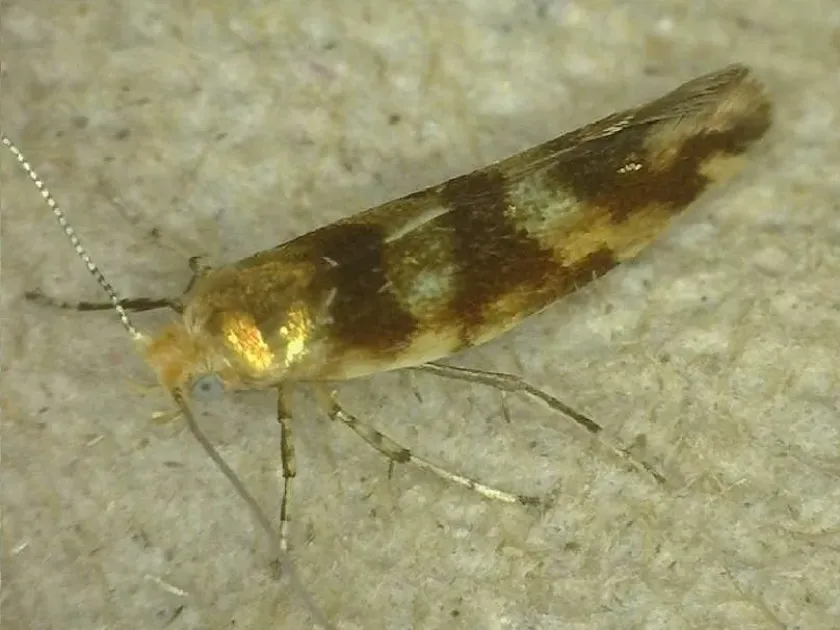
Its forewings are distinctive, characterized by a golden-yellow color with white transverse bands and spots, making it relatively recognizable to trained observers.
The hindwings are grayish-brown and possess long fringes, which is a common morphological trait for moths within this family.
Larvae, or caterpillars, are slender and light-colored with a dark head, which helps them remain hidden within the plant tissues they inhabit.
As a nocturnal and crepuscular species, the adult moths spend daylight hours resting quietly on foliage or bark, effectively camouflaging themselves.
What it damages
The primary host trees for Argyresthia goedartella are members of the genera Alnus (alder) and Betula (birch).
The damage is primarily caused by larvae that bore into the developing male and female catkins, consuming the internal reproductive tissues.
In addition to catkins, the larvae may feed on young shoots, tunneling inside and causing the tip of the branch to wither or die back.
Heavy infestations can lead to a significant loss of seed production, which has economic implications for forestry and plant nurseries.
The feeding wounds left by the larvae can serve as entry points for secondary pathogens, such as fungi or bacteria, potentially causing bark damage.
When it appears
The Alder moth completes one generation per year, with adult moths typically emerging and flying between June and August.
Females deposit their eggs into the crevices of the bark on young branches, where the eggs remain in diapause throughout the autumn and winter.
Hatching occurs in the spring, synchronized with the development of buds and catkins on alder and birch trees, providing immediate food for the larvae.
The larval stage lasts until the beginning of June, at which point the caterpillars undergo pupation either on the bark or within the catkin remnants.
After a short pupation period, the cycle repeats as the new generation of adults emerges during the mid-summer period.
Signs of infestation
A key indicator of an infestation is the appearance of silk-like webbing or fine threads on the catkins and shoots during the spring season.
Affected catkins often turn black, wither, and drop prematurely, as the inside of the catkin has been hollowed out by the feeding larvae.
Frass (larval excrement) can often be found near the entry holes on the shoots or at the base of the damaged catkins.
Leaves near the damaged shoots may show signs of yellowing or curling, indicating that the larvae have disrupted the vascular flow of the twig.
In severe infestation years, the entire canopy of an affected tree can appear discolored or scorched, reflecting extensive damage to reproductive buds.
Control measures
Sanitary pruning, which involves removing and disposing of infested branches before the larvae pupate, is an effective mechanical control method.
For ornamental or high-value trees, systemic insecticides applied during the early spring can effectively target larvae as they begin to feed.
Monitoring using pheromone traps is highly recommended to assess population levels and time the application of controls to maximize efficiency.
- Application of bio-insecticides containing Bacillus thuringiensis during the early larval stage for environmentally friendly management.
- Encouraging natural predators, such as parasitic wasps, which act as biological control agents to keep moth populations in check.
Consistent observation and maintaining tree vigor through appropriate silvicultural practices help prevent the establishment of severe moth populations.
Taxonomy
- Latin name
- Argyresthia goedartella
- Order
- Lepidoptera (butterflies)
- Family
- Yponomeutidae
- EPPO code
- ARGYGO
Discussion
No discussions yet — be the first.