
Dark bush-cricket
Arcyptera fusca
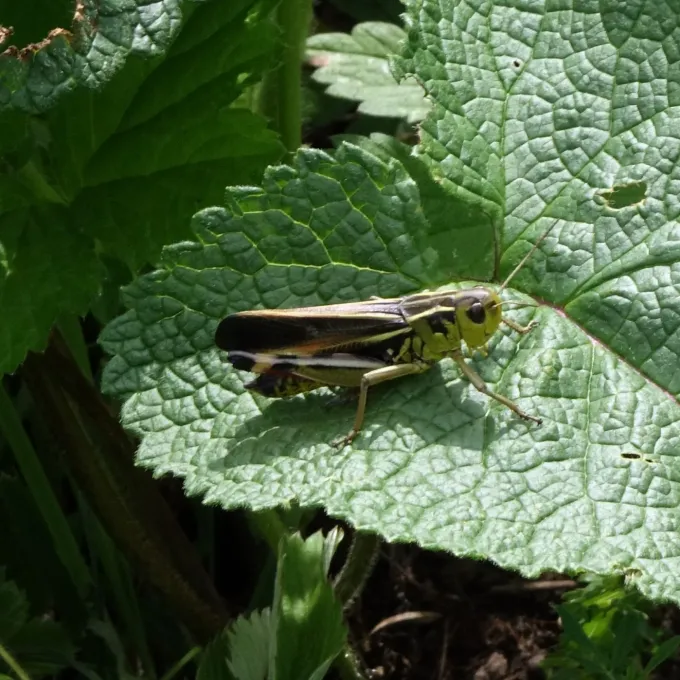
Description
How to identify
The Dark bush-cricket (Arcyptera fusca) is a significant insect species belonging to the order Orthoptera and the family Acrididae. It is recognized as a pest in various agricultural regions.
Adult specimens measure between 20 and 35 mm in length. Their coloration ranges from grayish-brown to dark brown, providing excellent camouflage in grasslands and dry soil environments.
A key diagnostic feature for identification is the bright red or orange coloration of the hind tibiae. This vibrant coloring is useful for field scouts during population assessments.
The species undergoes incomplete metamorphosis, consisting of three stages: egg, nymph (larva), and adult (imago). The nymphs resemble smaller versions of the adults but lack developed wings.
They prefer sunny, well-warmed, and sparsely vegetated habitats such as pastures, meadows, and forest margins, which are often near agricultural fields.
What it damages
As a polyphagous pest, the Dark bush-cricket is capable of feeding on a wide variety of plant species, causing economic losses when populations surge.
Cereals, including wheat, barley, oats, and millet, are among the preferred crops for this insect. They also frequently damage maize and various pasture grasses.
Beyond cultivated crops, these insects cause significant degradation of natural forage resources, reducing the overall biomass available for livestock grazing.
The voracious appetite of the nymphs and adults can result in severe defoliation of plants, which severely restricts photosynthesis and halts normal plant development.
Early-season infestations can cause patchy damage across fields, which often leads to uneven crop maturity and reduced harvest yields at the end of the season.
When it appears
The species overwinters in the egg stage. The eggs are laid by females in the soil within hardened, protective cases known as egg pods or egg masses.
Nymphs typically emerge in late spring, usually April or May, depending on the cumulative soil temperature. Monitoring during this period is essential for successful control.
Development involves five larval instars. This phase lasts approximately 40 to 60 days, during which the insects grow rapidly and feed intensely on host vegetation.
Adults emerge mid-summer, typically in June or July. This is the peak period for migration and mating, allowing them to spread across larger agricultural areas.
The lifecycle concludes as autumn approaches. After mating and laying their eggs for the following year, the adult population dies off, completing their annual cycle.
Signs of infestation
The primary sign of an infestation is irregular holes or jagged edges on leaves, as the insects typically consume leaf tissue while leaving behind the tougher veins.
Aggregations of nymphs are often observed at field margins, especially near uncultivated areas or roadsides where they initially hatch before moving into the crops.
Significant biomass loss in grasslands and thinning of crop density are clear indicators that a population of grasshoppers is actively feeding in the area.
In the mornings, scouts can often observe the insects resting on stems or within the foliage before they become highly active during the hotter parts of the day.
Frass (excrement) found on the leaves and stems of affected plants provides further evidence of the presence and intensity of the grasshopper infestation.
Control measures
Deep autumn plowing is a highly effective mechanical control measure, as it disrupts the egg pods buried in the soil and leads to high mortality of the eggs.
Regular field scouting is critical during the early nymphal stages. Treating infestations while nymphs are still in their early instars is much more effective than controlling adults.
Chemical control involving approved insecticides (such as pyrethroids or organophosphates) should be applied strictly according to regional agricultural regulations and thresholds.
Biological control options, such as using specific entomopathogenic fungi, can be implemented to suppress population growth in an environmentally sustainable manner.
Maintaining clean field borders by eliminating weeds helps reduce suitable egg-laying sites, making the crop environment less attractive to the Dark bush-cricket.
Taxonomy
- Latin name
- Arcyptera fusca
- Order
- Orthoptera (locusts)
- Family
- Acrididae
- EPPO code
- ARCPFU
Discussion
No discussions yet — be the first.