

Description
How to identify
The rice white tip nematode Aphelenchoides besseyi is a microscopic plant-parasitic nematode belonging to the order Tylenchida and the family Aphelenchoididae.
Adults are small, vermiform (worm-like), and colorless, typically measuring between 0.5 mm and 0.8 mm in length, which makes them invisible to the naked eye in field conditions.
The nematode feeds ectoparasitically and endoparasitically on leaves and seeds, utilizing its specialized stylet to puncture plant cells and ingest the cytoplasm.
Their biological cycle is rapid, with an egg-to-adult development time of approximately 8 to 12 days under optimal temperature conditions between 25°C and 30°C.
These nematodes possess remarkable survival capabilities; they can enter a quiescent state (anhydrobiosis) within dried seeds or plant residues for several years, ensuring long-term persistence in the environment.
What it damages
The most significant damage occurs in rice crops, where it causes the characteristic "white tip" disease, leading to severe yield losses due to grain sterility.
Strawberries are also major hosts, where the infestation results in "summer dwarf" or "crimp" disease, causing stunted growth and leaf crinkling.
Beyond rice and strawberries, the nematode can infect numerous other crops and weed species, acting as a reservoir that sustains populations in the absence of the primary host.
Infested plants suffer from reduced photosynthetic efficiency, restricted vegetative growth, and compromised reproductive development, which directly impacts harvest volume.
In severe cases, the grain quality is significantly downgraded, making the harvested product unsuitable for market and posing a risk of spreading to new areas through trade.
Signs of infestation
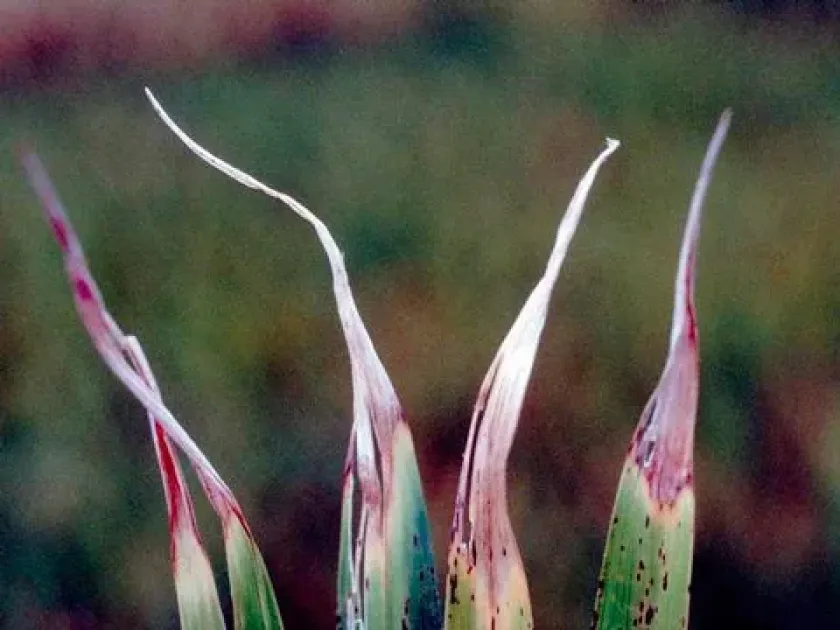
The most diagnostic sign in rice is the chlorotic and white coloration at the leaf tips, usually extending 3–5 cm, which eventually necroticize and turn brown.
Plants often exhibit irregular heading, with panicles remaining partially trapped inside the leaf sheath, and the resulting grains are frequently deformed or empty.
Strawberry plants infected by A. besseyi show crinkled, darkened, and leathery leaves, often accompanied by the total collapse of the crown in advanced stages.
During the vegetative phase, infested fields often display patchy growth, with specific areas showing stunted plants compared to the surrounding healthy crop.
Confirmation of the pest presence is only possible through microscopic examination of plant tissue samples taken from suspected infected areas during the growing season.
Control measures
Prevention is the cornerstone of management, specifically focusing on the use of certified, nematode-free seed stock and healthy planting material.
Seed treatment using hot water immersion at 50–55°C for 10–15 minutes is a highly effective method to eliminate nematodes within the seed coat before planting.
Crop rotation and effective weed management practices are essential to remove alternative hosts that allow the nematode to persist in the field between seasons.
Sanitation measures, including the cleaning of agricultural machinery and equipment, are crucial to prevent the accidental transfer of contaminated soil to healthy fields.
In nursery settings, systemic nematicides may be utilized, although focus should always remain on integrated pest management (IPM) strategies to ensure long-term control.
Reference
Connections · Rice white tip nematode
Most often together:
Marketplace
Products · 1
Biology
Taxonomy
- Latin name
- Aphelenchoides besseyi
- Order
- Nematodes
- Family
- Aphelenchoididae
- EPPO code
- APLOBE
Community
Discussion
No discussions yet — be the first.