
Aphelenchoides composticola
Aphelenchoides composticola
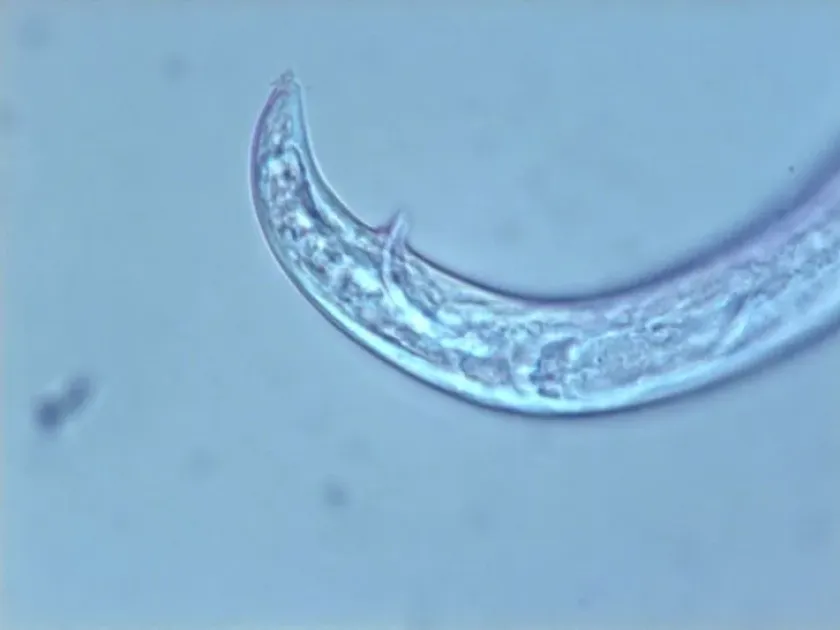
Description
How to identify
Aphelenchoides composticola belongs to the phylum Nematoda, order Aphelenchida, and family Aphelenchoididae. These are microscopic worms that predominantly lead a mycetophagous lifestyle, feeding on the hyphae of various fungal species.
Externally, they appear as thin, thread-like organisms that cannot be detected without specialized laboratory equipment. For accurate identification, experts conduct microscopic examination of compost samples or damaged fruiting bodies.
This pest is characterized by high mobility within the substrate and the ability to move rapidly through thin films of moisture. Nematode populations are capable of rapid growth under favorable conditions, making them extremely dangerous for commercial mushroom farms.
The biology of the pest is inextricably linked to the presence of mycelium. In the absence of food, these nematodes can enter a state of anabiosis, which complicates their complete eradication from affected areas.
The life cycle of Aphelenchoides composticola includes egg, four larval stages, and adult. At optimal temperatures, the development of one generation occurs quite rapidly, allowing the pest to infest large areas of mycelium in a short period.
What it damages
The primary hosts for this species are cultivated mushrooms, particularly button mushrooms. Nematodes feed on the mycelium, leading to direct destruction of the fungal network and a significant decrease in productivity.
During feeding, the pests damage the hyphae through which the fungus receives nutrients. Affected mycelium becomes sparse, loses its density, and fails to produce healthy fruiting bodies.
In addition to direct harm, nematodes act as vectors for various bacterial and fungal infections. By damaging fungal tissues, they create entry points for secondary pathogens that cause rot and decay.
The economic impact of nematodes also includes a substantial reduction in product quality. Fruiting bodies grown on infested mycelium are often deformed, discolored, and unsuitable for market sale.
The financial losses from an infestation can reach critical levels, potentially resulting in the complete loss of a crop in individual growing rooms. A high population density in the compost essentially guarantees a failed harvest.
Signs of infestation
The first sign of infestation is a slowing or complete cessation of mycelial growth in specific areas of the substrate. The mycelium may appear weakened and sparse compared to healthy sections.
In areas of high pest concentration, the structure of the compost may change: it becomes more viscous, overly wet, and acquires a specific unpleasant odor, which often indicates rotting processes.
At later stages, there is a lack of primordia formation. If fruiting bodies do appear, they are often underdeveloped or show signs of premature tissue wilting.
The surface of the substrate may develop patches where the mycelium has completely disappeared. Cross-sections of fruiting bodies may reveal necrotic spots caused by nematode activity.
To confirm a diagnosis, compost samples must be submitted to a specialized laboratory for extraction analysis, as external symptoms can often mimic other fungal diseases or environmental stressors.
Control measures
The primary method of control is the strict adherence to temperature regimes during compost pasteurization. High-quality heat treatment of the substrate effectively eliminates most nematodes and their eggs before spawning.
Maintaining high levels of hygiene on the farm is essential. Preventing cross-contamination by personnel and equipment between infested and healthy growing rooms is a critical management factor.
It is necessary to monitor the quality of raw materials used for compost preparation. Using unverified manure or peat without proper thermal preparation increases the risk of introducing the pest.
Upon detecting an outbreak, the affected substrate must be isolated or disposed of through thermal sterilization. Any remaining infrastructure in the room must be thoroughly disinfected.
- Use of certified, high-quality spawn.
- Regular laboratory monitoring of substrate health.
- Strict disinfection of tools, boots, and clothing.
- Installation of air filtration systems on ventilation units.
Taxonomy
- Latin name
- Aphelenchoides composticola
- Order
- Nematodes
- Family
- Aphelenchoididae
- EPPO code
- APLOCO
Discussion
No discussions yet — be the first.