
Oriental scale
Aonidiella orientalis
Description
How to identify
The Oriental scale (Aonidiella orientalis) belongs to the order Hemiptera, family Diaspididae. It is a tiny insect characterized by a protective, hard cover called a scale.
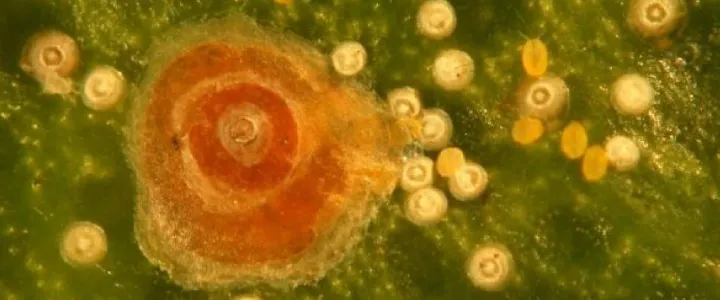
Females possess a nearly circular or oval scale, straw-colored or light brown, with a darker central portion marking the larval exuviae.
Males are significantly smaller than females and exhibit elongated scales. Adult females are sedentary, anchoring themselves permanently to the host plant surface.
The first-instar nymphs, known as crawlers, possess legs and move actively across the plant surface to locate a suitable feeding site.
This species is thermophilic and, in temperate regions, is primarily a pest in greenhouses, nurseries, and indoor environments, affecting ornamental and subtropical plants.
What it damages
This pest is a polyphage, attacking a wide range of ornamental, fruit, and subtropical crops. It causes severe damage to citrus, palms, ficus, and roses.
The insect settles on leaves, stems, and fruits, piercing the plant tissue and sucking out cell sap. Sustained feeding significantly depletes the plant's metabolic reserves.
Under heavy infestation, the pests can completely cover trunks and branches with a thick layer of scales, physically blocking the plant's respiration processes.
Affected leaves often turn yellow, deform, and drop prematurely, leading to a major loss in aesthetic value and overall plant health.
On fruit crops, the presence of scales on the surface renders the harvest unmarketable and contributes to a significant decrease in overall orchard productivity.
When it appears
The biological cycle of the Oriental scale is heavily influenced by temperature. Under optimal conditions, it can complete multiple generations throughout the year.
Reproduction is sexual. The female deposits eggs beneath her scale, and these hatch into mobile crawlers that disperse to new feeding locations.
The peak activity of crawlers occurs during warmer periods when they migrate to young shoots and leaves to establish new feeding sites.
In outdoor environments, development slows significantly during cooler seasons; however, in controlled greenhouse settings, the cycle remains continuous.
Due to the high fecundity of females, an infestation can rapidly escalate across a planting in a single season if not monitored or managed effectively.
Signs of infestation
The primary visual sign of infestation is the appearance of tiny brown or yellowish circular spots on leaves, which can be easily scraped off.
The presence of honeydew, a sticky excretion, is another indicator. This substance frequently promotes the growth of sooty mold, causing black staining on leaf surfaces.
Stunted growth of new shoots and gradual wilting indicate severe infestation, where the plant's nutrient transport system has been severely compromised.
- Yellowing of the leaf tissue surrounding the attachment point of the scale.
- Deformation of young twigs and curling of leaves.
- Premature leaf drop, especially in evergreen species.
- Loss of turgor and generalized plant decline.
On infested fruits, one may observe patches of discoloration or necrotic tissue resulting from the direct feeding activity of the insects.
Control measures
Effective management of the Oriental scale requires an integrated approach combining horticultural practices with biological and chemical controls.
Regular monitoring of plants is crucial. Pruning and disposing of heavily infested plant parts helps prevent the spread of the pest to healthy areas.
Systemic insecticides are highly effective, as they translocate within the plant sap, poisoning the scales as they feed on the host tissue.
In greenhouse environments, biological control agents such as parasitoid wasps are widely used to naturally suppress scale populations.
When applying horticultural oils, complete and uniform coverage of all plant surfaces is required to effectively suffocate the insects by sealing off their oxygen supply.
Taxonomy
- Latin name
- Aonidiella orientalis
- Order
- Hemiptera (bugs, aphids, leafhoppers)
- Family
- Diaspididae
- EPPO code
- AONDOR
Discussion
No discussions yet — be the first.