
California citrus scale
Aonidiella eremocitri
Description
How to identify
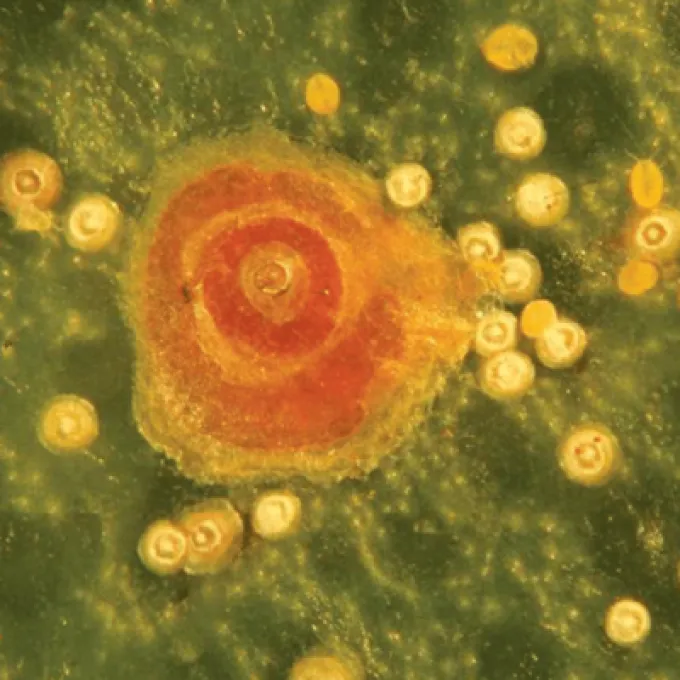
The California citrus scale (lat. Aonidiella eremocitri) belongs to the order Hemiptera and the family Diaspididae. Adult females possess a characteristic circular scale that adheres tightly to the plant surface.
The insect body underneath the scale is typically yellowish or brownish. The shield serves as a defensive mechanism, protecting the insect from environmental factors and many contact insecticides.
The pest exhibits significant sexual dimorphism: males differ from females by having wings and the ability to fly, although their lifespan is significantly shorter.
First-instar larvae, known as "crawlers," are highly mobile, microscopic in size, and light yellow, which makes them difficult to detect with the naked eye.
Identification of the species often requires microscopic examination of the pygidium, the posterior part of the female's body, where specific glands and setae are located.
What it damages
The primary hosts for this pest are members of the Citrus genus. Lemons, oranges, mandarins, and grapefruits are most severely affected.
The pest attacks almost all aerial parts of the plant: fruits, leaves, and young shoots. In cases of high infestation, scale insects may settle even on tree trunks and branches.
Mass reproduction of Aonidiella eremocitri can cause severe leaf deformation, stunted growth, and a significant decrease in crop yield.
Infested fruits lose their commercial value due to the formation of characteristic spots, rendering them unsuitable for the fresh market.
Continuous sap feeding drains the plant, making it vulnerable to secondary infections, such as sooty mold, which develops on the sugary honeydew excreted by the insects.
When it appears
The activity of scale insects is directly dependent on temperature. Optimal conditions for population growth occur during the warm spring and summer months.
The life cycle includes several generations per year, the number of which varies depending on the climatic zone where the citrus trees are grown.
The most active period for crawler dispersal occurs during spikes in daily average temperatures when larvae emerge in masses from beneath the mother scales.
The pests typically overwinter as larvae or mature females within bark crevices or on the undersides of leaves, protected from direct wind and rain.
In greenhouses or controlled environments, the life cycle may be continuous, necessitating year-round monitoring and appropriate agro-technical interventions.
Signs of infestation
The first sign of infestation is the appearance of small, circular, raised structures on leaves and fruits, which are firmly attached to the plant epidermis.
Chlorotic spots often form around the feeding sites of the scales — areas of yellowed tissue resulting from the injection of toxic saliva by the pest.
In cases of severe infestation, premature leaf drop, dieback of shoot tips, and a generally depressed condition of the woody crop can be observed.
A sticky residue on the leaf surface may signal the presence of the pest, serving as a medium for the growth of sooty mold fungus.
Visual inspection of branches may reveal entire colonies of scales merging into continuous crusty patches, which impede the plant's normal gas exchange.
Control measures
The foundation of control is strict quarantine of planting material and regular phytosanitary inspections of the orchard at all vegetation stages.
Systemic insecticides are effective during the crawler emergence period before the insects have formed a dense, protective shield.
Agro-technical practices, such as proper crown pruning, promote better aeration and allow chemical sprays to penetrate deep into protected tree zones.
Biological control plays a vital role, utilizing entomophages such as natural predators and parasitic wasps that feed on scale insects.
Mineral oil-based emulsions help by physically blocking the insect spiracles, leading to suffocation and death upon contact with the active substance.
Taxonomy
- Latin name
- Aonidiella eremocitri
- Order
- Hemiptera (bugs, aphids, leafhoppers)
- Family
- Diaspididae
- EPPO code
- AONDER
Discussion
No discussions yet — be the first.