
California red scale
Aonidiella
Description
How to identify
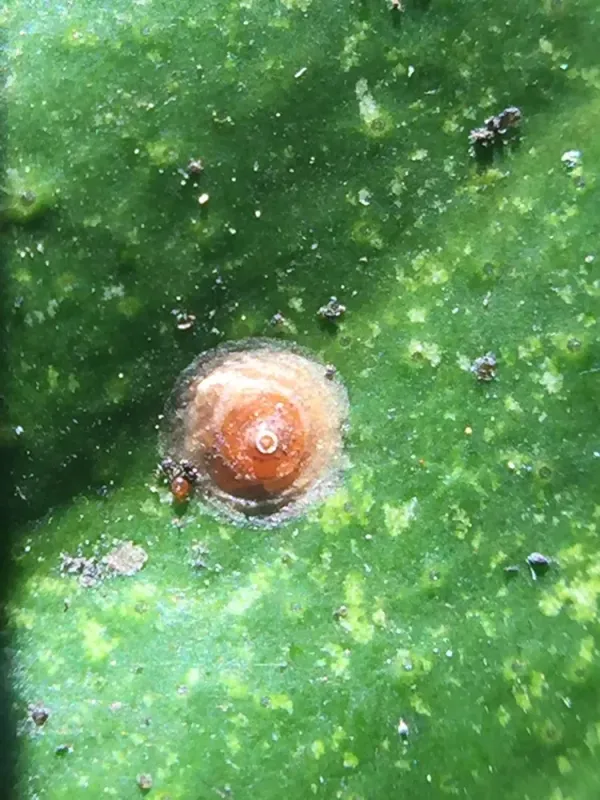
California red scale (Aonidiella aurantii) is a member of the Diaspididae family of armored scales. The adult female is protected by a circular, reddish-brown, wax-like cover that adheres tightly to the host plant surface.
The insect itself, located beneath the scale, has a pear-shaped body and a yellow to orange color. Adult females typically measure around 2 mm in diameter, making them inconspicuous against the bark or leaf surface.
Adult males are quite different; they are winged, small, and transient, serving only the purpose of mating. Because of their mobility and small size, they are rarely detected by visual inspection in the orchard.
The first-instar nymphs, commonly known as "crawlers," are the only mobile life stage that can disperse across the plant or be carried by wind to neighboring trees. They are light-colored and extremely small.
As a global pest, this species thrives in tropical and subtropical regions. In greenhouse environments, it can complete its life cycle year-round, requiring continuous vigilance to prevent infestations.
What it damages
This pest primarily attacks citrus crops, including lemons, oranges, and grapefruit, but it is also known to infest various ornamental plants like roses and laurels due to its broad polyphagous nature.
The insect feeds by inserting its mouthparts into the plant tissue and sucking cell sap. This continuous feeding depletes the plant's nutritional reserves, leading to metabolic stress and physiological decline.
Leaves, twigs, and fruit are the most frequent sites of infestation. Damaged leaves often develop chlorotic spots, wither, and eventually drop prematurely, causing defoliation of the canopy.
Fruit damage is particularly economically devastating. Infestations on the peel cause blemishes and pitting, which severely degrade the market value of the fruit and often lead to rejection during export inspections.
In cases of severe infestation, the death of twigs and branches can occur. A weakened tree becomes increasingly susceptible to secondary infections, environmental stress, and overall lack of vigor.
When it appears
The development of this pest is highly dependent on temperature. Under optimal subtropical conditions, the species can produce multiple generations annually, often ranging from 3 to 5 cycles per year.
Crawler activity peaks during the warmer months, typically when temperatures are consistently above 15-20°C. This period requires the most intensive monitoring to target the vulnerable mobile stage.
In sheltered environments like greenhouses, the generations may overlap significantly, resulting in a continuous presence of various life stages throughout the year.
As autumn approaches and temperatures drop, development slows down. The insects may enter a state of reduced activity or diapause, but they remain attached to the plant, overwintering on protected bark sections.
Understanding the synchronization of crawler emergence is critical for successful control, as the protective armor of adult females prevents most contact pesticides from penetrating effectively.
Signs of infestation
One of the earliest signs of infestation is the appearance of tiny reddish-brown spots on leaves and fruit. These spots represent the settled nymphs that have begun to form their protective shields.
Yellow halos or chlorotic spotting around the site of attachment are common indicators of localized toxicity caused by the scale's feeding behavior. This is a clear signal that the plant's defense system is reacting to the pest.
Heavy infestations can result in the twisting or malformation of young, tender shoots. If left untreated, the canopy will show significant thinning, and the overall plant height may be stunted.
The presence of large colonies on the bark makes it look rough or encrusted. Examining the undersides of leaves and the junction of twigs often reveals higher concentrations of the pest.
Reduced fruit set and premature fruit drop are frequently observed in heavily infested trees, as the plant sacrifices reproductive growth to maintain its basic physiological functions.
Control measures
Effective management requires an integrated approach that combines horticultural practices with targeted chemical or biological interventions to keep populations below economic injury levels.
- Application of systemic insecticides for long-lasting protection.
- Use of horticultural oils to suffocate insects by blocking their respiration.
- Release of parasitoid wasps like Aphytis melinus as a biological control agent.
- Pruning of heavily infested branches to improve spray coverage and airflow.
- Rigorous monitoring and quarantine measures for all new nursery stock entering the area.
Chemical control strategies are most effective when timed precisely to coincide with the crawler stage, as they are not yet protected by a waxy cover and are more susceptible to sprays.
Multiple applications may be necessary to target consecutive generations. Maintaining a clean orchard environment and ensuring optimal tree health help increase the tree's resilience to scale attacks.
Taxonomy
- Latin name
- Aonidiella
- Order
- Hemiptera (bugs, aphids, leafhoppers)
- Family
- Diaspididae
- EPPO code
- AONDSP
Discussion
No discussions yet — be the first.