
Water pipit
Anthus spinoletta
Description
How to identify
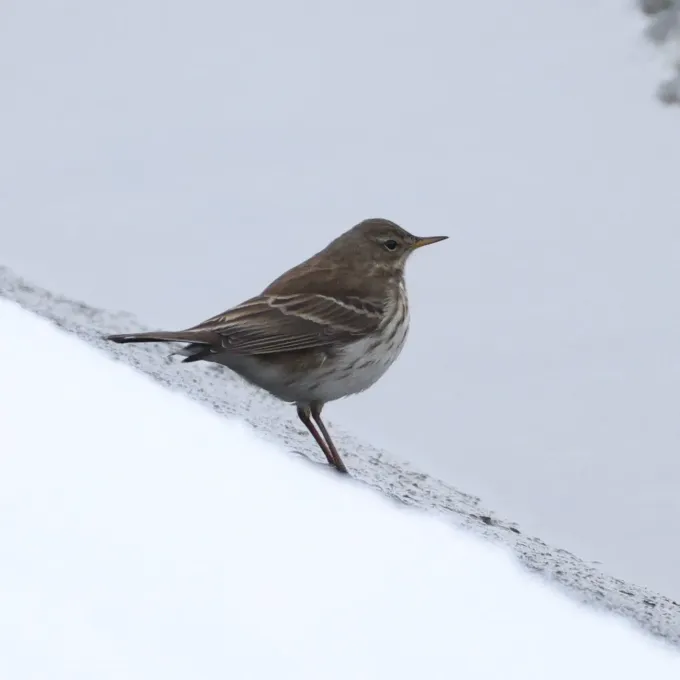
The Water pipit (Anthus spinoletta) is a passerine bird belonging to the Motacillidae family. It is a slender, small bird that often inhabits wet, open landscapes.
The plumage is typically greyish-brown with streaked underparts, which provides excellent camouflage against the soil and sparse vegetation.
Its beak is slender and perfectly adapted for foraging on small invertebrates found in soil, wet meadows, or near water channels.
A distinctive feature of this species is its habit of bobbing its tail frequently, a movement that is helpful for field identification.
While primarily nesting in mountainous regions, during winter months, these birds often move to lowland areas and may frequent fields or near-field water sources.
What it damages
The Water pipit is not an agricultural pest. Its diet consists almost exclusively of insects, spiders, and larvae, rather than grains or plant tissues.
Because they are insectivores, they do not consume crops, seeds, or seedlings, posing no direct threat to agricultural production.
Some minor surface disturbance of the soil may occur during foraging as they pick at the ground, but this is negligible and non-destructive to plant health.
In fact, their presence in fields can be beneficial as they contribute to the biological control of insect populations in the soil.
Agronomically, there is no evidence to suggest that the Water pipit causes any economic loss to farmers or damage to commercial crops.
When it appears
Water pipits are migratory birds, and their occurrence in low-lying fields is strongly linked to seasonal patterns, specifically during the colder months.
In late autumn and winter, when high-altitude breeding grounds freeze, they migrate down and may congregate in fields where moist soil and prey are accessible.
By the arrival of spring, as weather conditions improve, the birds migrate back to their breeding ranges in the mountains.
Because their presence in lowland fields is largely confined to winter, they are not present during the sensitive stages of crop germination and growth.
This timing significantly reduces any possibility of interference with farming activities or potential crop development.
Signs of infestation
Signs of their presence include small, delicate footprints on mud or soft soil along the edges of fields or drainage ditches.
Light markings on the soil surface, left by their sharp bills during feeding, indicate foraging activities focused on soil invertebrates.
Unlike pest birds that feed on seedlings, there will be no evidence of leaf damage, clipped stems, or uprooted plants in areas where they have been feeding.
Small amounts of avian droppings may be observed, but these do not constitute a sanitary risk or a threat to crop health in an open field environment.
Observation of these birds typically reveals solitary individuals or small, dispersed groups rather than large, organized flocks that cause significant damage.
Control measures
No control measures are necessary for the Water pipit. They do not damage crops, and their presence is considered a natural part of the agro-ecosystem.
The use of pesticides or bird deterrents is not recommended, as it would be both ineffective for this species and environmentally harmful.
Farmers are advised to continue standard agronomic practices, such as proper seed depth, which is sufficient to protect crops from any incidental disturbance.
Maintaining biological diversity is encouraged, as these birds can play a small role in managing the population of undesirable soil-dwelling insects.
There is no requirement for monitoring these birds as a management priority, and they should be regarded as a benign component of the field ecology.
Taxonomy
- Latin name
- Anthus spinoletta
- Family
- Motacillidae
- EPPO code
- ATHUSN
Discussion
No discussions yet — be the first.