
Pipit
Anthus
Description
How to identify
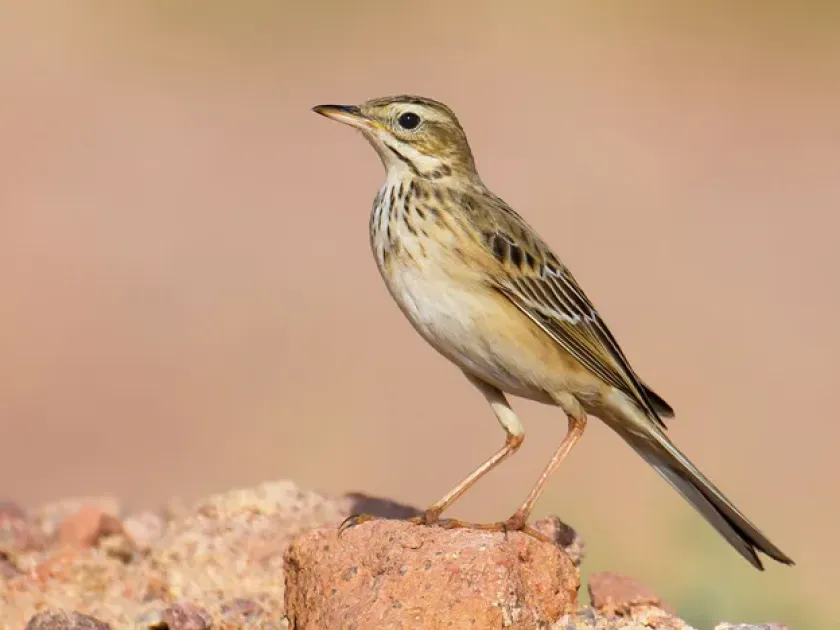
The pipit (genus Anthus) belongs to the order Passeriformes and the family Motacillidae. These small birds are often confused with wagtails but possess a more cryptic, earth-toned plumage that provides excellent camouflage in agricultural environments.
A distinctive anatomical feature of the pipit is the elongated hind claw on the hallux, which is adapted for walking on the ground rather than perching in trees or shrubs.
Pipits are predominantly terrestrial birds. They are characterized by their slim body shape, sharp, thin bills, and a habit of running or walking quickly across the surface of the soil.
Their coloration is generally brownish-grey with dark streaks, allowing them to blend perfectly with bare soil, dry grass, or stubble, making them difficult to spot during routine field inspections.
They typically nest directly on the ground in hidden locations among crops or tall grasses. Their biology is well-suited to open landscapes, which unfortunately often includes cultivated fields.
What it damages
The primary damage caused by pipits to crops is mechanical. They do not typically feed on the crops themselves, but their foraging behavior can be highly destructive to young seedlings.
When searching for insects on the ground, pipits often uproot or trample young plants, leading to significant stand thinning and irregular growth patterns in affected fields.
In the earliest growth stages of cereals and industrial crops, the combination of trampling and peck-induced damage to the stem base can cause plants to wither and eventually die.
High densities of these birds in a field can lead to localized compaction of the soil around the plant roots, which restricts water and nutrient uptake during the critical development phase.
While they consume some insect pests, the negative impact of their foraging habits on crop emergence and uniformity frequently outweighs their role as insect predators in intensive farming.
When it appears
Pipits arrive at agricultural fields early in the growing season, coinciding with soil preparation and sowing. This is the period when they are most likely to forage in bare fields.
The peak activity occurs during the breeding season, usually from late spring through mid-summer. During this time, birds establish territories and are consistently present in specific field sections.
As fledglings emerge from nests, the number of individuals on the field may temporarily increase, leading to intensified foraging pressure on surrounding vegetation.
The influence of pipits on agricultural lands declines as summer progresses and birds begin to prepare for autumn migration to their wintering grounds.
Monitoring the fields during the seedling emergence stage is vital, as this is when the vulnerability of the crop to avian-related damage is at its absolute maximum.
Signs of infestation
One of the most obvious signs of pipit presence is the appearance of small, distinct bird tracks on the soil surface, particularly visible in the loose earth between rows after rain.
Damaged seedlings that appear to have been pulled up, accompanied by small puncture marks in the soil around the roots, strongly indicate foraging activities by these birds.
Observing birds that fly short distances low to the ground and quickly disappear into the crop cover or surrounding vegetation is a clear indicator of their residency in the area.
Distinctive, thin, high-pitched calls are often the first sign that birds are active in the area, helping agronomists locate the hotspots of potential damage.
- Uprooted or crushed young seedlings.
- Presence of small holes in the soil surface near plant stems.
- Characteristic small bird footprints in the field.
Control measures
Managing pipit presence in agricultural settings focuses on non-lethal deterrent strategies that make the field less appealing for foraging and nesting purposes.
Acoustic deterrents that broadcast predator calls or distress signals can effectively discourage birds from staying in a particular area, providing immediate relief for vulnerable crops.
Visual aids, such as hawk kites, reflective ribbons, or inflatable predator decoys, can be strategically placed to disrupt the birds' sense of security and force them to forage elsewhere.
Agronomic practices, such as ensuring uniform and rapid germination through proper seedbed preparation and depth, reduce the time a crop remains in its most vulnerable state.
Maintaining clean field margins by removing weeds and tall grass reduces the availability of suitable nesting sites, thereby lowering the overall attractiveness of the plot for pipit colonies.
Taxonomy
- Latin name
- Anthus
- Family
- Motacillidae
- EPPO code
- ATHUSP
Discussion
No discussions yet — be the first.