
Meadow pipit
Anthus pratensis
Description
How to identify
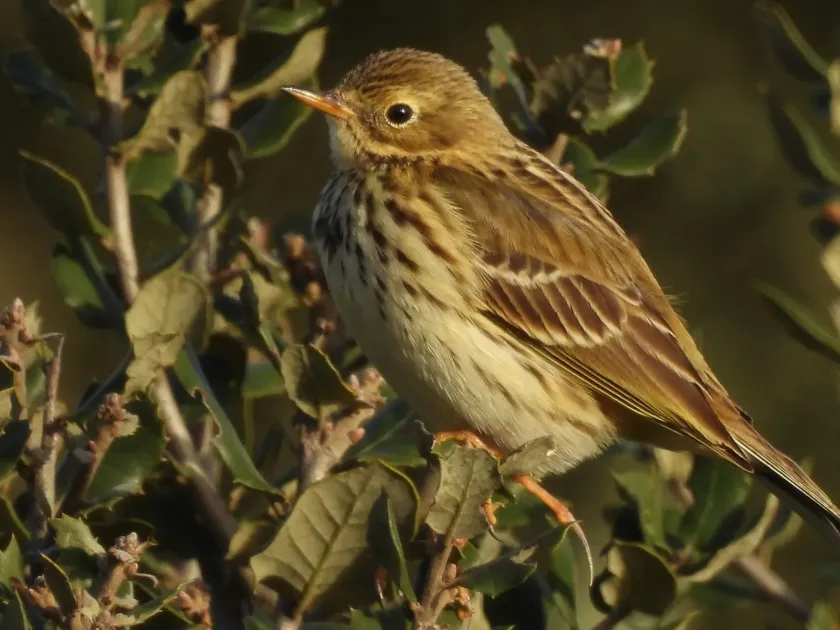
The meadow pipit (Anthus pratensis) is a small passerine bird belonging to the wagtail family, known for its cryptic plumage that blends perfectly with meadow and field environments.
Measuring about 14-15 cm in length, it features a slender build and a thin beak, which is adapted for picking insects and seeds from the ground or low vegetation.
These birds are predominantly ground-dwelling and are rarely seen perching on high trees, preferring the relative cover of tall grasses, shrubs, or open agricultural rows.
The identification can be confirmed by their distinct, high-pitched flight calls and the specific pinkish-beige color of their legs, distinguishing them from other similar pipit species.
Due to their migratory nature, their population density in agricultural areas fluctuates significantly throughout the year, peaking during the breeding season in the spring.
What it damages
The meadow pipit primarily causes economic damage by mechanically trampling emerging seedlings during their foraging activities in early spring.
In certain scenarios, they can damage sprouting seeds, particularly in fields where seeds are placed near the surface without adequate soil cover, making them accessible.
During the nesting phase, these birds gather fine stems and leaves from the crops to construct their nests, which leads to thinning of the crop stand in localized areas.
The direct physical damage to young plants often makes them susceptible to secondary infections, as damaged plant tissues are prone to fungal or bacterial colonization.
While individually small, a flock of meadow pipits can cause significant reduction in stand uniformity, especially in sensitive crops like early-sown cereals or forage grasses.
When it appears
The activity of the meadow pipit in agricultural landscapes begins in early spring, usually March or April, when they return to establish breeding territories.
The peak period of damage occurs from late April through May, which corresponds to the nesting period and the growth phase of many vital agricultural crops.
As summer progresses, the birds continue to forage in these areas to feed their offspring, maintaining pressure on the young vegetation until late summer.
In autumn, as the birds prepare for migration, they may congregate in larger flocks on stubble fields, although their impact on crops at this stage is generally lower.
In temperate regions, the meadow pipit migrates south for the winter, meaning the risk to agriculture is entirely absent during the dormant season.
Signs of infestation
Signs of infestation include patches of flattened or uprooted seedlings in the field, indicating active foraging or nesting areas of the pipits.
Finding a well-concealed cup-shaped nest on the ground, often hidden under a tussock of grass, provides definitive proof of a local nesting pair.
Droppings left on the foliage of young plants, combined with characteristic thin scratch marks on the surface of the soil, are typical evidence of their presence.
Repeated, low-level flight patterns across a specific area of the field suggest that the birds are either nesting nearby or have established a primary feeding ground.
A noticeable decrease in plant density around specific zones of the field, combined with scattered plant debris, usually points to intense avian activity.
Control measures
Effective control of meadow pipits in agricultural settings focuses on non-lethal deterrent methods to protect vulnerable crop areas without harming the ecosystem.
Visual deterrents such as reflective tapes, predator kites, or flashers are useful for keeping birds away from high-value crop sections during the germination phase.
Acoustic deterrents that simulate the distress calls of birds or other natural sounds can be highly effective in preventing flocks from settling in a specific field.
- Deploy ultrasonic bird repellers in the field.
- Maintain clean field edges to reduce nesting habitat.
- Install mesh covers for small-scale high-value crops.
Integrated management should prioritize cultural practices that ensure vigorous and rapid crop emergence, minimizing the time plants remain vulnerable to bird trampling.
Taxonomy
- Latin name
- Anthus pratensis
- Family
- Motacillidae
- EPPO code
- ATHUPR
Discussion
No discussions yet — be the first.