
Antestia bug
Antestia cincticollis
Description
How to identify
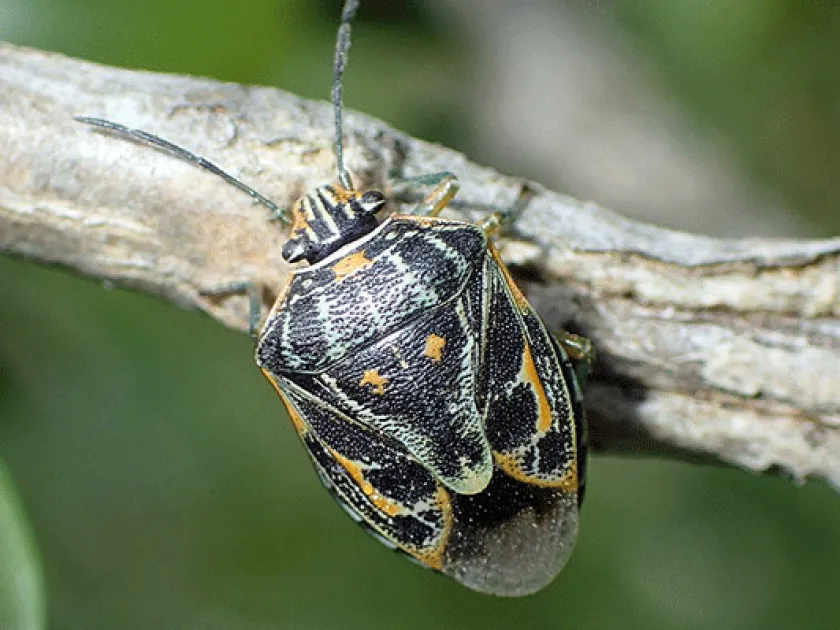
The Antestia bug (Antestia cincticollis) belongs to the order Hemiptera and the family Pentatomidae. It is a small, shield-shaped insect often characterized by its distinctive mottled appearance and protective coloration.
The life cycle of this pest consists of the egg stage, five nymphal instars, and the adult stage. Females typically lay eggs in small clusters on the underside of leaves to protect them from direct sunlight and predators.
Nymphs of early instars exhibit gregarious behavior, often found feeding in groups on the same branch or fruit. As they mature, they disperse throughout the host plant to find optimal feeding sites.
The development time of the Antestia bug is highly dependent on environmental factors, particularly temperature and humidity, which influence both the speed of maturation and the reproductive rate.
Adults are highly mobile and capable of flying between trees, making the rapid colonization of coffee plantations a significant challenge for farmers and agronomists.
What it damages
This species primarily targets coffee trees (Coffea arabica), using its piercing-sucking mouthparts to feed on various parts of the plant, including berries, flowers, and buds.
The damage caused by the bug's feeding leads to the direct loss of fruit yield and significant quality degradation, as the puncture wounds allow entry for fungal pathogens.
The most severe impact is the transmission of the fungus Nematospora coryli, which causes the internal rotting of coffee beans, commonly referred to as "black bean" disease.
Feeding on young shoots and floral buds often results in stunted growth, deformation of foliage, and premature abscission of buds and developing fruits.
Without intervention, high pest populations can cause massive yield losses, severely impacting the commercial profitability of coffee production.
When it appears
The activity level of the Antestia bug is closely tied to the phenological stages of the coffee tree, particularly during the flowering and fruit-setting seasons.
Population density often fluctuates based on seasonal rainfall patterns; extremely wet conditions may favor the development of natural fungal pathogens that limit bug populations.
Conversely, dry spells often coincide with increased pest activity, as insects move from drying wild vegetation into the lush, irrigated environments of coffee plantations.
Farmers should monitor the plantation closely during the transition between seasons when the shift in weather conditions triggers migration patterns.
Year-round monitoring is necessary, as multiple overlapping generations can be present, creating constant pressure on the crop throughout the year.
Signs of infestation
Early identification of an infestation is possible by inspecting the undersides of leaves and fruit clusters for the presence of nymphs or adult bugs.
Visible signs on fruits include small, dark puncture spots surrounded by localized tissue necrosis where the bug has fed.
Heavy shedding of flowers and young green cherries is a primary indicator that the bug population has reached a damaging density.
Upon harvesting or cutting open the coffee cherries, internal dark staining and rot indicate that the pest has successfully transmitted fungal infections.
The presence of insect excreta, often appearing as small dark spots on leaves and stems, serves as a secondary indicator of bug infestation.
Control measures
Control strategies for the Antestia bug rely on an integrated pest management (IPM) approach to minimize damage while protecting environmental health.
Cultural practices, such as pruning the coffee trees to open up the canopy, improve airflow and light penetration, making the environment less favorable for the bugs.
- Regular manual removal of adult bugs during the early morning hours.
- Application of selective insecticides when the infestation exceeds the economic threshold.
- Encouraging the presence of natural predators, such as parasitic wasps that target eggs.
- Removing weeds and wild host plants near the plantation to reduce breeding sites.
Insecticide use should be carefully timed to target the nymphal stages, which are generally more susceptible to chemical intervention than adults.
Adopting biological control measures and maintaining overall plant health can significantly reduce the need for harsh chemicals, ensuring the sustainability of the crop.
Taxonomy
- Latin name
- Antestia cincticollis
- Order
- Hemiptera (bugs, aphids, leafhoppers)
- Family
- Pentatomidae
- EPPO code
- ANTECI
Discussion
No discussions yet — be the first.