
Anoplotermes
Anoplotermes
Description
How to identify
Anoplotermes is a genus of termites belonging to the family Termitidae within the order Blattodea. Unlike mound-building termites, these are strictly soil-dwelling insects that live entirely within the subterranean environment.
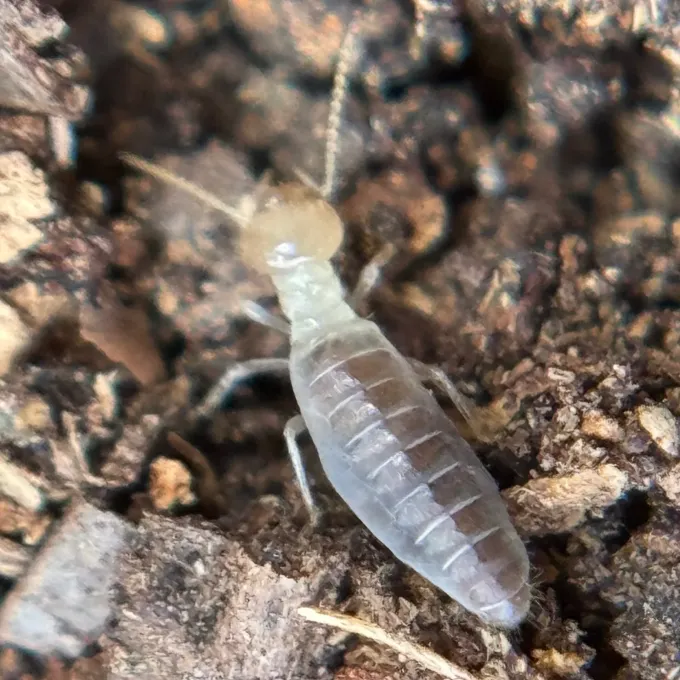
Workers are characterized by soft, pale, or yellowish bodies, typically ranging from 3 to 5 mm in length. They lack eyes and are fully adapted to life in total darkness, navigating through intricate soil tunnels.
This genus is unique because it lacks a specialized soldier caste, meaning all functional tasks, including colony expansion and foraging, are performed by the workers.
They are highly dependent on the presence of organic matter in the soil, which serves as both their primary food source and structural material for their tunnels.
These termites are cryptic and rarely appear on the surface, making their presence difficult to detect without careful excavation of the root zone or soil profiles.
What it damages
Anoplotermes can cause significant damage to a wide variety of crops, including cereals, vegetables, and tubers, particularly in tropical and subtropical agricultural regions.
The damage occurs when these termites feed on the roots, root hairs, and the basal portion of the stems, effectively disrupting the plant's ability to take up water and nutrients.
Young plants and seedlings are at the highest risk, as even minor root feeding can lead to total plant death or severe stunting, impacting overall crop yield.
For tuber crops like potatoes or carrots, the damage manifests as galleries bored into the flesh, which significantly lowers the commercial value and quality of the harvest.
Furthermore, feeding wounds created by termites often serve as entry points for soil-borne pathogens, leading to secondary infections that accelerate the decay of the plant tissues.
When it appears
The activity of Anoplotermes is primarily driven by soil moisture levels and temperature. Their foraging intensity increases significantly during the wet season or under irrigation.
During dry spells, the colony retreats to deeper soil horizons where moisture levels are more stable, although they continue their feeding activities on deeper root systems.
Agricultural fields that maintain high moisture content throughout the year are more susceptible to constant pressure from these subterranean pests.
The most critical window for monitoring is during the early developmental stages of the crop, when the root system is not yet fully established and is most vulnerable to termite pressure.
Seasonal patterns of crop growth often overlap with the periods of peak termite movement in the upper soil layers, coinciding with temperature increases in the spring.
Signs of infestation
A primary indicator of infestation is the sudden wilting of healthy-looking plants that cannot be explained by drought or standard leaf-borne diseases.
Evidence of tunnels or «clay-like» piping along the roots is a strong diagnostic sign, as these termites construct protective coverings to traverse exposed surfaces.
Infested areas in a field often show patches of stunted or chlorotic plants, which may appear easily uprooted because their anchor roots have been consumed.
When excavating near the base of affected plants, one may observe white or pale workers quickly retreating into the soil as the tunnels are disturbed.
Baiting traps made of cardboard or soft wood, buried near the rhizosphere, provide an effective way to confirm the presence of an active Anoplotermes colony.
Control measures
Cultural control via deep plowing and regular soil cultivation is essential to disrupt the termite tunnel networks and reduce their population density by exposing them to predators.
The incorporation of high-quality organic matter into the soil is recommended, as it provides termites with alternative food sources, potentially reducing their attacks on live crops.
Biological control, such as the application of entomopathogenic fungi like Metarhizium anisopliae, is considered an effective and environmentally friendly management strategy.
Chemical control using systemic soil-applied insecticides should be used as a last resort, given the potential negative impact on the beneficial soil ecosystem.
- Rotate crops to break the cycle of termite infestations.
- Ensure adequate irrigation management to avoid localized drought.
- Use termite-resistant varieties if available for the specific region.
Taxonomy
- Latin name
- Anoplotermes
- Family
- Termitidae
- EPPO code
- ANOTSP
Discussion
No discussions yet — be the first.