
Anacridium moestum
Anacridium moestum
Description
How to identify
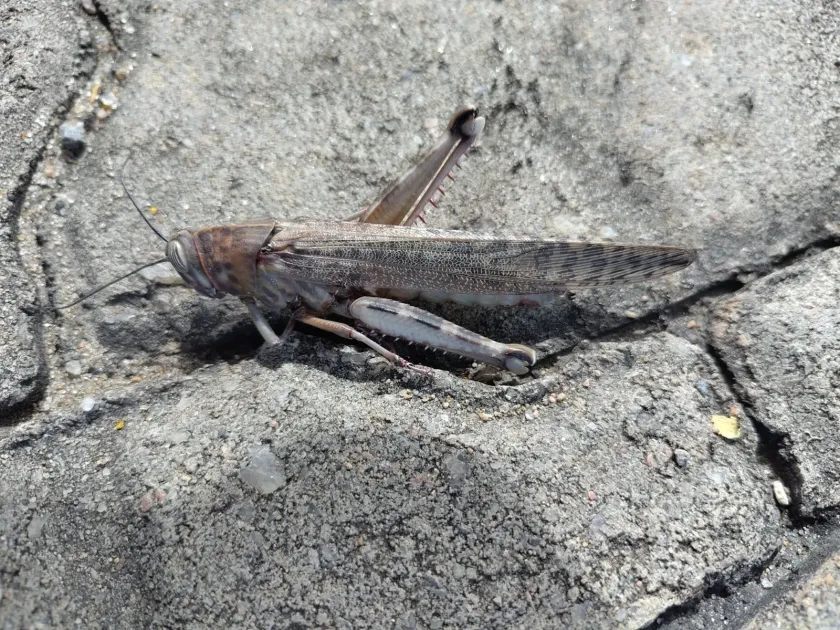
Anacridium moestum, commonly known as the desert tree locust, belongs to the order Orthoptera and the Acrididae family. This large insect possesses a robust body structure that facilitates long-distance migratory flights.
The adult is characterized by its grayish-brown or brownish coloration, which serves as camouflage against dry vegetation. Distinct dark stripes are often visible on the hind femurs, serving as a diagnostic feature.
Its life cycle follows an incomplete metamorphosis, consisting of three primary stages: egg, nymph, and adult. Nymphs closely resemble miniature versions of adults but lack functional wings.
Unlike many gregarious locust species, this pest often maintains a solitary or semi-gregarious lifestyle, though it can form localized swarms under optimal environmental conditions.
This species is well-adapted to arid environments, possessing high tolerance for extreme temperatures and moisture scarcity, which dictates its specific geographic distribution and activity patterns.
What it damages
As a highly polyphagous pest, Anacridium moestum feeds on a wide range of green plants. It poses a significant threat to cereal crops such as wheat, barley, corn, and sorghum, often causing complete crop failure.
In various regions, it is a known threat to orchards and vineyards. The insects consume foliage, tender shoots, and even the bark of young twigs, leading to severe tree stress and eventual mortality.
Vegetable crops, including solanaceous and cucurbit plants, are also preferred food sources. High population densities can result in the loss of 80-90% of a harvest within a short period of time.
Adults are capable of migrating over long distances in search of succulent food, meaning that even low population numbers can escalate into a major issue for large-scale agricultural operations.
Beyond direct defoliation, the pest causes physical damage to stems, which creates entry points for secondary fungal and bacterial pathogens, further compromising plant health.
When it appears
The activity of this pest is strictly regulated by temperature. Hot summer months are most favorable for reproduction and feeding, as soil temperatures facilitate rapid egg incubation.
Nymphal emergence typically occurs in late spring or early summer, coinciding with the rapid growth stage of many essential agricultural crops.
The peak of damage occurs in the second half of summer when mature adults actively migrate from wild grasses to irrigated fields in search of more hospitable food sources.
Adults remain active until the onset of significant autumn cooling. In warmer climates, some level of activity may persist throughout milder seasons.
The developmental cycle is often staggered, meaning nymphs of various stages and adults can be observed simultaneously in the field, which complicates precise monitoring and control.
Signs of infestation
The most visible sign of infestation is the presence of heavily skeletonized foliage or complete leaf stripping, leaving only the primary stalks behind. Plants often look as if they have been aggressively pruned.
Visual inspection of the fields typically reveals large Orthoptera specimens that jump or fly short distances when disturbed by human presence or machinery.
Accumulated frass (insect excrement) beneath damaged plants serves as a clear indicator of concentrated feeding activity in specific patches of the field.
Infestation patterns are usually focal, starting in isolated spots and expanding rapidly into large, contiguous areas of destruction across the cultivated plot.
Regular scouting using sweep nets or counting insects per square meter is essential to detect populations before they reach the economic injury level.
Control measures
The primary control method involves timely chemical intervention using insecticides from the organophosphate, pyrethroid, or neonicotinoid classes to protect vulnerable crops.
Agronomic measures, such as deep plowing in autumn, are highly effective as they disrupt egg pods buried in the soil, exposing them to desiccation, predation, or mechanical destruction.
Maintaining clean field borders is crucial, as weed-heavy margins often serve as breeding and staging grounds for nymphs before they invade the main crop.
- Monitoring population levels with pheromone or light traps.
- Applying biological control agents based on entomopathogenic fungi.
- Encouraging natural predators such as birds, lizards, and beneficial parasitic insects.
Once the economic threshold is crossed, immediate localized spraying is required to prevent mass migration and minimize the total impact on the overall crop yield.
Taxonomy
- Latin name
- Anacridium moestum
- Order
- Orthoptera (locusts)
- Family
- Acrididae
- EPPO code
- ANCRMO
Discussion
No discussions yet — be the first.