
Tree locust
Anacridium melanorhodon
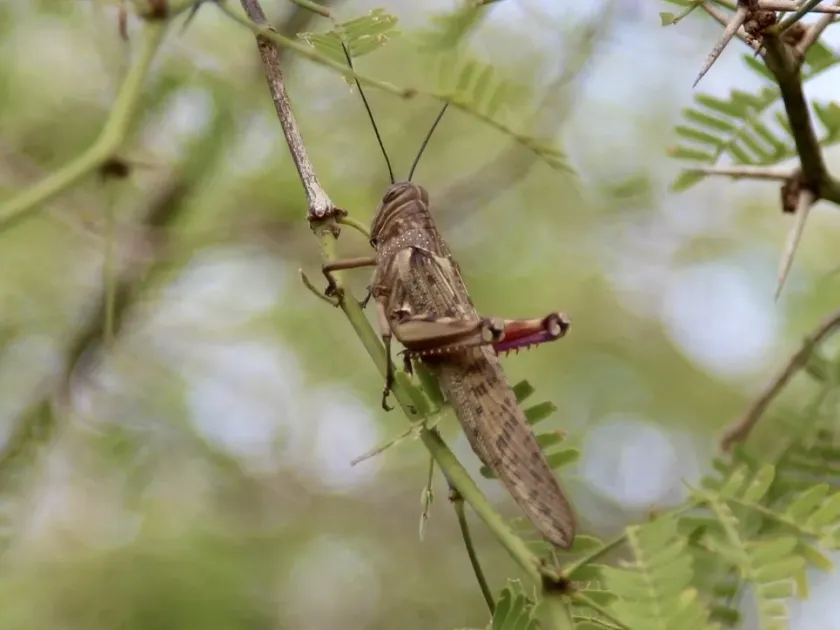
Description
How to identify
The Tree locust (Anacridium melanorhodon) is a significant member of the Acrididae family, known for its ability to occupy woody vegetation, which distinguishes it from many ground-dwelling grasshoppers.
Adult insects are characterized by their robust size and the presence of prominent spines on their hind tibiae. Their coloration provides excellent camouflage against tree bark and dry foliage.
The life cycle involves egg deposition in the soil, followed by several nymphal stages. Unlike swarming desert locusts, they have a strong preference for resting and feeding in trees and shrubs.
These insects are highly migratory, capable of flying over extensive areas to find suitable host plants, making them a transboundary threat in semi-arid environments.
Their morphological adaptations, including powerful wings and strong legs, allow them to navigate effectively through dense tree canopies and survive in harsh ecological conditions.
What it damages
The Tree locust poses a major threat to forestry, fruit orchards, and various agricultural commodities, including grain crops and cotton, particularly in arid regions.
They feed on foliage, young buds, and tender bark. In cases of severe infestations, they can strip entire trees of their leaves, causing significant physiological stress to the host.
Economic damage is severe because the pest attacks not only the current season's crop but also the structural health of perennial woody plants and windbreaks.
Widespread outbreaks can devastate local agricultural economies, destroying vegetation that is critical for both commercial farming and community food security.
The feeding activity often leads to total defoliation, which inhibits photosynthesis, weakens the plant, and makes it susceptible to secondary pests and drought stress.
Signs of infestation
Visual identification of large swarms or clusters resting on tree branches during the cool parts of the day is the primary indicator of an infestation.
Noticeable damage to foliage, such as ragged leaf edges, skeletonized leaves, or total defoliation of tree branches, clearly signals the presence of feeding locusts.
Accumulation of fecal pellets under trees and on the ground serves as a clear indicator of a high population density of the pest in the immediate area.
The sound of mass movement, often described as a collective rustling or clicking within the canopy, frequently precedes visible damage detection.
The discovery of exuviae (cast-off skins) on branches confirms that a new generation of nymphs has successfully emerged and is actively developing within the canopy.
Control measures
Effective management requires consistent field monitoring to detect early-stage nymphs and prevent the formation of massive, highly mobile adult swarms.
Chemical control involving timely application of insecticides is the most effective method when infestations reach economic injury levels, targeting both nymphs and adults.
Mechanical control measures, such as soil cultivation in identified egg-laying hotspots, are essential for disrupting the life cycle before egg hatching begins.
Biological control strategies, utilizing fungal pathogens like Metarhizium species, offer a sustainable alternative for long-term population suppression.
- Regular monitoring programs to identify hotspots.
- Targeted insecticide sprays in affected tree canopies.
- Deep plowing of known oviposition sites.
- Promoting the presence of natural predators, such as birds and lizards.
Taxonomy
- Latin name
- Anacridium melanorhodon
- Order
- Orthoptera (locusts)
- Family
- Acrididae
- EPPO code
- ANCRMA
Discussion
No discussions yet — be the first.