
Egyptian locust
Anacridium
Description
How to identify
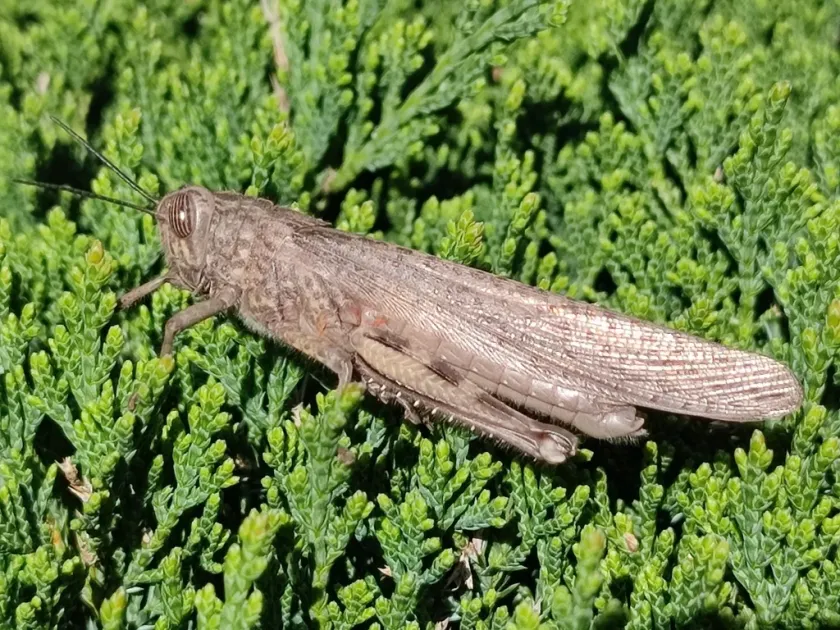
The Egyptian locust (Anacridium aegyptium) is a large insect belonging to the Acrididae family. It is widely recognized as one of the largest grasshopper species in the Mediterranean region.
Adults typically measure between 50 to 70 mm in length. Their body color ranges from grey to brownish, providing excellent camouflage against tree bark and dry vegetation.
A distinctive feature of this species is its eyes, which are marked with characteristic dark vertical stripes, often compared to zebra stripes, and a noticeable ridge on the pronotum.
The hind tibiae are usually reddish, and the wings are well-developed, allowing these insects to fly long distances in search of suitable food sources.
Nymphs resemble the adults in appearance but lack fully developed wings. Their size increases with each molt until they reach the adult stage.
What it damages
As a polyphagous insect, the Egyptian locust feeds on a wide range of plants, making it a significant threat to various agricultural sectors.
It causes substantial damage to fruit trees, including citrus, stone fruits, and grapes. It prefers eating leaves, young buds, and sometimes the bark of thin twigs.
In addition to horticultural crops, it can infest field crops like maize and sunflowers, especially when these are planted near its natural breeding habitats.
Feeding damage is characterized by large, irregular holes in the leaves, which, in severe cases, can lead to complete defoliation of the affected tree.
Heavy infestations can significantly weaken plants, reduce photosynthetic capacity, and lead to reduced yields or even the death of young saplings.
When it appears
The Egyptian locust typically completes one generation per year, with the adult stage being responsible for overwintering in protected sites.
When spring temperatures rise, the adults emerge from hibernation, start feeding actively, and prepare for the breeding season that follows shortly after.
During the summer months, females lay their eggs in the soil, protecting them within foam-based egg pods (oothecae) to ensure survival until hatching.
The nymphal stage occurs during the summer, involving several molts. During this phase, nymphs consume large amounts of green tissue to support their rapid growth.
By late summer and early autumn, the new generation of adults reaches maturity and feeds intensively before entering the winter diapause.
Signs of infestation
The presence of this pest is often signaled by extensive damage to the foliage of trees, showing characteristic ragged edges or completely missing leaves.
Scattered droppings on the ground beneath the canopy or on the foliage are reliable indicators of a locust colony's activity in the area.
Visual identification is possible, as these large insects are often visible on branches or near the base of the plant during the cooler parts of the day.
In some cases, physical damage to the bark of young twigs or branches can be observed, which may lead to subsequent plant health issues.
During large-scale outbreaks, the audible sound of the locusts moving and feeding, along with their characteristic flight noise, becomes obvious.
Control measures
Monitoring is the primary strategy for managing the Egyptian locust. Early detection of nymphs allows for more targeted and effective interventions.
Cultural control methods, such as soil cultivation (plowing) in infested areas, can destroy the egg pods buried in the ground and reduce future populations.
Chemical control involving approved insecticides is necessary when infestation thresholds are exceeded to prevent significant crop loss.
Biological control options, including the use of entomopathogenic fungi or natural predators, are increasingly used to manage populations in a sustainable way.
- Regular inspection of orchard perimeters and wasteland areas.
- Removal of weeds that provide shelter and secondary food sources.
- Targeted application of insecticides during early nymphal stages.
Taxonomy
- Latin name
- Anacridium
- Order
- Orthoptera (locusts)
- Family
- Acrididae
- EPPO code
- ANCRSP
Discussion
No discussions yet — be the first.