
Green-striped grasshopper
Aiolopus thalassinus
Description
How to identify
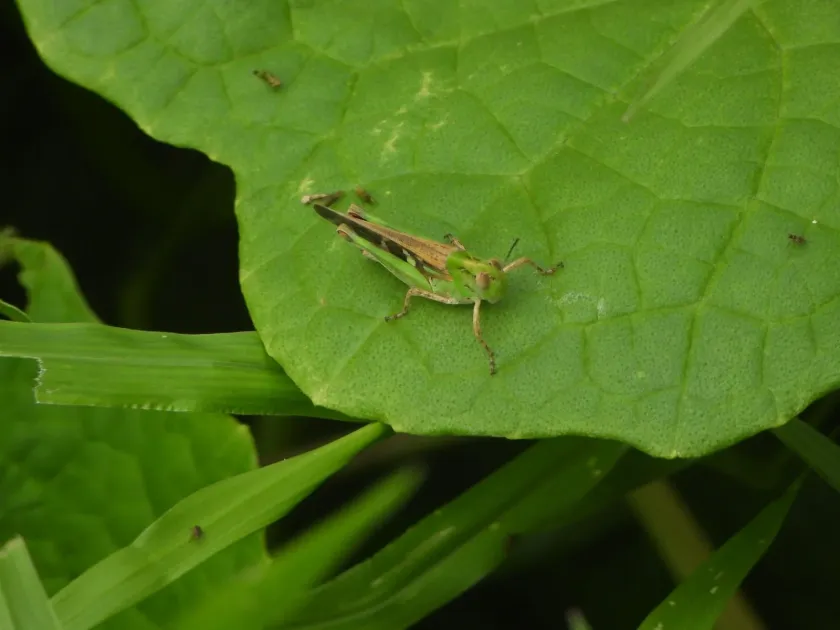
The green-striped grasshopper (Aiolopus thalassinus) belongs to the order Orthoptera and the family Acrididae. It is a medium-sized insect often found in moist, grassy habitats, including agricultural fields.
Adults typically range from 15 to 25 mm in length. Their coloration varies from green to brown-grey, often featuring distinct stripes on the tegmina (forewings) that help them blend into their surroundings.
The hind wings are usually clear and membranous, a key diagnostic feature distinguishing this species. Their robust hind legs enable powerful jumps, which are their primary method of escaping threats.
Nymphs resemble smaller, wingless versions of the adults. They undergo several molting stages, increasing in size and developing wing pads before reaching the final adult stage.
They are known for their high ecological plasticity, allowing them to thrive in various conditions, provided there is sufficient vegetation and moisture to support their populations.
What it damages
This grasshopper is a polyphagous pest, meaning it feeds on a wide range of plants. It is particularly damaging to cereal crops, including wheat, barley, sorghum, and corn, where it consumes leaves and stems.
Beyond cereals, it can infest vegetable crops and industrial plants like sugar beets and sunflowers. In cases of high population density, it can cause significant loss of biomass in pastures.
Both nymphs and adults contribute to the damage. They feed on the leaf tissues, often starting from the edges or creating irregular holes, which significantly reduces the photosynthetic capacity of the plants.
Feeding on the reproductive parts of the crop, such as the heads or ears of grain, directly impacts yield quality and quantity, potentially leading to substantial economic losses for farmers.
While not typically forming migratory swarms as dense as some other locust species, their local feeding intensity can be devastating to young seedlings, sometimes requiring immediate re-seeding.
When it appears
The species overwinters as eggs in the soil, deposited in egg pods during the late summer and autumn. Hatching typically occurs in late spring, corresponding with the warming of the soil.
The life cycle is closely linked to climatic factors. In warmer southern regions, the insect can complete two generations per season, increasing its potential for rapid population expansion.
Peak feeding activity occurs during the summer months when nymphs reach their later instars and adults are actively mating. This coincides with the vegetative growth stages of many summer crops.
Adults remain active until the onset of cooler autumn temperatures. During this time, they focus on feeding to build energy reserves for egg production and subsequently laying eggs for the following year.
Monitoring should intensify from May through July, especially in areas with high soil moisture, as these conditions are optimal for both egg survival and nymphal development.
Signs of infestation
Detection of the pest is often based on visual damage to the foliage. Leaves may appear ragged or partially consumed, with irregular margins and holes that are characteristic of orthopteran feeding.
A common sign of infestation is the sudden jumping of grasshoppers when walking through a crop field. High numbers of nymphs moving in the lower canopy are a clear indication of a significant population.
- Ragged or skeletonized leaf edges;
- Presence of insect frass (droppings) on the soil or lower leaves;
- Damaged or hollowed-out cereal ears;
- Visible nymphs clustered in dense vegetation;
- Stunted or yellowing young plants due to leaf area loss.
Significant defoliation of young corn or cereal plants is a warning sign. When the growing point of a young seedling is damaged, the plant may fail to mature properly, leading to uneven crop stands.
Scouting should be conducted during the cooler parts of the day, such as early morning, when the insects are less mobile and easier to count and identify.
Control measures
Effective management begins with cultural practices. Deep autumn plowing is a highly recommended method to disturb and destroy egg pods in the soil, exposing them to frost and predators.
Maintaining clean field borders and managing weeds is crucial, as these areas serve as primary breeding grounds and refuges for the grasshoppers before they move into the crop area.
Chemical control involving insecticides, such as pyrethroids or organophosphates, should be applied when populations exceed economic injury levels, targeting early instar nymphs for maximum efficiency.
It is important to time insecticide applications carefully to coincide with the most vulnerable developmental stages of the insect, thereby reducing the amount of chemical needed.
Integrated Pest Management (IPM) programs may also include the use of natural enemies, such as birds or predatory insects, and, in some cases, biological pesticides that specifically target grasshoppers.
Taxonomy
- Latin name
- Aiolopus thalassinus
- Order
- Orthoptera (locusts)
- Family
- Acrididae
- EPPO code
- AIOLTA
Discussion
No discussions yet — be the first.