
Egyptian grasshopper
Aiolopus simulatrix
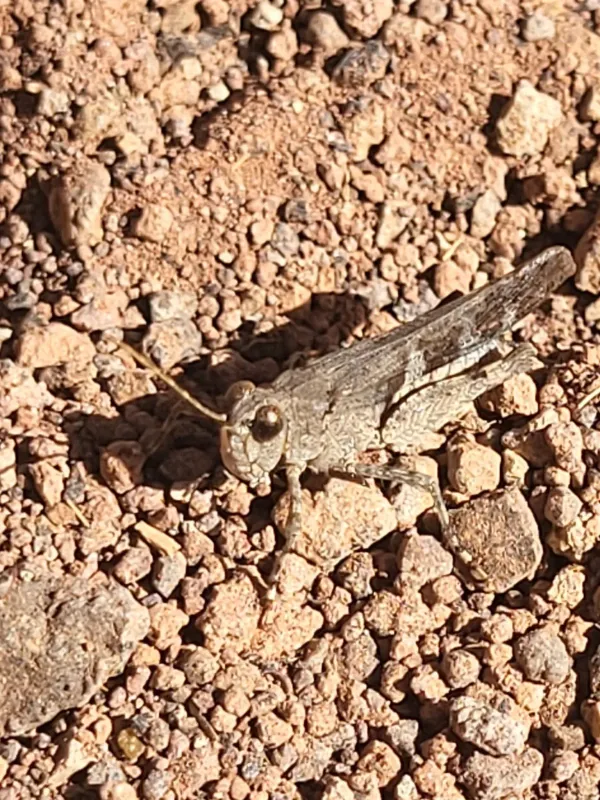
Description
How to identify
The Egyptian grasshopper (Aiolopus simulatrix) is a member of the order Orthoptera and the family Acrididae. It is a medium-sized insect known for its robust jumping legs and functional wings, allowing for both crawling and flight across agricultural fields.
Adults exhibit cryptic coloration, ranging from greyish-brown to green, which serves as camouflage against vegetation. The species can be identified by the specific patterns on the hind femurs and its translucent wings that remain tightly pressed against the body when resting.
Nymphs resemble smaller, wingless versions of adults. Throughout their development, they progress through several instars, gradually increasing in size and developing wing pads before reaching maturity.
This pest is highly active in hot and arid environments. Adults are exceptionally mobile, enabling them to quickly migrate between crops in search of nutritious host plants, which facilitates the rapid spread of infestations.
As a typical inhabitant of semi-arid zones, the species has the potential for explosive population growth, particularly when environmental conditions remain favorable for successive generations.
What it damages
The Egyptian grasshopper is a significant polyphagous pest capable of causing substantial economic damage to various agricultural crops. Its dietary range includes both wild grasses and major cereal crops.
The most severe damage is often reported in wheat, barley, and maize fields. Additionally, the pest frequently attacks alfalfa and other fodder crops, significantly reducing green biomass yields and overall forage quality.
During mass outbreak years, these insects can completely defoliate crops across vast areas, leaving behind only skeletonized stems. The damage affects leaf tissue, reproductive organs, and young shoots, halting plant development.
Beyond direct feeding, the insects weaken plants by creating mechanical wounds. These damaged areas often become entry points for secondary fungal and bacterial infections, further compromising the health of the crop.
The scale of loss depends on population density. In scenarios with high pest pressure, complete crop failure on specific field sectors can occur, necessitating immediate mitigation actions to prevent total yield loss.
When it appears
The life cycle of Aiolopus simulatrix is closely linked to seasonal precipitation and temperature patterns. In warmer regions, the species can complete multiple generations within a single growing season if moisture levels are sufficient.
The species primarily overwinters in the egg stage, buried in the soil. Nymph hatching typically occurs in the spring, triggered by rising soil temperatures that signify the optimal onset for the life cycle.
Peak activity occurs during the summer months when adults feed, mate, and disperse. During this period, the damage to actively growing vegetation reaches its maximum, as the population achieves its peak density.
As autumn approaches and temperatures decrease, the metabolic rate of the insects slows down, and they transition to egg-laying. This ensures the survival of the species through the dormant season.
Climatic variability has a profound impact on population dynamics. A dry spring often favors nymph survival, whereas high humidity can trigger outbreaks of entomopathogenic fungi that act as natural population suppressors.
Signs of infestation
The primary symptom of infestation is the appearance of jagged, uneven edges on crop leaves. Grasshoppers typically feed from the margins inward, eventually leading to severe leaf skeletonization where only the veins remain.
The presence of the pest is often detected visually; one might observe a high number of insects jumping through the vegetation during field inspections. Localized aggregations often attract insectivorous birds and small predators.
Early signs of infestation manifest in patches. If left unmanaged, these localized spots expand rapidly, merging into larger affected zones where the crop canopy is noticeably thinning or completely destroyed.
The presence of grasshopper frass (excrement) on leaves and stems serves as a definitive indicator of feeding activity and a signal of high population density within the agricultural ecosystem.
The appearance of fully winged adults is a critical warning sign. It signifies the end of the nymphal stage and the start of the migratory phase, making the pest significantly harder to control due to increased mobility.
Control measures
Pest management for the Egyptian grasshopper relies on consistent monitoring and proactive intervention. Agronomists should track nymphal densities to apply control measures against younger instars, which are the most susceptible to treatment.
Cultural control methods should focus on rigorous weed management, particularly along field margins and boundaries, as these areas serve as key oviposition sites and initial development hubs for the pest.
When the economic injury level is reached, chemical control via insecticides is necessary. Products with contact and stomach action provide the best results, ensuring rapid suppression of the population.
Application timing is crucial; spraying should be conducted during early morning or late evening hours. During these times, insects are less active and more likely to be found on the plants rather than hidden in the canopy or soil.
Biological control, including the use of entomopathogenic fungi or natural predators, offers a sustainable alternative for long-term population regulation within integrated pest management (IPM) programs.
Taxonomy
- Latin name
- Aiolopus simulatrix
- Order
- Orthoptera (locusts)
- Family
- Acrididae
- EPPO code
- AIOLSI
Discussion
No discussions yet — be the first.