
Black-and-red shield bug
Agonoscelis rutila
Description
How to identify
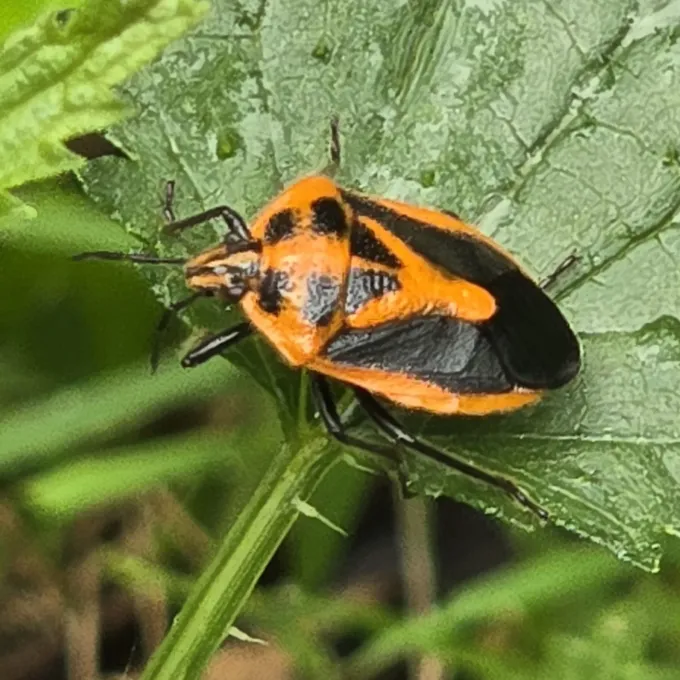
The black-and-red shield bug (Agonoscelis rutila) is a member of the Pentatomidae family, commonly known as stink bugs. Adult specimens are easily recognized by their striking black and red or orange pattern covering the thorax and scutellum.
The body of the adult insect is oval and slightly convex, typically reaching about 10–12 millimeters in length. Its head and limbs are usually black, providing a distinct contrast to the bright colors of the dorsal side, which function as an aposematic signal against predators.
The species undergoes incomplete metamorphosis, consisting of egg, five nymphal instars, and adult stages. Nymphs often resemble adults in shape but differ in size and color intensity, progressively developing the characteristic adult pattern as they molt.
This bug is a thermophilic insect, thriving in warm and dry climates where rapid population growth can occur. They are primarily active during the day, frequently observed on foliage and fruit where they feed on plant sap.
Identification can be confirmed by observing the shape of the scutellum, which fits tightly against the abdomen, and the specific geometric pattern on the wing covers that distinguishes them from similar species.
What it damages
The black-and-red shield bug primarily feeds on plants within the Brassicaceae family, as well as various legumes and solanaceous crops. Both nymphs and adults cause damage by using their piercing-sucking mouthparts to extract sap from plant tissues.
The pest poses a significant threat during periods of drought or high heat, when plants are already under water stress. Sustained feeding leads to weakened plant health, reduced photosynthetic activity, and overall stunted growth.
Heavy infestations lead to direct damage of young shoots, buds, and developing fruits. This feeding often results in fruit deformation and internal tissue damage, significantly reducing the market value and quality of the harvest.
In agricultural settings, these bugs frequently migrate from wild host plants and weeds into crop fields. If left uncontrolled, their feeding can create open wounds on plant surfaces, inviting secondary fungal or bacterial infections.
On seed crops, feeding on the developing pods can be particularly devastating, drastically reducing germination rates and overall yield, making the material unsuitable for agricultural propagation.
Signs of infestation
The primary sign of infestation is the presence of the bugs themselves on the undersides of leaves or on fruiting bodies. Careful inspection reveals tiny, light-colored stippling or pinprick-like marks on the plant tissue.
Infected plants show signs of chlorosis, with leaves gradually turning yellow and potentially wilting as the bug extracts essential sap. Affected fruits often exhibit sunken spots or dimples where the insect has inserted its rostrum.
In severe cases, stem deformation and premature leaf drop are common. During humid conditions, necrotic lesions may appear at the feeding sites as a result of secondary infections entering the plant tissue.
Clusters of eggs, typically laid in neat rows on the undersides of leaves, are a definitive indicator of an active population breeding within the field. Monitoring for these egg masses is crucial for early detection.
A distinctive, pungent odor, often released by the bugs when they are disturbed or threatened, is another clear sign of their presence, which can often be detected even before seeing the insects themselves.
Control measures
Effective management of the black-and-red shield bug starts with integrated pest management (IPM) practices, emphasizing cultural control and field sanitation. Removing wild host weeds is vital to eliminate primary breeding grounds.
Crop rotation and maintaining spatial isolation between crop fields and wild habitats significantly help in reducing the population density. Deep plowing of fields after harvest can also bury and eliminate overwintering adults.
Chemical control involving systemic or contact insecticides may be necessary during the peak nymphal emergence phase. Applications should be timed carefully and follow label instructions to minimize environmental impact.
Biological control methods, such as encouraging local parasitic wasps (parasitoids) that target the eggs and nymphs, provide a sustainable and environmentally friendly way to keep populations below the economic damage threshold.
- Implementing pheromone traps for routine monitoring of adult movement.
- Targeting border rows of fields with insecticides upon initial detection.
- Ensuring timely harvesting to prevent mass migration of the pest to adjacent healthy crops.
Taxonomy
- Latin name
- Agonoscelis rutila
- Order
- Hemiptera (bugs, aphids, leafhoppers)
- Family
- Pentatomidae
- EPPO code
- AGOSRU
Discussion
No discussions yet — be the first.