
Ageneotettix
Ageneotettix
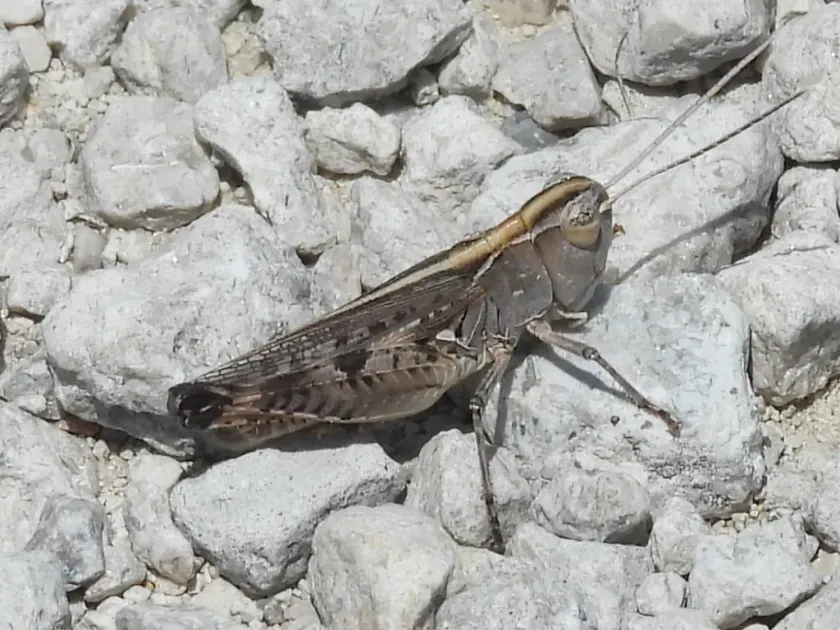
Description
How to identify
Ageneotettix belongs to the order Orthoptera and the family Acrididae. These insects are typical members of the grasshopper group, adapted for life in grassland environments.
Adults possess specialized hind legs for jumping and a body shape typical of the Gomphocerinae subfamily. Their coloration ranges from tan to grayish-brown to match dry grass.
Identification is primarily based on the morphology of the head and the pronotum, as well as specific wing venation patterns characteristic of the genus.
Nymphs resemble smaller, wingless versions of adults. They undergo five nymphal instars before reaching the mature adult stage in late summer.
Agronomists identify these pests by conducting sweep-net surveys across fields to estimate population density and identify the presence of specific developmental stages.
What it damages
This pest primarily feeds on monocotyledonous plants, including wheat, barley, oats, and various forage grasses found on pastures and rangelands.
Both nymphs and adults cause damage by consuming leaf tissue. In young cereal crops, they can destroy seedlings entirely by severing the stems at the base.
During the heading stage of grain crops, they may feed on the spikelets and developing grains, leading to reduced yield and poor grain quality.
In pastures, heavy infestations result in severe overgrazing, leading to the degradation of the sward and a significant decrease in biomass production.
The damage is often patchy at first, but under favorable conditions, the pest population can expand rapidly, causing widespread destruction across the field.
When it appears
The life cycle is univoltine, meaning there is one generation per year. Winter is spent in the egg stage, deposited in soil pods laid by females.
Egg hatching begins in late spring, triggered by rising soil temperatures. The duration of hatching depends on the microclimate of the field site.
Nymphs feed actively through late spring and early summer, growing through their successive instars until they reach maturity.
Adults are most active during the peak of summer, engaging in feeding and reproduction. Migration to fresher pastures often occurs during this time.
Egg laying typically occurs in late summer or early autumn. Following oviposition, the adult population dies off as temperatures drop significantly.
Signs of infestation
Initial signs of infestation include ragged leaf margins and irregular feeding patterns. In severe cases, large bare patches appear in the field.
Visual observation during sunny days reveals grasshoppers jumping away from the observer. This is the most common way to notice an emerging problem.
Fecal deposits found on the soil surface or plant leaves indicate active feeding sites, signaling that the population density is increasing.
The damage is typically localized but can spread quickly. Wilting or yellowing of injured plants is a secondary sign of heavy pest pressure.
In arid conditions, the pests become more apparent as they move toward remaining green vegetation, concentrating damage on the last available forage.
Control measures
Tillage is a primary cultural control method, as soil disturbance in the autumn helps destroy egg pods and exposes them to predators.
Good weed management is essential, as many weed species serve as alternative hosts during the early development stages of the pest.
Chemical control with insecticides is applied when population levels exceed the economic threshold, targeting nymphs in their early instars.
Biological control, including the protection of birds and insect predators, is important for long-term population suppression in pasture environments.
- Regular monitoring of population density per square meter.
- Targeted treatment of field edges and hotspots.
- Use of fast-acting insecticides according to regional guidelines.
Taxonomy
- Latin name
- Ageneotettix
- Order
- Orthoptera (locusts)
- Family
- Acrididae
- EPPO code
- AGETSP
Discussion
No discussions yet — be the first.