
Aelia triticiperda
Aelia triticiperda
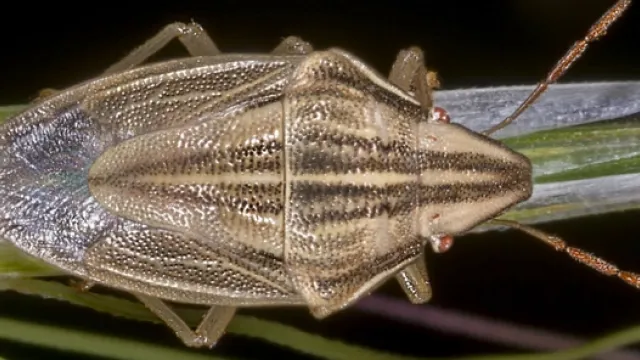
Description
How to identify
Aelia triticiperda is a species of shield bug belonging to the Pentatomidae family. These insects have an elongated body, typically measuring 10-12 mm in length, with a coloration ranging from yellowish-grey to brown, featuring characteristic dark stripes on the pronotum.
The head of the bug is pointed, which serves as a key diagnostic feature for distinguishing it from other similar species. Their bodies are protected by a tough chitinous exoskeleton that guards against environmental stress and physical injury.
The eggs are barrel-shaped and greenish, usually deposited in clusters on the underside of cereal leaves. Larvae progress through five distinct instars, gradually changing their appearance as they approach adulthood.
Adult bugs overwinter in leaf litter, debris, or soil near field margins. As temperatures rise to +12...15°C in spring, they emerge from hibernation and migrate to cereal crops to begin feeding and reproduction.
The lifecycle involves several stages: egg, five larval instars, and the adult stage, with the duration of these stages depending heavily on regional climate and temperature conditions.
What it damages
Aelia triticiperda primarily feeds on cereals, including winter and spring wheat, barley, and rye, although it can also survive on wild grasses found in the vicinity of fields.
The pest utilizes a piercing-sucking mouthpart to access plant sap. The most significant damage occurs during the grain filling and ripening stages, as the insects target the developing grains.
By feeding on wild hosts, the bug maintains its population levels during periods when cereal crops are not available, ensuring a steady presence in the agro-ecosystem.
Damage caused during the early stages of grain development severely impacts seed quality, leading to reduced germination rates and overall crop vigor.
In cases of high infestation, this pest can cause yield losses of 20-30%, posing a substantial risk to agricultural production if left unmanaged.
Signs of infestation
Visual signs of infestation include small puncture marks on leaves and stems, which eventually turn yellow and die as the plant tissue is compromised.
Damage to the ear during the milk stage often results in the "white head" effect, where the ear becomes empty or the grains within it shrivel completely.
Enzymes in the bug's saliva break down gluten proteins within the grain, rendering it unsuitable for milling and baking purposes, which significantly lowers the market value.
Early-season damage can often be identified by the wilting of the central leaf of the plant, indicating that the stem has been damaged at its base.
During the day, the bugs are often found resting directly on the ears of the wheat or hiding within leaf sheaths, where they feed on the plant sap.
Control measures
Integrated pest management includes strict crop rotation, rapid harvesting to minimize the duration the crop is exposed, and deep autumn plowing to bury overwintering sites.
Effective control also involves the removal of weeds along field borders and in nearby hedgerows, where these insects tend to aggregate before winter.
Chemical control is implemented using systemic or contact insecticides when the pest population exceeds the economic injury level for the specific field.
Biological control, such as the release of Trichogramma wasps, can successfully suppress population growth by parasitizing the eggs of the bug.
- Field monitoring during the boot stage and heading.
- Use of pyrethroid or organophosphate insecticides.
- Stubble cultivation immediately after harvest.
Taxonomy
- Latin name
- Aelia triticiperda
- Order
- Hemiptera (bugs, aphids, leafhoppers)
- Family
- Pentatomidae
- EPPO code
- AELITR
Discussion
No discussions yet — be the first.