
Aelia rostrata
Aelia rostrata
Description
How to identify
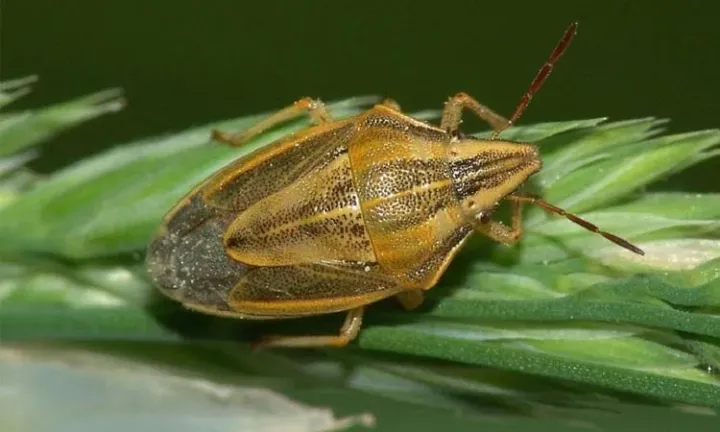
Aelia rostrata, commonly known as a type of shield bug, belongs to the family Pentatomidae. It is characterized by its elongated body, typically 10–12 mm long, and a distinctively pointed head. Its coloration ranges from grayish-yellow to light brown, often featuring darker longitudinal stripes.
The insect possesses a long scutellum, a triangular plate that covers the abdomen, which is a key identifying feature. The thorax also features sharp lateral protrusions, contributing to its "pointed" appearance, which helps it blend into dry grass and stubble.
The life cycle involves a single generation per year. Adults hibernate in protected areas such as forest edges, leaf litter, or deep within dense, dry vegetation. As temperatures rise in spring, they migrate to cereal fields to feed and reproduce.
Eggs are typically laid in rows on the underside of leaves or stems. The nymphs undergo five growth stages (instars) before reaching maturity. While they resemble adults, nymphs are smaller, lighter in color, and lack fully developed wings during their earlier stages.
This bug is highly adapted to open habitats and is a well-known pest in temperate grain-producing regions. Its physical structure allows it to move efficiently through dense wheat or barley crops while remaining relatively camouflaged.
What it damages
Aelia rostrata primarily targets cereal crops, including wheat, barley, rye, and oats, as well as wild grasses. It feeds by piercing plant tissues with its specialized mouthparts, sucking sap from stems, leaves, and developing grain kernels.
When feeding on young plants, the bug inhibits growth and causes the yellowing or twisting of stems. Heavy infestations can lead to a condition where the central leaf or the entire plant withers, significantly reducing the crop's vitality.
The most severe damage occurs during the grain-filling stage. By sucking nutrients from the developing kernel, the insect causes the grain to become shriveled and lightweight, which drastically decreases both yield and quality for milling purposes.
Beyond physical damage, the bug secretes digestive enzymes into the grain during feeding. These enzymes break down gluten proteins, rendering the wheat unsuitable for high-quality baking, as the resulting dough becomes sticky and loses its structure.
Economic losses can be substantial, often exceeding 20-30% in untreated fields. The presence of the pest also creates pathways for secondary fungal infections, further damaging the crop and complicating the harvesting process.
Signs of infestation
The presence of the pest can be identified by visually inspecting the crop, especially during the early morning or late evening when the bugs are most active. One might observe the adult bugs resting on the wheat ears or along the stems.
A key indicator of infestation is the appearance of "white heads" or bleached, empty ears, caused by the bug feeding on the stem or the peduncle, which cuts off the nutrient supply to the developing grain.
Upon closer examination of the kernels, one can often see small, dark puncture marks surrounded by a discolored halo. These marks are direct evidence of the bug's feeding activity and the enzymatic damage occurring within the grain.
Field observation may reveal uneven patches of stunted or withered plants. These patches tend to grow larger over time as the insect population spreads through the crop canopy, necessitating immediate intervention.
Monitoring the edges of the field is crucial, as the bugs often migrate from surrounding wild grass areas. Frequent checks for nymphs on the ears during the milk-ripening stage will help determine the severity of the infestation.
Control measures
Effective management begins with cultural practices such as crop rotation and the destruction of weeds in fallow areas or forest belts. These measures significantly reduce the available overwintering sites, lowering the next season's population.
Chemical control is required when the insect population exceeds the economic threshold. Systemic or contact-kill insecticides are applied to target nymphs and adults, with timing crucial for success to maximize the protection of the grain.
Spraying should ideally coincide with the period of mass nymph hatching, as younger instars are more susceptible to chemical treatments. Choosing insecticides that are selective can also help preserve beneficial insects that naturally prey on the bug.
Edge treatment is often a cost-effective strategy, focusing the application on field boundaries where the bugs first congregate. This reduces the total amount of pesticide used while still maintaining effective control over the population.
Biological control, including the protection of egg-parasitoids like Telenomus species, can assist in suppressing population surges. Integrated Pest Management (IPM) strategies, which combine cultural, biological, and chemical methods, offer the most sustainable approach.
Taxonomy
- Latin name
- Aelia rostrata
- Order
- Hemiptera (bugs, aphids, leafhoppers)
- Family
- Pentatomidae
- EPPO code
- AELIRO
Discussion
No discussions yet — be the first.