
Aelia germari
Aelia germari
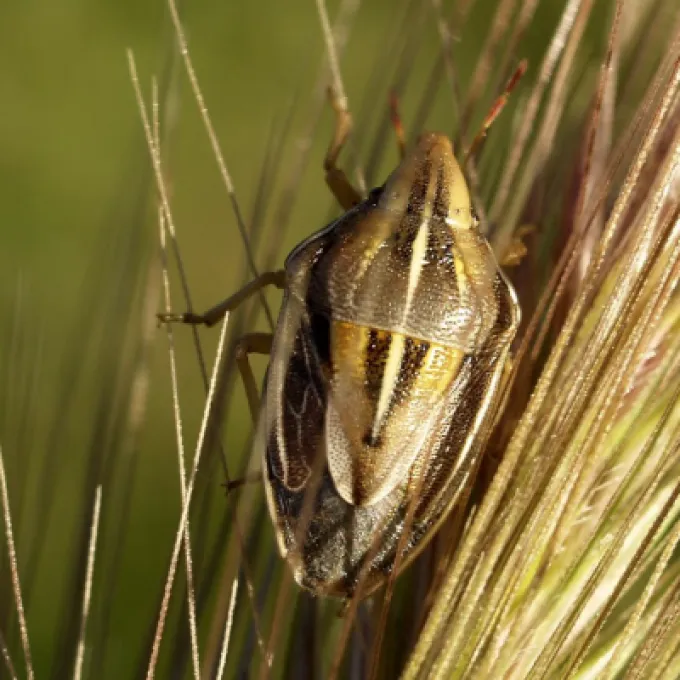
Description
How to identify
Aelia germari is a species of stink bug (family Scutelleridae) within the order Hemiptera. These insects are closely related to the notorious sunn pest, sharing similar morphological traits.
The adult bug typically exhibits an elongated body shape, ranging in color from pale yellow to light brown, often featuring darker longitudinal stripes that mimic dry cereal stalks.
The head is triangular in shape, and a diagnostic feature of the species is the structure of the pronotum, which possesses specific lateral projections that distinguish it from other Aelia species.
The life cycle consists of five nymphal instars. As the nymphs develop, they grow in size and gradually change color until they resemble the mature adult form.
The insect overwinters as an adult, typically seeking shelter under leaf litter, in hedgerows, or within dense crop residue where it remains dormant until spring.
What it damages
The primary hosts for Aelia germari include small cereal grains such as wheat, barley, and rye, which are heavily infested during the growing season.
The pest also utilizes various wild grasses as alternative food sources, allowing the population to survive when cultivated crops are not available.
The most significant damage occurs during the milky and soft dough stages of grain development, when the bug pierces the ear to extract nutrients.
Infestation leads to reduced grain yields, as the kernels become shriveled and thin, directly impacting the marketable weight of the harvested crop.
Beyond physical loss, the enzymes introduced by the bug's saliva degrade the gluten quality, rendering the grain unsuitable for commercial baking.
When it appears
Adults emerge from their overwintering sites in early spring as soon as average temperatures rise consistently above 10-12 degrees Celsius.
Upon emergence, the bugs initially settle on nearby weeds before migrating to cereal fields to feed and begin the mating and oviposition process.
Egg-laying usually coincides with the stem elongation and heading stages of winter and spring wheat, aligning the nymph's growth with the most susceptible grain phase.
The nymphal development phase lasts for several weeks during the summer months, with the next generation of adults appearing shortly before harvest.
After the harvest, adult bugs perform migration flights back to their overwintering grounds in preparation for the upcoming winter season.
Signs of infestation
The most prominent sign of an infestation is the presence of puncture marks on the stems beneath the ear, which causes the ears to turn white and die prematurely.
Farmers can identify egg masses, which are laid by the females in neat rows on the undersides of cereal leaves, signaling the need for immediate action.
Kernels affected by the bugs display dark, sunken spots where the feeding occurred, often surrounded by discolored tissue due to salivary enzyme activity.
An easy way to detect high population density is to shake the ears over a field sweep net; if nymphs are present, they will fall into the net.
Significant infestations often result in stunted plants and ears that fail to produce full, healthy grain, leading to severe economic losses in the field.
Control measures
Effective management begins with cultural practices, including timely harvest and post-harvest tillage to destroy crop residues and eliminate potential food sources.
Maintaining clean field borders by clearing weeds and brush can significantly reduce the number of favorable overwintering sites for the stink bug population.
Chemical control involving systemic or contact insecticides is the primary intervention method when population levels exceed established economic thresholds.
It is crucial to time insecticide applications carefully, targeting the younger nymphal stages when they are most vulnerable and before they cause permanent damage.
Monitoring field populations using sweep net counts allows for precise application of pesticides, ensuring both economic efficiency and minimal environmental impact.
Taxonomy
- Latin name
- Aelia germari
- Order
- Hemiptera (bugs, aphids, leafhoppers)
- Family
- Pentatomidae
- EPPO code
- AELIGE
Discussion
No discussions yet — be the first.