
Long-legged grasshopper
Acrotylus longipes
Description
How to identify
The long-legged grasshopper (Acrotylus longipes) belongs to the order Orthoptera and the family Acrididae. It is a highly specialized insect adapted to arid, sandy, and stony environments.
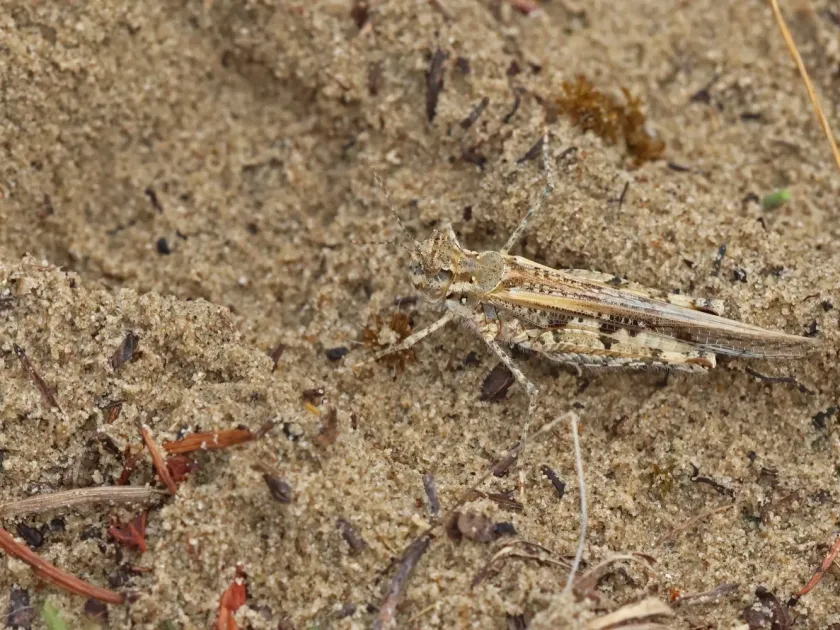
The adult insect has protective coloration, which allows it to camouflage perfectly with the soil, and long hind legs that enable powerful jumping capabilities.
Typically, adults measure between 15 and 22 mm in length. They possess large compound eyes, making them very alert and difficult to approach undetected.
The lifecycle follows a hemimetabolous pattern: egg, nymph, and adult. Females deposit eggs into the soil inside protective pods, which safeguard them against environmental extremes.
This species is known for its ecological resilience, thriving in hot climates and environments with sparse vegetation, which are common in steppe and semi-desert zones.
What it damages
The long-legged grasshopper is a polyphagous insect, meaning it feeds on a diverse array of plant species, including both wild grasses and various agricultural crops.
In agricultural settings, it can cause significant damage to cereals, legumes, and vegetable crops, particularly during the early seedling stages when plants are most fragile.
Mass outbreaks can lead to severe crop loss, as these insects can quickly consume large amounts of green leaf area, stunting plant growth significantly.
Beyond the destruction of vegetative parts, they may also damage reproductive organs such as flowers or developing grains, reducing the overall yield quality.
Feeding wounds created by these insects also serve as entry points for various pathogens, potentially leading to secondary fungal or bacterial infections in damaged crops.
When it appears
Activity levels are highly dependent on temperature and moisture availability, with the most active periods occurring during late spring and summer months.
Nymphs typically emerge in late spring, going through several molting stages to reach adulthood, requiring consistent access to food sources during this growth phase.
During the peak of summer, adult grasshoppers are highly mobile and will readily migrate to areas with more favorable conditions or better food availability.
Reproduction often peaks in mid-to-late summer, after which females lay eggs in the soil, which serve as the overwintering stage for the next year's generation.
Overwintering as eggs provides the species with a robust mechanism to withstand cold winters, ensuring that populations re-emerge as the weather warms up.
Signs of infestation
The first signs of infestation are ragged leaf edges and holes in leaves, which result from the insect's feeding behavior on the leaf tissue.
A quick inspection of the field can be done by observing sudden jumps of insects when walking through the crop, indicating their presence and distribution.
- Irregular feeding holes on leaves.
- Thinning of crop stands in specific patches.
- Presence of insect frass on the soil or leaves.
- Visible damage to the stems of young seedlings.
- Increased activity near the edges of fields or fallow land.
Early morning visual inspections of the lower plant canopy often reveal nymphs resting or feeding in the cooler, protected parts of the plants.
Control measures
Effective management begins with proper agrotechnical practices, such as deep plowing, which disturbs egg pods in the soil and reduces the emerging population.
Controlling weed growth along field borders and neighboring non-crop areas is essential, as these locations often serve as reservoirs for initial populations.
When infestation levels exceed the economic threshold, the application of registered insecticides is necessary to protect the crop from significant yield loss.
Consistent monitoring of field edges and hotspots allows for early detection, enabling targeted treatments rather than broad-spectrum spraying.
Biological control strategies, including the use of entomopathogenic fungi or protecting local predatory insects, offer sustainable alternatives for long-term population management.
Taxonomy
- Latin name
- Acrotylus longipes
- Order
- Orthoptera (locusts)
- Family
- Acrididae
- EPPO code
- ACOTLP
Discussion
No discussions yet — be the first.