
Acrida unguiculata
Acrida unguiculata
Description
How to identify
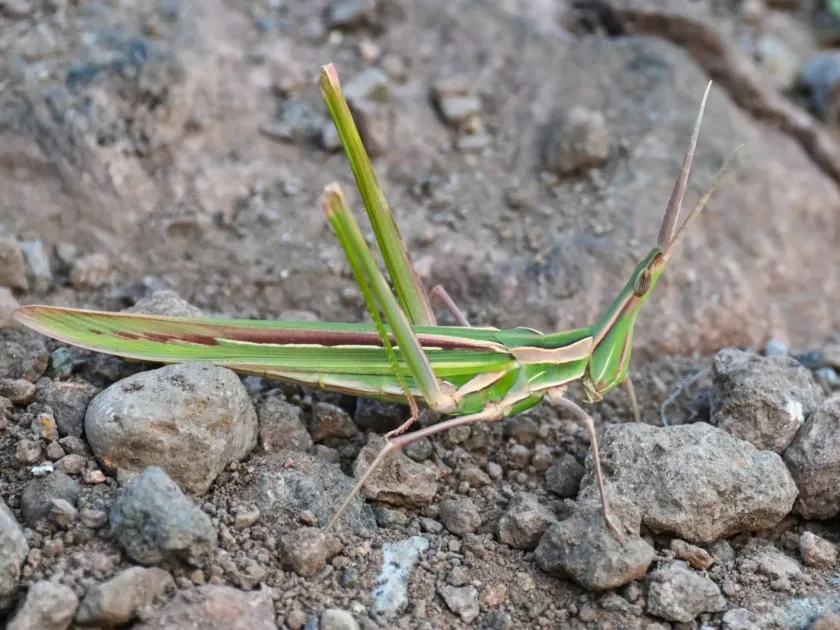
Acrida unguiculata, commonly known as the Oriental long-headed grasshopper, is a distinctive member of the family Acrididae. It is easily identified by its elongated body and pointed, tapering head.
The insect possesses a coloration ranging from vibrant green to dull brown, providing excellent camouflage against blades of grass and crop stems. Its hind legs are long and powerful, designed for long-distance jumping.
Adult specimens can reach lengths of 60 to 80 millimeters, with females being significantly larger than males. A key diagnostic feature is its ensiform (sword-shaped) antennae, which are thickened at the base.
Unlike some migratory locusts, this species does not typically form massive swarms; however, it can be a serious pest when local populations reach high densities in agricultural environments.
Nymphs resemble smaller, wingless versions of adults. They undergo several molting stages, gradually developing wings as they mature through the summer season.
What it damages
Acrida unguiculata is a polyphagous pest, meaning it feeds on a wide range of vegetation. It is particularly notorious for damaging cereal crops such as wheat, corn, millet, and rice.
In addition to cereals, it frequently attacks vegetable crops, legumes like alfalfa, and various forage grasses. During drought conditions, these grasshoppers move from wild grasslands into managed fields.
The damage is caused by the voracious feeding of both nymphs and adults on the foliage. They chew leaves and stems, significantly reducing the plant's capacity to photosynthesize.
High population densities can lead to the defoliation of plants, leaving only the primary veins of leaves intact. This severely stunts growth and directly reduces the harvest yield and quality.
Wounds created by their feeding also act as entry points for bacterial and fungal pathogens, potentially leading to secondary infections that further weaken the crop stands.
When it appears
The life cycle of the long-headed grasshopper is strictly seasonal. The species overwinters in the egg stage, which are laid in the soil in protective clusters called egg pods.
Nymph emergence typically begins in late spring, around May or June, coinciding with soil warming and increased humidity, which are critical for successful hatching.
The nymphs go through five developmental stages (instars) over the summer months. During this time, they feed continuously and grow rapidly to prepare for the final transition to adulthood.
Adult activity peaks during the hot summer months of July and August. This is the period when they are most voracious and focus their energy on feeding and subsequent reproduction.
With the arrival of autumn and cooler temperatures, the reproductive phase concludes, and the adults die off, leaving the eggs in the soil to survive the winter and restart the cycle.
Signs of infestation
The most visible sign of infestation is irregular, notched feeding patterns along the edges of leaves. This mechanical damage is distinct from the necrotic spots caused by plant diseases.
During field inspections, one can observe insects jumping between plants when disturbed. When threatened, they often cling tightly to the stems, making them difficult to spot due to their mimicry.
Small, cylindrical fecal pellets found on the ground or leaves are a clear indicator of the presence and activity of the grasshoppers in the specific area.
In areas of high infestation, crops often show localized patches of stunted or shredded leaves. These spots often start near field edges and progress inward as the population spreads.
Extensive defoliation is noticeable when observing the field from a distance, where the plants may look thin or ragged compared to non-infested areas of the farm.
Control measures
Effective management begins with mechanical control. Deep plowing in the autumn helps destroy egg pods embedded in the top layer of the soil, significantly reducing the next season's population.
Maintaining clean field borders by removing weeds and wild grasses is essential, as these areas serve as primary habitats for egg-laying and early-stage nymph development.
Chemical control involving the targeted application of insecticides is recommended if monitoring indicates that population thresholds have been exceeded and damage is becoming economic.
Biological control, such as encouraging local predators (birds, spiders, and predatory insects), plays a vital role in maintaining the balance and suppressing grasshopper numbers.
- Regular monitoring using sweep nets to estimate population density.
- Applying insecticides to borders before the infestation spreads to the center of the field.
- Crop rotation to minimize the accumulation of soil-bound eggs in cereal-heavy regions.
Taxonomy
- Latin name
- Acrida unguiculata
- Order
- Orthoptera (locusts)
- Family
- Acrididae
- EPPO code
- ACRIVA
Discussion
No discussions yet — be the first.