
Acrida ungarica
Acrida ungarica
Description
How to identify
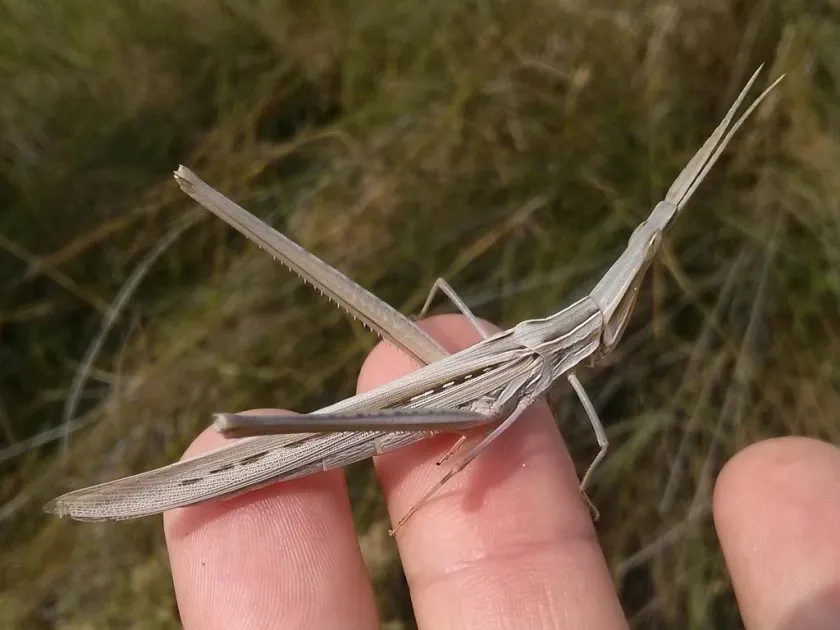
Acrida ungarica, commonly known as the cone-headed grasshopper, belongs to the family Acrididae, order Orthoptera. This insect is characterized by an elongated body and a pointed head, allowing it to blend perfectly into dry grasses and cereal stems.
Adults typically reach a length of 30 to 70 mm, with females being notably larger than males. Their coloration ranges from bright green to brownish-yellow, providing excellent camouflage against vegetation.
The pronotum of this species is narrow and shield-like, and the hind legs are powerful, adapted for sudden, strong leaps. Their well-developed wings enable them to travel significant distances in search of food sources.
Nymphs are smaller versions of the adults, undergoing gradual development through several instars. These immature stages look very similar to the mature form, with minimal morphological changes throughout their growth.
This species favors open habitats with low-growing vegetation, including steppes, meadows, dry pastures, and the edges of cultivated fields with well-drained soils.
What it damages
Acrida ungarica is a polyphagous pest, meaning it feeds on a wide range of plant species. In agroecosystems, it causes significant damage to cereal crops.
The pest consumes leaves, stems, and reproductive parts of cultivated plants, reducing overall vegetative mass. This consumption leads to stunted plant growth and a significant decrease in final yields.
Acrida poses a major threat to young seedlings during their rapid growth phase, when the succulent tissues become the primary food source for localized insect populations.
Beyond direct defoliation, the structural damage to stems facilitates the entry of various plant pathogens, further compromising the plant's natural immune system and health.
Although this species may not form massive migratory swarms like the desert locust, high population densities in localized areas can quickly devastate entire field sections.
When it appears
The lifecycle of Acrida ungarica is strictly linked to temperature. The insect overwinters in the egg stage, with eggs laid by females in the soil during late summer or early autumn.
Nymph hatching occurs in the spring, triggered once soil temperatures at the depth of the egg pod reach optimal thresholds for completing embryonic development.
Peak feeding activity for adults occurs in mid-to-late summer, as they prioritize nutrient intake to support the subsequent reproductive cycle.
There is one generation per year. Their activity is confined to the warm season, and adults typically perish with the arrival of the first significant autumn frosts.
Development speed is heavily influenced by regional weather patterns: humid summers can delay development, whereas hot and arid conditions often accelerate metabolism and increase feeding intensity.
Signs of infestation
The primary sign of Acrida ungarica presence is the appearance of jagged, uneven leaf edges on cereal plants, which appear as though they have been crudely eaten.
In fields, a clear indicator of a high population is the mass scattering of grasshoppers as they jump when disturbed by agricultural machinery or human movement.
The discovery of small, pellet-shaped frass (excrement) on leaf surfaces and in field rows is another reliable indicator of recent feeding activity by Orthoptera.
In cases of heavy infestation, distinct patches of depleted plants become visible, where foliage is stripped down to the veins and stalks, indicating intense localized grazing.
Regular visual monitoring of field margins, particularly those adjacent to fallow or uncultivated lands, is essential for detecting the early stages of pest migration into the crop.
Control measures
A fundamental control measure is timely agronomic practice, including deep autumn plowing to disturb the soil and destroy egg pods before they reach hatching stage.
Maintaining clean field borders by removing weeds and tall grasses is highly recommended, as these areas serve as vital refuges and food sources for the pests early in the season.
Chemical control involves the application of contact-stomach insecticides once the economic injury threshold is exceeded, typically defined as 2-5 individuals per square meter.
Applications should be timed for early morning or late evening when the insects are less active, which increases treatment efficacy and minimizes risks to beneficial pollinators.
Biological control agents, such as formulations containing entomopathogenic fungi or bacteria, can be effective against early nymphal stages, providing an environmentally sustainable approach to population management.
Taxonomy
- Latin name
- Acrida ungarica
- Order
- Orthoptera (locusts)
- Family
- Acrididae
- EPPO code
- ACRIHU
Discussion
No discussions yet — be the first.