
Parent bug
Acanthosoma
Description
How to identify
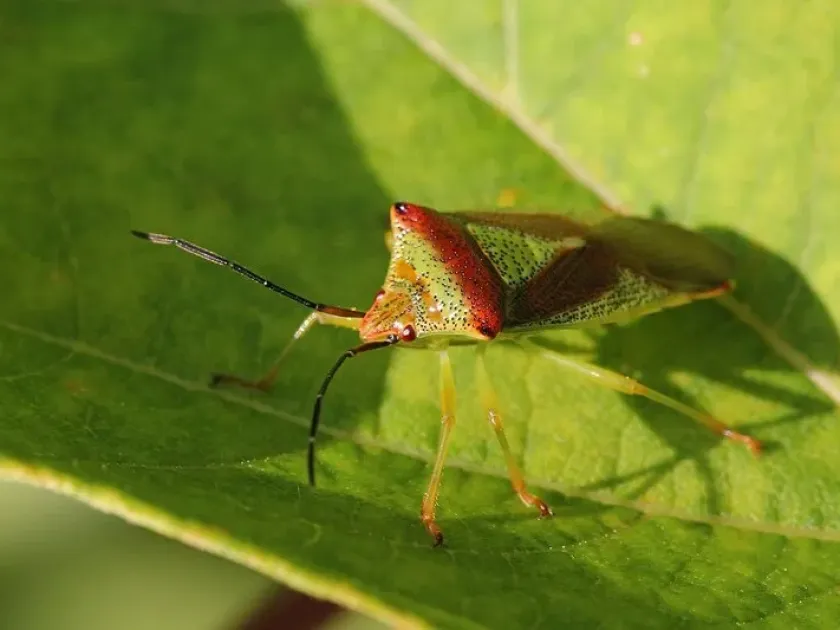
The parent bug (Acanthosoma haemorrhoidale) belongs to the family Acanthosomatidae, within the order Hemiptera. Adults typically measure between 12 and 17 mm in length and feature a distinct elongated body with prominent lateral pronotal angles.
Their coloration ranges from bright green to reddish-brown, allowing for effective camouflage among foliage. A key diagnostic feature of this species is the presence of a long, sharp spine on the underside of the thorax.
The eggs are barrel-shaped and are usually deposited in clusters on the underside of leaves. Nymphs closely resemble adults in appearance but are smaller and lack fully developed wing structures.
During their growth, the nymphs progress through five instars, gradually increasing in size and changing in pigmentation. Adult bugs are capable of strong flight, which facilitates their movement across orchards.
The life cycle is generally univoltine, meaning one generation per year, though warmer climates may occasionally support a partial second generation.
What it damages
This pest primarily attacks fruit and berry crops, including apple, pear, hawthorn, and rowan. The bug feeds on plant sap by piercing young shoots and developing fruits with its proboscis.
Fruit damage manifests as depressions, necrotic spots, and premature fruit drop. Feeding on young shoots can lead to stunted growth and significant deformation of the branch tips.
Beyond mechanical injury, the bugs introduce toxic enzymes into the plant tissue, which degrade quality and taste. These puncture wounds also serve as entry points for secondary fungal and bacterial pathogens.
In high-density populations, the overall yield can be significantly reduced due to the cumulative effect of fruit deformity and early abscission. Commercial value is severely impacted by the unsightly appearance of damaged fruit.
Monitoring for signs of damage is essential, particularly during the critical stages of fruit formation and ripening in early summer.
When it appears
Adult bugs overwinter in sheltered locations, such as leaf litter, bark crevices, or under debris. Emergence occurs in early spring as temperatures begin to rise consistently.
The peak feeding and mating period typically coincides with the flowering and fruit setting stages of host plants. Egg-laying usually occurs throughout late spring and early summer.
The nymphal stage is active throughout the summer months as they feed on sap to store nutrients. By autumn, the new generation of adults reaches maturity and prepares for overwintering.
Migration to hibernation sites is triggered by cooling temperatures in late autumn. Environmental conditions, especially humidity and warmth, strongly dictate the success and timing of the life cycle.
A deep understanding of these seasonal patterns allows growers to implement timely management strategies that mitigate potential losses.
Signs of infestation
Initial signs of an infestation include small, darkened punctures on the skin of fruits, often leading to spongy or discolored tissue underneath. This is a tell-tale sign of adult feeding activity.
Leaves may exhibit chlorosis, yellowing, or leaf curling due to constant sap extraction by large numbers of nymphs. Small spots of excrement on the foliage are common indications of bug presence.
In early summer, finding egg clusters on the underside of leaves confirms the presence of a breeding population. Detecting adult bugs on the branches during evening inspections is also possible.
The species produces a distinctive, pungent odor when disturbed, which can often be detected by growers in the immediate vicinity. Increased activity of adult bugs between trees is common during warm, still days.
Deformed terminal shoots, which appear stunted or twisted, serve as a long-term indicator of persistent pest pressure on a host plant.
Control measures
Cultural control involves thorough garden maintenance, including the removal of leaf litter and debris where adults hibernate. Maintaining clear zones around tree trunks reduces suitable overwintering habitats.
Biological controls are highly recommended, as the bug is susceptible to natural enemies such as parasitoid wasps and various bird species. Preserving a diverse ecosystem encourages these natural predators.
Chemical control should only be implemented when pest density exceeds economic damage thresholds. If required, contact-action insecticides approved for fruit crops can be utilized.
To avoid harming beneficial insects, applications should be avoided during the peak flowering stage. Rotating insecticide groups is crucial for long-term resistance management.
- Fall cultivation of soil in the orchard.
- Manual removal of egg clusters and nymphs on small crops.
- Usage of light traps to monitor and catch adult bugs.
Taxonomy
- Latin name
- Acanthosoma
- Order
- Hemiptera (bugs, aphids, leafhoppers)
- Family
- Acanthosomatidae
- EPPO code
- ACHMSP
Discussion
No discussions yet — be the first.