

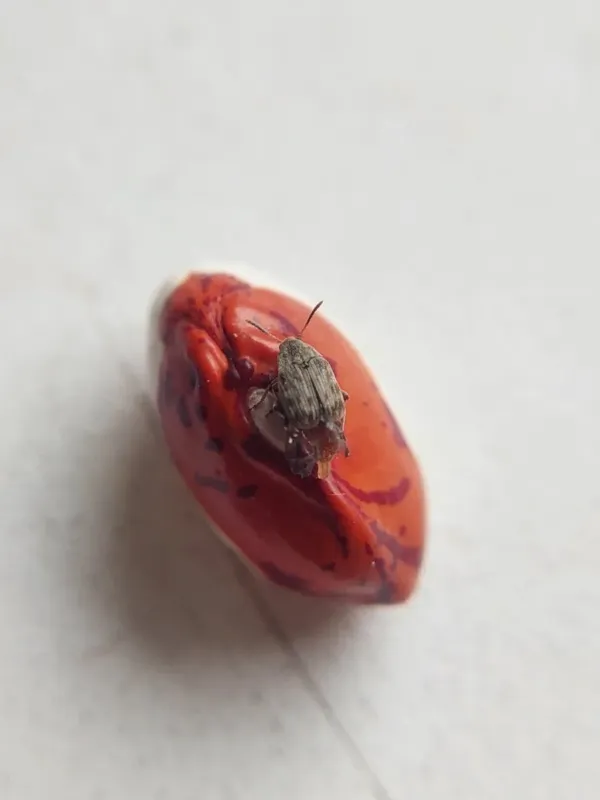
Description
How to identify
The bean weevil (Acanthoscelides obtectus) is a notorious member of the beetle family Bruchidae. Adults are small, measuring about 3-4 mm in length, and have an oval body shape densely covered with brown and gray hairs, giving them a mottled appearance.
The larvae are white, C-shaped, and legless in their later stages, specifically adapted to live within the tight confines of a bean seed. They have strong mouthparts designed to bore through the hard outer coat of pulses.
Eggs are oval-shaped, translucent, and extremely small. Females deposit them either on the surface of ripening pods in the field or directly onto stored beans in a warehouse setting.
The life cycle of the bean weevil is highly plastic and temperature-dependent. In optimal conditions, such as temperatures between 25°C and 30°C, the entire developmental cycle can be completed in just one month.
This pest is highly adaptable and can continue its reproduction cycles throughout the year inside heated storage areas, making it a critical threat to food security in pulse-producing regions.
What it damages
The primary host for this pest is the common bean (Phaseolus vulgaris). However, the weevil is known to infest various other legumes, including chickpeas, lentils, peas, and cowpeas.
Larval feeding causes extensive internal damage to the seed. As they consume the starch and protein, they leave behind only the thin seed coat, effectively destroying the nutritional value of the product.
Seed germination is severely compromised because the larvae often consume the embryo of the bean. Consequently, an infested batch is entirely unsuitable for use as seed material for the next planting season.
Weight loss in stored beans can be significant, often reaching up to 30-50% in heavily infested batches. This renders the crop economically non-viable for market sale.
Secondary issues frequently arise due to the pests' presence, including the accumulation of fecal matter, debris, and the subsequent growth of fungi or molds due to moisture changes within the bean pile.
When it appears
In the field, bean weevils migrate to crops during the maturation phase when pods begin to dry and crack. This usually occurs in late summer, aligning with the end of the growth period.
Post-harvest, the weevils are transported directly into storage facilities along with the contaminated seeds. This is when the population explosion often occurs, as the environment becomes stabilized.
In temperate climates, the weevil completes fewer generations per year in the field, but inside warehouses, the cycle remains constant if temperatures are kept above 15°C.
Winter survival is highly successful for this species if the storage areas are insulated or heated, as they require temperatures above 10°C for active metabolic processes and development.
In cold, unheated storage, the weevil's activity is significantly reduced, though adults can survive for a duration by entering a period of diapause until environmental conditions improve.
Signs of infestation
The most distinct sign of infestation is the appearance of small, perfectly circular emergence holes, approximately 1-2 mm in diameter, on the surface of the beans.
Before the adult emerges, one might observe small, translucent circular patches on the seed coat. These are called window panes, which are the thin layers of skin left over the exit hole.
During a heavy infestation, you may notice a layer of fine, grayish, powdery dust at the bottom of storage bags or bins, which is composed of larval excrement and fine seed debris.
- Circular holes on the seed surface.
- Transparent window-like patches on the bean coat.
- Presence of live beetles crawling on the surface of stored seeds.
- A stale or musty odor coming from the storage container.
- Significant decrease in the weight of the bean batch.
When cutting open an infested seed, you will find larval chambers containing larvae, pupae, or fully developed adults waiting to emerge.
Control measures
Early harvesting is the most effective cultural method to prevent initial field infestation. Gathering the beans before the pods dry and crack on the plant prevents the female from laying eggs.
Proper post-harvest drying is crucial. Reducing the seed moisture content to below 13% inhibits the larvae's ability to thrive and slows down the reproductive rate of the beetles.
Sanitation of storage facilities is essential. Thoroughly cleaning out old debris and residual seeds from silos or pantry shelves removes potential breeding grounds for the next generation.
For household storage, the most reliable methods are freezing the seeds at -15°C for at least 72 hours or heating them at 60°C for one hour to kill all developmental stages.
In commercial operations, professional fumigation using authorized chemicals is standard practice to treat large stockpiles and ensure the total elimination of the pest population.
Content graph
Connections · Bean weevil
Most often together:
Marketplace
Products · 3


Biology
Taxonomy
- Latin name
- Acanthoscelides obtectus
- Order
- Coleoptera (beetles)
- Family
- Chrysomelidae
- EPPO code
- ACANOB
Community
Discussion
No discussions yet — be the first.