
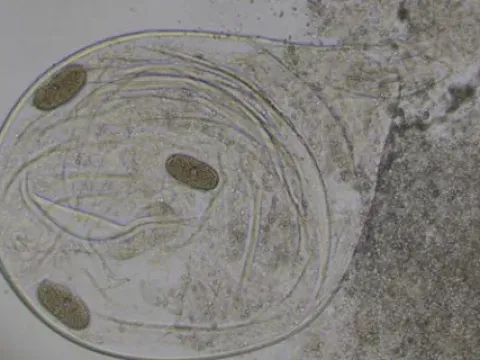
Barley root-knot nematode
Meloidogyne naasi
The barley root-knot nematode (Meloidogyne naasi) is a plant-parasitic nematode that belongs to the genus Meloidogyne, known for causing significant damage to cereal crops worldwide.
What the section contains
Barley root-knot nematode
These organisms are sedentary endoparasites, meaning the female spends most of her life cycle protected inside the host plant's root tissue.
The second-stage juveniles (J2) are the infectious forms of the nematode that migrate through the soil and penetrate the root tips of susceptible cereal species.
Taxonomically, they are classified as obligate biotrophic pathogens, meaning they require living host tissue to feed and reproduce, completing their cycle through a series of larval stages.
Microscopic analysis of soil and root samples is necessary for identification, as the characteristic root galls are the primary evidence of their presence in the field.
The primary hosts of this nematode are cereals such as barley, wheat, and rye, although certain grasses can also act as reservoir hosts for the pathogen.
The nematode feeds on the root vascular tissue, inducing the formation of galls, which disrupts the uptake and translocation of essential nutrients and water.
Significant economic losses occur because infected plants exhibit stunted growth, reduced tillering, and an overall decrease in grain quality and yield quantity.
The damage is particularly noticeable in fields with poor drainage or heavy clay soils, which favor the movement and survival of the nematodes.
Beyond direct damage, the nematode-induced root lesions provide entry points for secondary fungal pathogens, further compromising plant health and vitality.
Field signs of infestation often appear as irregular patches of chlorotic, stunted plants that are significantly smaller than the surrounding healthy crop.
The root system is the key diagnostic area; it typically displays small, localized galls that create a knotted, irregular appearance on the roots.
During the vegetative growth phase, affected plants struggle to thrive and may show premature wilting during dry periods due to impaired root function.
Lower biomass in the root system is a constant indicator of severe infestation, limiting the plant's ability to anchor effectively in the soil.
In addition to root malformations, the overall vitality of the crop is reduced, leading to thinning of the stand and increased vulnerability to environmental stress.
Crop rotation is the most effective management strategy; planting non-host crops like legumes or oilseeds for several years can significantly reduce the soil nematode population.
Good soil management, including effective drainage and optimal tillage, helps minimize the environmental conditions that favor the spread of the nematode.
Sanitation practices are essential; cleaning agricultural equipment between fields prevents the spread of infested soil containing nematode eggs and larvae.
Breeding and selecting nematode-resistant crop varieties remains the preferred long-term solution for farmers in regions where the pest is established.
Chemical control via nematicides is rarely practical for large-scale cereal production due to high costs and potential environmental impact, making integrated pest management (IPM) vital.