
Verticillium wilt
Verticillium
Description
How to identify
The causative agent of Verticillium wilt belongs to the kingdom Fungi, specifically the genus Verticillium. These are soil-borne, imperfect fungi that survive in the soil for many years as microsclerotia. The most significant species causing widespread agricultural issues are Verticillium dahliae and Verticillium albo-atrum.
The pathogen enters plants primarily through the root system, often via microscopic wounds or damage caused by soil pests. Once it invades the vascular system (xylem), the fungus proliferates, obstructing the upward flow of water and essential nutrients.
Microsclerotia are highly resilient survival structures. They can endure extreme environmental stresses, including freezing temperatures and prolonged periods of drought, remaining dormant in the soil until a susceptible host root grows nearby.
As the fungus colonizes the xylem, it secretes toxins that spread throughout the plant tissue. These toxins, combined with the physical obstruction caused by fungal hyphae and spores, lead to systemic symptoms and, ultimately, the decline of the plant.
The pathogen is highly versatile and capable of infecting hundreds of different plant species. This broad host range makes it a persistent challenge in diverse cropping systems, as the fungus can cycle through various weeds and crops.
What it damages
Verticillium wilt causes significant damage to a wide range of economically important crops, including potatoes, tomatoes, eggplants, strawberries, and various fruit trees like stone fruits. It is responsible for substantial yield losses worldwide.
In fruit trees, the disease can manifest as a chronic condition leading to limb dieback. Over time, affected trees become unproductive and may eventually succumb to the infection, resulting in the need to remove and replace entire orchard sections.
Vegetable crops often show rapid wilting, especially during the fruit-set stage, which leads to immediate loss of the harvest. The fruit produced on infected plants is often undersized, of poor quality, and unmarketable.
In addition to direct yield loss, the presence of Verticillium in the soil limits future land use. Once the pathogen is established in a field, growers are often forced to avoid planting susceptible crops for several years to reduce the inoculum load.
The cumulative damage includes the loss of plant vigor, reduced growth rates, and increased susceptibility to other biotic and abiotic stresses. In intense agricultural production, this disease acts as a limiting factor for yield maximization.
When it appears
The disease thrives in temperate conditions, with optimal development occurring between 20°C and 25°C. Symptoms usually become most evident during the warmer months of the growing season when plants are under high transpiration demand.
In the soil, the pathogen persists year-round in its dormant state. Infection can occur throughout the growing season whenever soil moisture is sufficient to trigger the germination of microsclerotia near the host roots.
High soil moisture promotes the infection process, while drought conditions aggravate the symptoms in plants that are already infected. The inability of the impaired vascular system to supply water during hot, dry spells results in rapid wilting.
In greenhouse settings, where environmental conditions are optimized for crop growth, Verticillium can develop year-round. This creates a persistent infection risk, necessitating strict hygiene and sanitation protocols.
At the end of the season, as plant tissues senesce, the fungus produces new microsclerotia. These structures are returned to the soil with crop debris, completing the life cycle and preparing the soil for the next season's infection cycle.
Signs of infestation
The initial symptom of Verticillium wilt is typically the yellowing or chlorosis of lower leaves. This yellowing often takes on a characteristic V-shape, starting at the leaf margins and progressing inward, followed by necrosis.
A hallmark sign is unilateral wilting, where one side of a leaf, branch, or even the entire plant wilts while the other remains temporarily healthy. This is a direct consequence of the localized vascular blockage by the fungal infection.
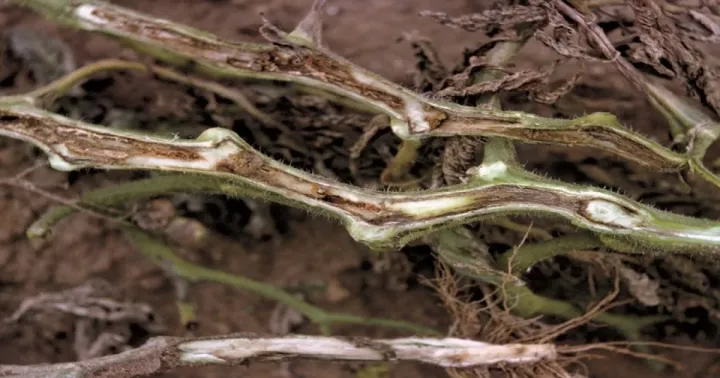
A cross-section of the stem or root reveals dark, brownish discoloration of the vascular tissue. This discoloration indicates the presence of the fungus within the xylem vessels and is a key diagnostic feature for field identification.
Plants often exhibit stunted growth and loss of vigor. Although wilting may be reversible in the early stages during cool nights, the plant will eventually lose the ability to recover, leading to irreversible death of branches or the whole plant.
- V-shaped yellowing of leaves followed by necrosis.
- Brown discoloration of vascular bundles in stem cross-sections.
- Daytime wilting with partial recovery at night during early stages.
- Stunted plant growth and reduced vigor.
- Premature leaf drop and branch dieback.
Control measures
Crop rotation is the most critical management strategy. It is recommended to avoid planting susceptible crops in the same field for at least 4 to 5 years, utilizing non-host crops like cereals to break the infection cycle.
Selecting and planting resistant or tolerant varieties is the most effective approach for large-scale operations. Genetic resistance helps maintain productivity even in the presence of soil-borne inoculum.
Strict field sanitation is essential. All infected plant debris should be removed from the field and destroyed by burning or deep burial to minimize the buildup of microsclerotia in the soil.
Good agricultural practices, such as maintaining optimal irrigation and controlling soil-dwelling pests like nematodes, can reduce the frequency of infection. Healthy root systems are more resilient to initial fungal colonization.
While some fungicides are available, their efficacy against established vascular infections is limited. Therefore, management must focus on prevention, sanitation, and the use of resistant cultivars rather than curative chemical treatments.
Causes diseases · 1
Discussion
No discussions yet — be the first.