
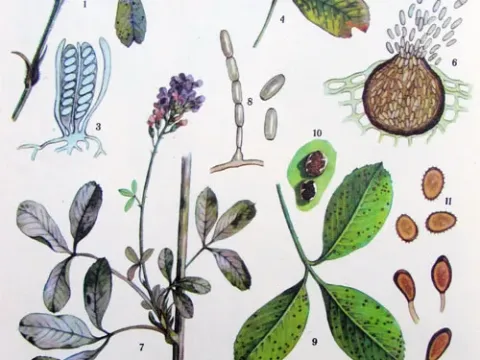
Alfalfa rust
Uromyces striatus
Alfalfa rust is caused by the fungus Uromyces striatus, classified under the phylum Basidiomycota. This obligate parasite depends entirely on living alfalfa tissue to complete its complex biological cycle.
What the section contains
Alfalfa rust
The pathogen is heteroecious, meaning it requires two different hosts to complete its life cycle. It alternates between alfalfa as the primary host and various Euphorbia species (spurge) as the intermediate host.
The fungus colonizes the internal tissues of the plant, developing a vegetative mycelium that extracts nutrients through structures known as haustoria.
Reproduction involves several spore stages, including urediniospores that allow for rapid cycles of infection during the growing season and teliospores designed for survival.
Because it is a highly specialized pathogen, its presence significantly alters the host plant's metabolism, focusing energy on fungal growth rather than biomass production.
The primary damage occurs on leaves, although the fungus can also affect petioles and stems. This physical colonization disrupts the photosynthetic capacity of the alfalfa foliage.
As the infection progresses, the plant experiences accelerated leaf senescence and premature drop, which directly translates into significant reductions in total dry matter yield per hectare.
Beyond quantity, the quality of the forage is severely compromised. The rust infection reduces protein content and digestibility, making the resulting hay less valuable for livestock.
Repeated rust outbreaks stress the plant crown and root system, reducing the plant's overwintering ability and overall stand longevity, leading to premature field thinning.
Seed production fields are especially vulnerable, as the pathogen diverts nutrients away from reproductive development, resulting in lighter seeds and poorer germination rates.
The disease typically emerges during the summer months when environmental conditions favor fungal activity. Warm temperatures and high humidity are the primary triggers.
Frequent rain events or heavy dews are essential for the germination of urediniospores, allowing the fungus to spread efficiently through the dense alfalfa canopy.
Epidemics usually peak in the mid-to-late summer when the environmental conditions remain consistently favorable, enabling multiple generations of the pathogen to develop.
The fungus can persist in the environment through teliospores on crop debris or, in warmer climates, by remaining as active mycelium in living plant tissue throughout the winter.
The severity of the disease is highly dependent on the microclimate within the field; lodged or dense canopies provide the perfect environment for rapid spore multiplication.
The most distinctive symptom is the appearance of small, reddish-brown pustules on the underside of the leaves. These pustules represent the eruption of urediniospores through the leaf epidermis.
When disturbed, these pustules release a characteristic rusty, powdery dust, which is a diagnostic feature of Uromyces striatus infections in the field.
As the season progresses and conditions become less favorable for the fungus, the pustules turn dark brown or nearly black, indicating the formation of teliospores.
Chlorotic yellow halos often appear around the pustules, eventually leading to tissue necrosis. This causes leaves to curl, wither, and drop prematurely from the plant stems.
In cases of severe infestation, the entire field can take on a brownish or "burnt" appearance, which is a clear indicator of heavy rust pressure across the forage stand.
The most effective strategy for managing alfalfa rust is the selection and planting of resistant or tolerant alfalfa varieties, which provide the best long-term protection.
Implementing a rigorous cutting schedule is essential. Harvesting the crop before the onset of heavy sporulation helps remove the fungal inoculum from the field.
Sanitation practices, including the removal or deep incorporation of infected crop residues, reduce the primary inoculum load available for the next growing season.
While chemical control is possible, fungicides are typically reserved for high-value seed production fields where the risk of significant yield loss justifies the treatment costs.
Managing weed hosts, particularly wild spurge species near the field borders, helps to break the disease cycle and minimizes the risk of early-season infection from the intermediate host.