
Northern Corn Leaf Blight
Trichometasphaeria turcica
Description
How to identify
Northern Corn Leaf Blight (NCLB) is caused by the fungus Setosphaeria turcica (teleomorph: Trichometasphaeria turcica, anamorph: Exserohilum turcicum). It is a member of the Ascomycota phylum.
The pathogen overwinters primarily in infested corn residues on the soil surface as mycelium, conidia, and chlamydospores, remaining viable for several seasons.
Primary infection starts when spores are splashed by rain or wind onto the lower leaves of young corn plants during periods of moderate temperatures.
The disease cycle is polycyclic; under favorable conditions of high humidity and temperatures between 20°C and 25°C, new spores are produced repeatedly.
Rapid spread is facilitated by wind dispersal of conidia, allowing the fungus to infect upper leaves and neighboring fields throughout the growing season.
What it damages
While corn is the primary host, the fungus can also infect sorghum, sudangrass, and several other grass species in agricultural ecosystems.
The disease affects all aerial parts of the plant, but foliage infection is the most critical factor reducing the plant's photosynthetic capacity.
Significant yield losses occur when the disease reaches the ear leaves before or during the silking stage, leading to reduced grain filling.
Stem infection, often resulting from systemic or severe leaf colonization, weakens the stalk, causing increased lodging and harvest difficulties.
In addition to quantitative losses, heavy infections can lead to poor grain quality, including lower test weight and increased susceptibility to secondary ear rots.
Signs of infestation
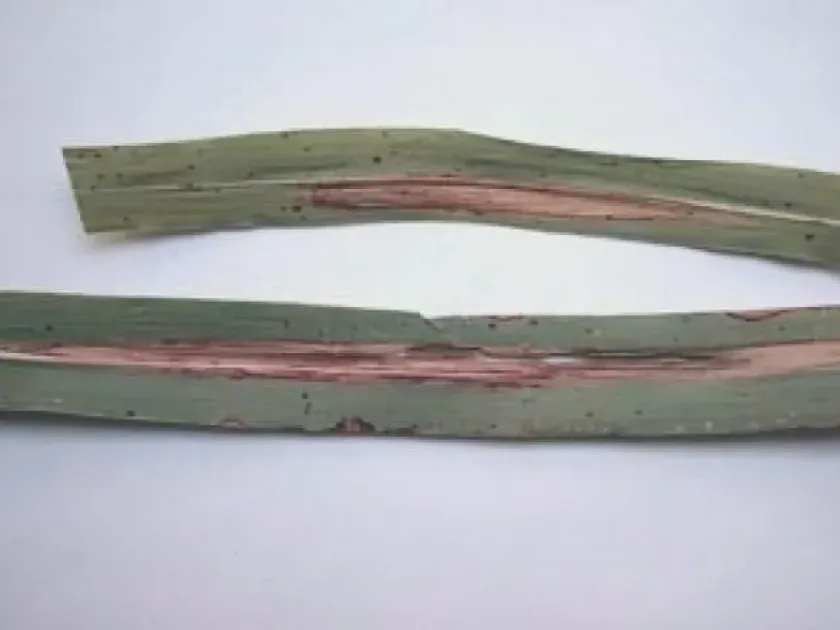
Symptoms appear as small, elliptical, water-soaked lesions on lower leaves, which eventually turn tan or grey as they mature.
The characteristic cigar-shaped lesions can grow up to several centimeters in length, often surrounded by a chlorotic halo or a dark necrotic margin.
Under humid conditions, the lesions exhibit a dark olive-grey or black velvety appearance, which represents the sporulation of the fungus.
In susceptible hybrids, lesions can merge and cover the entire leaf surface, causing the foliage to wither and die prematurely.
Rarely, lesions can be found on the leaf sheaths and husks, but leaf-level infection remains the primary indicator of the disease's severity.
Control measures
The primary and most effective strategy for NCLB management is the cultivation of resistant corn hybrids that express specific quantitative or qualitative resistance genes.
Cultural practices, such as deep tillage to bury crop residues and rotating fields to non-host crops, help to significantly reduce primary inoculum levels.
Fungicide applications are recommended when disease pressure is high, particularly when lesions appear on or above the ear leaf during early reproductive stages.
Integrated pest management (IPM) practices, including weed control and maintaining soil fertility, contribute to plant vigor and disease tolerance.
- Selecting NCLB-resistant or tolerant corn hybrids.
- Crop rotation to break the disease life cycle.
- Managing crop debris to minimize pathogen carryover.
- Timely fungicide sprays based on scouting and environmental conditions.
Causes diseases · 1
Discussion
No discussions yet — be the first.