
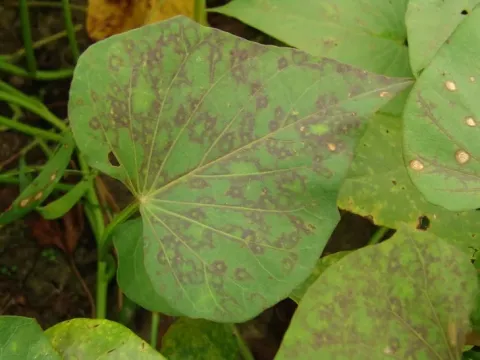
Sweet potato chlorotic fleck virus
Sweet potato
The Sweet potato chlorotic fleck virus (SPCFV) is a plant pathogen classified within the Potyvirus genus and the Potyviridae family. It is a single-stranded RNA virus that is widely distributed across regions where sweet potatoes are cultivated.
What the section contains
Sweet potato chlorotic fleck virus
The primary transmission mechanism for this virus is through insect vectors, specifically aphids (Aphididae family), which transmit the pathogen in a non-persistent or semi-persistent manner. It is also frequently disseminated through infected vegetative planting materials, including vines and roots.
As an obligate parasite, the virus relies entirely on the host plant's cellular machinery to replicate and spread. In the absence of living hosts, the virus survives in alternative wild weeds or asymptomatic carrier plants, making it difficult to eradicate completely.
In many field scenarios, SPCFV is found in mixed infections alongside other sweet potato viruses. These synergistic complexes often cause more severe symptoms and greater yield losses than individual viral infections would alone.
Diagnosis requires molecular techniques such as ELISA (Enzyme-Linked Immunosorbent Assay) or RT-PCR (Reverse Transcription Polymerase Chain Reaction) because visual inspection can be misleading due to symptom overlap with nutrient deficiencies or environmental stress.
The primary host for this virus is the sweet potato (Ipomoea batatas). The infection interferes with the plant’s ability to photosynthesize and translocate sugars to the tuberous roots, resulting in significant physiological disruption.
Economic damage is primarily driven by a substantial reduction in both the size and the total number of marketable storage roots. Infected crops can experience yield losses ranging from 20% to over 50%, significantly impacting farm profitability.
Early-season infection is particularly detrimental as it retards the overall development of the vine, leading to stunted plants that never reach their full productive potential by the time of harvest.
Quality degradation is another major issue, as roots from infected plants may be deformed, cracked, or possess poor internal characteristics, rendering them unsuitable for high-value commercial markets.
Additionally, infected plants exhibit increased vulnerability to environmental stressors, such as water shortages and heatwaves, which further suppresses growth and complicates successful farm management.
The most characteristic symptoms on sweet potato leaves include chlorotic flecks, mild mottling, and yellowing patterns along the leaf veins. In some cultivars, the leaf blades may also show slight twisting or distortion.
Chronic infections often result in a reduction of internode length, creating a stunted or bushy appearance. The plants may appear visibly less vigorous and smaller compared to healthy neighboring plants.
Symptom expression can be highly variable and depends on the specific cultivar’s susceptibility. Some varieties may act as asymptomatic carriers, showing little to no external damage while still harboring high viral titers.
It is important to distinguish these viral symptoms from those caused by fungal pathogens or environmental damage. Viral flecks typically do not show visible fungal structures or necrosis in the center of the spots.
Symptoms are usually most distinct during periods of rapid growth under favorable environmental conditions, which also happen to be optimal for aphid activity, thus highlighting the presence of the virus.
The cornerstone of managing SPCFV is the use of virus-indexed, pathogen-free planting material. Sourcing vines or cuttings derived from certified meristem-tip culture is the most effective way to prevent the virus from entering a field.
Effective management of aphid vector populations is critical. Regular application of suitable insecticides during peak insect flight periods can significantly reduce the secondary spread of the virus within the crop.
Phytosanitary practices, such as routine field inspections and the immediate roguing (removal and destruction) of symptomatic plants, help to lower the initial viral inoculum level in the field.
Implementing proper field spacing and isolation from older or abandoned sweet potato plots reduces the risk of cross-contamination. Furthermore, controlling weeds within the Convolvulaceae family is essential as these plants may serve as virus reservoirs.
- Use certified virus-free planting stock.
- Implement strict insect vector control programs.
- Perform timely roguing of infected plants.
- Maintain weed control to eliminate reservoir hosts.