
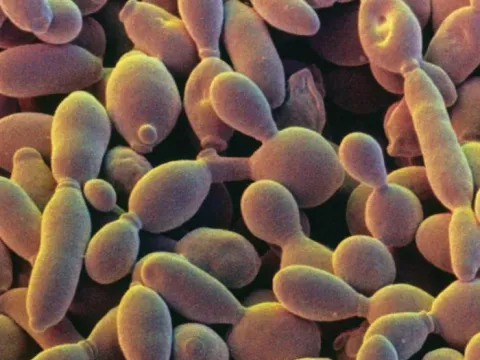
Baker's yeast
Saccharomyces cerevisiae
Saccharomyces cerevisiae belongs to the kingdom Fungi, phylum Ascomycota. While widely known in industrial food applications, this organism can act as a facultative parasite or epiphyte when environmental conditions facilitate the colonization of plant tissues.
What the section contains
Baker's yeast
Biologically, it consists of single-celled organisms that propagate via budding, allowing for rapid population growth in nutrient-rich environments, particularly on sugary fruit surfaces.
In agricultural settings, these yeasts are disseminated by rain splash, wind currents, and insect vectors, settling on leaves and developing fruits.
The organism is highly resilient, capable of surviving in dormant states within soil or on plant debris, which serves as a primary inoculum source for subsequent seasons.
Identification is typically achieved through culturing on specialized agar media supplemented with antibiotics, where it forms distinct, creamy, convex colonies.
The primary damage is inflicted upon fleshy fruits and berries, such as grapes, strawberries, and orchard fruits like apples, especially during the final stages of ripening when sugar content peaks.
Infection occurs primarily through micro-wounds in the cuticle caused by mechanical damage, weather events like hail, or previous pest activity, providing an entry point for yeast fermentation.
The metabolic activity of the yeast leads to the degradation of fruit tissue, significantly altering the chemical profile and physical structure, effectively turning the fruit into a substrate for fermentation.
Beyond direct damage, the colonization process creates a favorable microenvironment for secondary pathogens, such as Botrytis cinerea, leading to rapid, systemic rot.
In commercial operations, this results in significant post-harvest losses, reduced shelf life, and total rejection of affected batches due to loss of quality and odor.
Infection activity typically peaks during late summer and early autumn, aligning with the ripening phase of most fruit crops and the accumulation of soluble sugars in tissues.
High humidity and rainy weather during harvest periods are the most significant environmental drivers, as they facilitate the spread and colonization of yeast cells.
The optimal temperature range for development is between +20 and +30 degrees Celsius, although the organism shows high plasticity regarding thermal tolerance.
The frequency of outbreaks is often directly correlated with the presence of sucking pests that compromise the integrity of the fruit epidermis.
In greenhouse environments, the risk persists throughout the growing season, particularly if ventilation is inadequate, leading to surface condensation on fruits.
The first visual sign of infestation is the appearance of a wet, translucent spot on the fruit surface that expands rapidly.
A distinct, sharp fermentative odor is characteristic of this infection and can be identified long before extensive tissue collapse occurs.
Active infection often manifests as the release of gas bubbles and foamy liquid from fissures, a clear indicator of alcoholic fermentation occurring within the fruit.
Affected tissue quickly loses its structural integrity, becoming soft and mushy, and often showing signs of discoloration or surface film formation.
- Moist, spreading lesions on fruit skin.
- Strong smell of fermentation in the orchard or storage facility.
- Increased presence of fruit flies attracted by yeast-derived volatiles.
- Softening and structural decay of the internal fruit matrix.
The most effective management strategy focuses on maintaining the structural integrity of the fruit crop through diligent pest control to prevent physical damage to the skin.
Good agricultural practices during harvest, such as minimizing bruising and handling damage, are crucial to reducing the primary points of yeast entry.
Proper aeration and moisture management in post-harvest storage facilities are essential to suppress yeast cell division by preventing surface condensation.
Sanitation measures, including the prompt removal and destruction of fallen fruit and diseased plant material, help significantly lower the primary inoculum levels.
When necessary, the application of registered, orchard-approved fungicides can be utilized to protect high-value crops during susceptible ripening phases.