
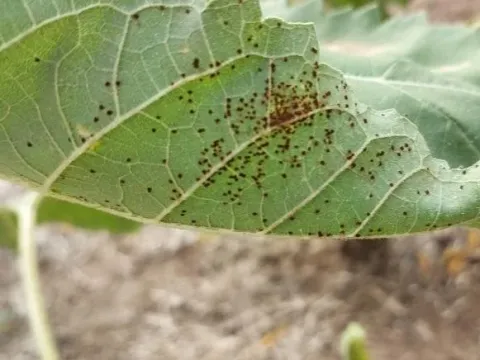
Sunflower rust
Puccinia helianthi
The causative agent of sunflower rust is the fungus Puccinia helianthi, which belongs to the Basidiomycota phylum. It is an obligate parasite, meaning it can only complete its life cycle on living host plant tissues.
What the section contains
Sunflower rust
The fungus is characterized by having five different spore stages, making it a highly resilient and adaptive pathogen. It is a macrocyclic rust that completes its entire life cycle on a single host, the sunflower plant.
The disease typically overwinters in the soil as teliospores on crop residues. When conditions become favorable in the spring, these spores germinate to initiate the infection cycle on emerging seedlings.
Secondary spread is driven by urediniospores, which can be dispersed over long distances by wind. Under favorable conditions, the fungus can produce multiple generations of spores within a single growing season, leading to widespread infection.
Environmental conditions are critical for development. Optimal infection occurs when temperatures are between 15°C and 25°C, combined with prolonged periods of leaf wetness or high relative humidity.
Sunflower rust affects all aerial parts of the plant, including leaves, petioles, and stems. The most noticeable damage occurs on the leaves, where the pathogen colonizes the tissue and interferes with normal metabolic processes.
By rupturing the epidermis to form pustules, the fungus causes significant water loss through transpiration. This weakens the plant and leads to premature leaf senescence, which cuts short the grain-filling period.
Photosynthesis is drastically reduced due to the destruction of chlorophyll-rich tissue. Consequently, the energy production required for seed development is severely compromised, resulting in lower yields and reduced oil content.
In cases of severe infestation, the impact on grain yield can range from 30% to over 50%. The plants may also become stunted and exhibit increased susceptibility to other pathogens, such as stalk rot.
The economic impact of the disease is significant, as it affects both the quantity and the quality of the harvest. Management of the crop becomes more difficult, and the structural integrity of the plant is weakened.
The primary and most effective strategy for managing sunflower rust is the cultivation of resistant or tolerant sunflower hybrids. Genetic resistance is the cornerstone of an integrated pest management program.
Cultural practices are essential, starting with a strict crop rotation cycle of at least 6-8 years. Proper burial of infested plant debris through deep tillage helps to reduce the primary inoculum load in the field.
Sanitation measures, including the eradication of volunteer sunflowers, are vital to break the infection cycle. Keeping surrounding areas free of sunflower debris prevents the pathogen from surviving between seasons.
Chemical control involving fungicides, such as triazoles or strobilurins, is recommended when early symptoms of rust are observed. Timely application is crucial to suppress the spread of spores to healthy tissue.
- Optimizing nitrogen fertilization to avoid lush, susceptible foliage growth.
- Regular field scouting during warm and humid weather conditions.
- Ensuring spatial separation between new sunflower fields and those used in previous years.