
Potato psyllid
Paratrioza cockerelli
Description
How to identify
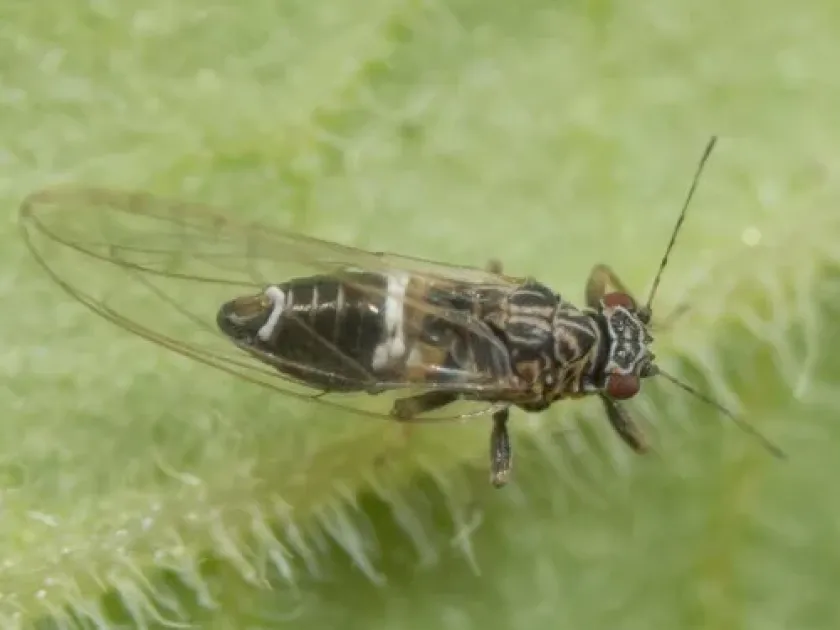
The potato psyllid (Bactericera cockerelli), also known as the tomato psyllid, is a small hemipteran insect belonging to the Triozidae family.
Adult psyllids are about 2-3 mm long and resemble miniature cicadas. They have dark bodies with characteristic white markings and transparent wings held tent-like over their abdomen.
The nymphs are flattened, oval, and pale green or yellow. They are relatively stationary during their feeding stage and often reside on the underside of leaves.
The life cycle consists of the egg stage, five nymphal instars, and the adult stage. Eggs are laid on slender stalks, which is a diagnostic feature used to identify infestations.
This insect is primarily recognized as a vector for the bacterium Candidatus Liberibacter solanacearum, the causal agent of significant diseases in solanaceous crops.
What it damages
Potato psyllids primarily attack plants in the Solanaceae family, including potatoes, tomatoes, peppers, eggplants, and several species of weeds.
Direct damage occurs when nymphs and adults suck sap from the phloem, causing general plant decline, stunting, and reduced fruit or tuber quality.
The insects inject toxic saliva into the plants, leading to a condition commonly referred to as "psyllid yellows," characterized by chlorosis and leaf curling.
The most severe damage is associated with the transmission of the bacterium that causes the "Zebra chip" disease, which renders potato tubers unmarketable.
Economic losses are devastating, as entire harvests can be discarded due to the internal browning caused by the pathogen transmitted by the feeding psyllids.
When it appears
The activity of the potato psyllid is heavily influenced by temperature, with moderate, dry conditions being ideal for rapid population growth.
Adults typically migrate to host plants in late spring and early summer, as temperatures consistently rise to levels suitable for their biological development.
The species can complete multiple generations in a single growing season, leading to sudden and explosive population spikes during mid-to-late summer.
Wind currents play a significant role in the dispersal of this pest, allowing it to move over vast geographical areas in relatively short periods.
Activity diminishes with the onset of cooler autumn temperatures, though the insects may survive on weed hosts or in greenhouses during the winter months.
Signs of infestation
Symptoms often begin as chlorosis (yellowing) at the leaf margins and tips, which may progress to a reddish or purple discoloration in some varieties.
Plants affected by the psyllid-induced toxins often exhibit shortened internodes and upright, curling foliage, giving them a bushy appearance.
The presence of sticky honeydew and white, waxy excretions on the underside of leaves is a clear indicator of nymphal feeding activity.
Zebra chip disease manifests as dark, necrotic lines or blotches in the vascular tissue of potato tubers, which become pronounced upon cooking.
In advanced stages, the roots may stop growing, and the entire plant may wither prematurely, resulting in significantly lower yields and poor tuber development.
Control measures
Effective management requires an integrated approach starting with strict monitoring using yellow sticky traps to detect the arrival of the first adults.
Sanitation is critical; growers must eliminate weeds that serve as reservoirs for the psyllid and the associated bacterium, especially wild solanaceous species.
Chemical control involving systemic insecticides is often necessary, but these must be rotated to manage the risk of insecticide resistance development.
Physical barriers like fine-mesh row covers can protect high-value crops from psyllid colonization during the peak migration periods in spring.
- Monitor crops regularly for the presence of eggs and nymphs.
- Use certified pest-free seed potatoes to prevent early season infections.
- Apply insecticides based on economic thresholds and expert guidance.
- Implement proper crop rotation cycles to disrupt the pest lifecycle.
Causes diseases · 1
Discussion
No discussions yet — be the first.