
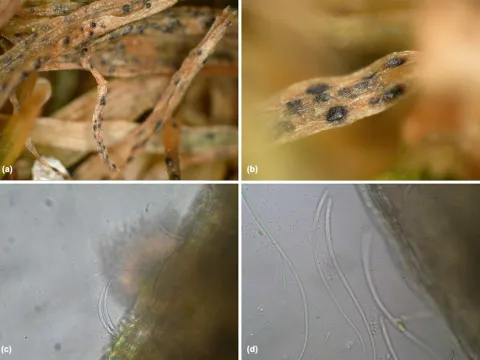
Microdochium sorghi
Microdochium sorghi
Microdochium sorghi is a fungal pathogen belonging to the order Hyphomycetes, responsible for causing anthracnose in sorghum. As a plant pathogen, it primarily infects various species of the Sorghum genus, leading to significant yield losses globally.
What the section contains
Microdochium sorghi
The fungus is characterized by the production of septate mycelium and the formation of sporodochia, which serve as structures for producing asexual spores known as conidia. These spores are essential for the rapid dissemination of the disease throughout a field.
Taxonomically, it is classified within the kingdom Fungi. Its ability to survive in soil debris allows it to persist between seasons, making it a challenging pathogen to eradicate once it is established in an agricultural environment.
Identification in the field involves observing characteristic leaf lesions, while laboratory confirmation requires microscopic examination of the curved, hyaline conidia. Culturing the fungus on specific media can further confirm the identification based on colonial morphology.
As a highly adaptable pathogen, Microdochium sorghi can evolve to overcome plant resistance, necessitating continuous monitoring and the use of integrated pest management practices by agronomists.
The host range of Microdochium sorghi includes grain sorghum, sweet sorghum, and forage types like sudangrass. The fungus can attack all parts of the plant, including leaves, stems, and the panicle, significantly reducing the plant's overall health.
The primary damage is caused by the disruption of photosynthetic surfaces, leading to reduced grain filling and weight. Infected crops often show poor development, resulting in a substantial decline in both quantity and quality of the final harvest.
Early infection during the seedling stage can lead to damping-off, which causes significant stand losses. This reduces plant population density and forces farmers to deal with empty patches in their fields, impacting the overall economy of production.
Stem infection is particularly dangerous as it compromises the structural integrity of the plant, often leading to lodging. Lodging creates major difficulties during mechanical harvesting and further increases crop loss due to grain being left in the field.
Beyond yield loss, the infection can degrade the nutritional value of the forage and grain. In severe cases, the presence of mycotoxins associated with secondary infections may render the harvest unsuitable for feed or industrial processing.
The development of Microdochium sorghi is highly dependent on environmental conditions, specifically high humidity and temperatures between +20°C and +28°C. These conditions favor the germination of spores and the subsequent infection of host tissues.
The disease cycle often initiates in the spring from infected crop residues left on the soil surface. Conidia are spread by wind-driven rain, splashes, and insect activity to the lower leaves of emerging sorghum seedlings.
Secondary cycles occur throughout the growing season whenever there is sufficient moisture from dew or rain. The speed of the disease cycle allows it to reach epidemic proportions rapidly if environmental conditions remain favorable for a sustained period.
The most critical window for infection is during the flowering and grain-filling stages. During this time, the panicle becomes highly susceptible to colonization, which directly correlates with the final yield loss observed at harvest.
As the season comes to an end, the fungus produces specialized survival structures within crop debris. These structures allow the pathogen to survive the winter and remain ready to infect the next season's crop, continuing the cycle.
Initial signs of anthracnose appear as small, circular to oval lesions that are typically reddish, brown, or purple in color. Over time, these spots expand, often developing a light-colored center surrounded by a dark, distinct border.
A diagnostic feature of this pathogen is the formation of small, black, cushion-like structures called sporodochia in the center of the lesions. Under humid conditions, these may be covered in a pinkish or greyish mass of spores.
When the stem is infected, dark, necrotic streaks develop, which can eventually girdle the stalk. This weakens the internal vascular system, leading to wilting and, eventually, premature drying or lodging of the plant.
Infected panicles show dark necrotic spots on the glumes and rachis. In severe cases, the entire panicle may become discolored and fail to produce viable grain, resulting in a 'blighted' appearance of the grain head.
Visual identification is often possible by noting the presence of these characteristic lesions and the associated black specks, which differentiate it from other foliar pathogens that might affect sorghum.
The most effective strategy for controlling Microdochium sorghi is the cultivation of resistant or tolerant sorghum hybrids. Breeding programs focus on enhancing the innate immunity of the crop against this specific fungal pathogen.
Crop rotation is fundamental to reducing the initial inoculum levels in the soil. Avoiding sorghum monoculture by rotating with non-host crops like legumes or small grains helps break the disease's life cycle.
Sanitation practices, such as deep plowing to bury crop residues, are essential to remove primary sources of infection. Minimizing surface residue helps accelerate the natural decay of the fungus, reducing the disease risk for the next planting.
Seed treatment with systemic fungicides is a standard procedure to protect young seedlings from early infection. This is especially critical in regions where environmental conditions during planting are cool and wet, which delay emergence.
Foliar fungicide applications during the growing season can be used when disease pressure is high. Timely application, according to economic thresholds and weather forecasts, is necessary to achieve effective protection and preserve yield.