
Northern corn leaf blight
Maize leaf
Description
How to identify
Northern corn leaf blight (NCLB) is caused by the fungal pathogen Bipolaris maydis (formerly known as Helminthosporium maydis). This fungus belongs to the class Dothideomycetes and is a significant pathogen that affects maize crops globally.
The pathogen reproduces by forming conidia on the surface of infected tissues. These conidia are easily dispersed by wind and rain splashes, allowing the disease to spread rapidly across fields and over large geographic areas.
The fungal cycle begins when conidia land on a suitable host leaf and, given sufficient humidity, germinate to form germ tubes. These tubes penetrate the leaf surface through stomata or directly through the cuticle.
Once inside the plant, the fungus grows intercellularly, producing toxins that degrade plant cells and eventually cause the characteristic necrotic lesions associated with the disease.
The fungus survives the winter primarily in infected corn residue left on the soil surface, acting as a primary source of inoculum for the next growing season.
What it damages
NCLB primarily affects the foliage, leading to a significant loss of photosynthetic leaf area. If the infection occurs early in the season, it can severely stunt plant growth.
The reduction in leaf area directly impairs the plant's ability to fill the kernels, resulting in lower grain weight, poorly filled ears, and reduced overall yield potential.
Severe infections can lead to premature plant death, which weakens the stalk and significantly increases the risk of lodging, making mechanical harvesting difficult and wasteful.
In addition to quantitative losses, kernel quality can be compromised, as the pathogen can invade the ear and create conditions favorable for ear rot and mycotoxin contamination.
Total yield losses can be substantial, often ranging from 10% to 50% under environmental conditions highly favorable to the pathogen, depending on hybrid resistance.
When it appears
The disease typically appears during mid-to-late summer, following periods of extended leaf wetness, high humidity, and moderate to warm temperatures (optimally between 20°C and 30°C).
Frequent rainfall and heavy dews during the pollination stage are critical triggers for the rapid spread and establishment of the blight within a corn field.
In dry seasons, the disease may develop slowly, remaining restricted to lower leaves and not causing significant economic impact unless conditions shift towards higher moisture.
The pathogen persists in the environment during the off-season, and the cycle repeats annually if the conditions are favorable and the host plant is present.
Monitoring the fields for initial symptoms during the vegetative and reproductive stages is essential for timely decision-making regarding potential management actions.
Signs of infestation
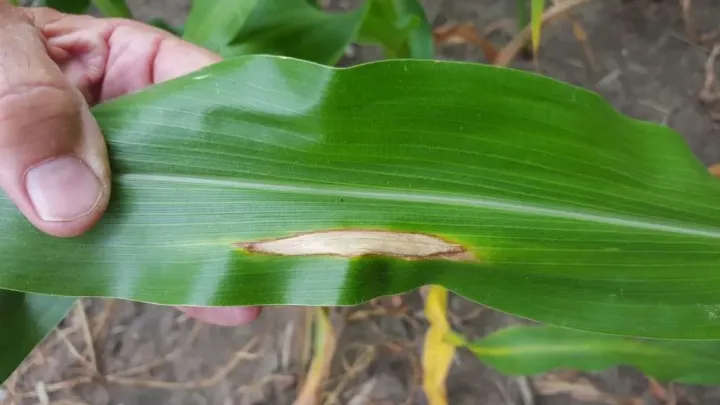
The characteristic symptoms of NCLB are elongated, cigar-shaped lesions that are typically tan or gray in color. These lesions appear initially on lower leaves and spread upwards.
As the disease progresses, the lesions grow larger, measuring several centimeters in length, and may merge, resulting in large areas of necrotic tissue that appear as if scorched.
Under humid conditions, the lesions produce an abundance of olive-gray to black spores, which give the necrotic spots a distinct velvety or fuzzy texture upon close inspection.
The lesions are often surrounded by a slightly darker border. Over time, the dead tissue becomes brittle and may tear in windy weather, leading to a ragged appearance of the leaves.
On susceptible hybrids, the blight can spread from the lower leaves to the ear leaves rapidly, significantly impacting the grain-filling process.
Control measures
Selecting and planting resistant or tolerant corn hybrids is the most cost-effective and essential strategy for long-term management of Northern corn leaf blight.
Crop rotation to non-host crops like soybeans or small grains helps break the disease cycle by allowing infected residues to decompose before the next corn crop is planted.
Tillage practices that incorporate crop residue into the soil accelerate the decomposition process and reduce the availability of primary inoculum for the following season.
Foliar fungicides, particularly those containing strobilurins and triazoles, are effective tools when applied during the VT (tasseling) or R1 (silking) stages if disease pressure is high.
Field scouting and integrated pest management (IPM) practices, including weed control and balanced nutrient management, help maintain plant vigor and reduce overall disease stress.
Causes diseases · 1
Discussion
No discussions yet — be the first.