
Late Blight
High
Description
How to identify
The causative agent of late blight is Phytophthora infestans, a water mold belonging to the Oomycetes class. Although it resembles fungi, it is phylogenetically closer to algae.
The pathogen reproduces through sporangia, which can act as zoospores when water is present, allowing them to swim and infect new plant tissues rapidly.
The disease cycle is highly dependent on environmental conditions, utilizing both asexual reproduction for rapid spread and sexual reproduction to ensure survival through oospores.
Phytophthora infestans is an obligate parasite, meaning it requires living host tissue to complete its life cycle and maintain its population levels.
The infection spreads through stomata or wounds in the plant, where the mycelium grows intercellularly, absorbing nutrients and causing localized cell death.
What it damages
Late blight is the most devastating disease affecting Solanaceae crops, primarily potatoes and tomatoes, often leading to total crop failure if left unmanaged.
In potatoes, the pathogen attacks leaves, stems, and tubers. Infected tubers stored in conditions that are not optimal will rot, spreading the disease to healthy tubers.
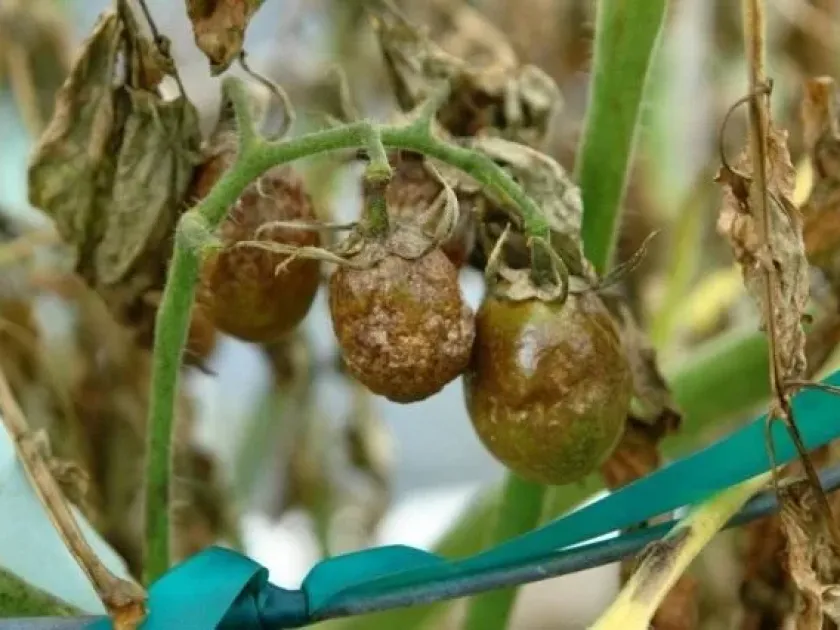
In tomatoes, the disease causes blighting of leaves and stems. Fruits develop dark, firm, sunken lesions, rendering them completely inedible and non-marketable.
The destruction of foliage significantly reduces the plant's ability to perform photosynthesis, leading to stunted growth and minimal tuber or fruit development.
Secondary infections by soft rot bacteria often follow late blight, resulting in complete degradation of infected plant material in the field or in storage facilities.
When it appears
The disease thrives during periods of cool, wet weather, typically occurring in late summer when temperatures range between 15°C and 22°C with high humidity.
Prolonged leaf wetness caused by fog, dew, or rain is essential for the germination of sporangia, triggering the development of new infection cycles.
Epidemics often initiate in localized areas with poor air circulation, such as densely planted fields, where moisture persists longer after precipitation.
The incubation period can be as short as three to five days under optimal humidity, leading to rapid spread throughout a crop in a matter of days.
As temperatures rise above 25°C or conditions become consistently dry, the rate of infection decreases, although the pathogen survives in cooler, shaded spots.
Signs of infestation
The first symptoms appear as small, dark, water-soaked spots on the leaves, which quickly enlarge into brown or black lesions with a yellowish halo.
During periods of high humidity, a characteristic white, fuzzy mycelial growth appears on the undersides of the leaves at the edges of the necrotic lesions.
Stem infections manifest as dark, elongated lesions that can girdle the stem, causing the entire plant or specific branches to wilt and collapse.
Tubers infected with late blight show dark, reddish-brown, dry, granular rot that extends into the inner tissue, often causing a rough, sunken appearance on the surface.
- Dark, water-soaked leaf spots.
- White, fuzzy growth on the underside of leaves.
- Dark lesions on stems and petioles.
- Firm, rusty-brown rot in potato tubers.
Control measures
Integrated disease management begins with planting healthy, certified seed potatoes and avoiding the proximity of potato and tomato crops to reduce cross-infection.
Agricultural practices such as hilling potatoes to protect tubers from surface-borne spores and ensuring proper plant spacing are crucial for disease prevention.
Regular monitoring of weather conditions allows for proactive fungicide applications using a combination of protectant and systemic products.
Systemic fungicides are vital during periods of active growth and high disease pressure to penetrate plant tissue and inhibit internal mycelial development.
Resistance management is achieved by alternating fungicides with different modes of action to ensure the pathogen does not develop immunity to specific chemical controls.
Causes diseases · 1
Discussion
No discussions yet — be the first.