
Helminthosporium root rot
Helminthosporium sativum
Description
How to identify
The causative agent of the disease is the imperfect fungus Bipolaris sorokiniana (synonym Helminthosporium sativum), belonging to the division Ascomycota. This phytopathogen is characterized by dark-colored multicellular conidia, which serve as the primary source of infection for plants in the field.
The fungus persists as conidia and mycelium on seeds, in the soil, and on crop residues for several years. During the growing season, it spreads actively via wind and rain splashes, infecting healthy plant tissues whenever free moisture is present on the surface.
What it damages
Helminthosporium root rot affects a wide range of crops, including wheat, barley, rye, oats, and many wild grasses. The disease manifests itself in all stages of plant development, from seed germination to grain maturity.
Young seedlings, roots, leaf blades, and the developing ear during the grain-filling stage are most susceptible to infection. The pathogen can colonize roots, the stem base, leaves, stems, and the kernels within the ear directly.
When it appears
Disease development occurs throughout the growing season, but infection peaks often coincide with periods of high humidity and moderate temperatures (from +15°C to +25°C). Heavy dew and frequent precipitation significantly accelerate the germination process of the fungal conidia.
Initial infection foci appear in early spring on seedlings, originating from contaminated seeds or crop residues. Secondary spread to actively growing plants continues throughout the summer under favorable weather conditions.
Signs of infestation
The symptoms of the disease are diverse and depend on the growth stage and the host plant species. Key signs include the following manifestations:
- Darkening and death of seedlings before emergence (pre-emergence damping-off).
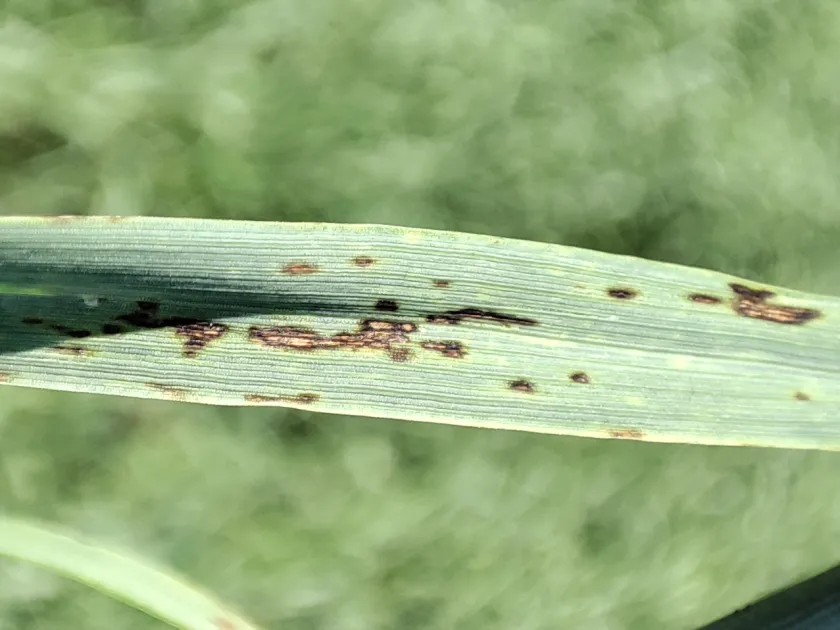
- Presence of dark brown or black lesions with a yellow halo on leaves, which can coalesce over time.
- Root rot accompanied by browning of the stem base and decay of the root system.
- Infection of the ear, manifesting as "black point" on the grain, which lowers grain quality and marketability.
Severe infection on the flag leaf leads to premature wilting of plants, disruption of photosynthetic processes, and a drastic reduction in thousand-kernel weight and overall crop yield.
Control measures
Effective protection requires an integrated approach combining agronomic, chemical, and breeding practices. The foundation of the strategy is the use of resistant varieties and high-quality, certified planting material.
Key control measures include: adherence to crop rotation, avoiding the return of cereals to the same field for at least 2-3 years, thorough incorporation of crop residues, and control of grass weeds.
Seed treatment with systemic and contact fungicides is a mandatory practice to disinfect planting material from both soil-borne and seed-borne infections. During the growing season, if disease pressure is high, foliar application of fungicides, particularly triazoles and strobilurins, is recommended.
Causes diseases · 1
Discussion
No discussions yet — be the first.