
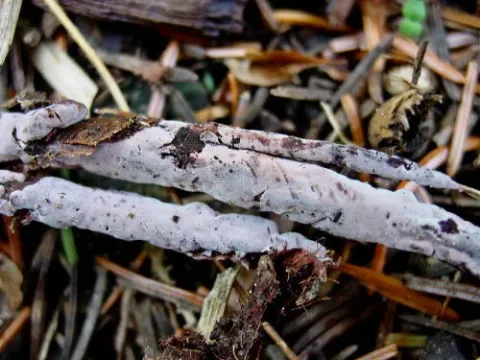
Helicobasidium
Helicobasidium
Helicobasidium purpureum is a pathogenic fungus belonging to the kingdom Fungi, order Septobasidiales. It is best known as the causal agent of violet root rot, a destructive soil-borne disease affecting a wide range of agricultural crops.
What the section contains
Helicobasidium
The fungus survives in the soil primarily through mycelium and sclerotia embedded in decaying plant residues. It thrives in high-moisture environments where it develops its characteristic purple fungal mat on host tissues.
It acts as a facultative parasite, meaning it can survive as a saprophyte on organic matter in the soil but readily attacks living roots when they come into contact with its hyphae.
Biological dispersal occurs via basidiospores produced under humid conditions, which can be distributed by water runoff or soil-dwelling pests across infested fields.
Its persistence in the soil makes it a significant challenge for growers, as the fungal structures can remain viable and infectious for several years without a host plant present.
This pathogen infests the roots of sugar beets, carrots, potatoes, alfalfa, and clovers. It causes severe damage to the vascular and root tissues, leading to reduced nutrient uptake and plant decline.
In root crops, the infection results in soft rot, which renders the produce unmarketable and causes significant yield losses during both the growing season and in storage.
Field-grown alfalfa and clover crops often show patchy areas of stunted or dead plants, which can spread progressively throughout the field if environmental conditions remain favorable for the fungus.
Young tree seedlings in nurseries are particularly vulnerable to Helicobasidium, often suffering from high mortality rates that lead to severe economic losses for commercial growers.
Secondary infections by soil bacteria often occur alongside the fungal rot, further complicating the diagnosis and speeding up the total decomposition of the affected plant material.
The development of the fungus is highly dependent on soil moisture and temperature. It is most active during periods of cool, wet weather, typically observed in early spring or late autumn.
During the summer months, dry soil conditions inhibit the surface activity of the pathogen, though it remains protected in deeper, more humid soil layers.
Symptoms of the disease usually become apparent to agronomists and farmers in the latter half of the growing season, when plants begin to manifest signs of water stress or nutrient deficiency.
If conditions are persistently wet throughout the season, the rate of infection can accelerate, leading to the rapid formation of large necrotic patches in a field.
The disease cycle can persist indefinitely in the field as long as susceptible weed hosts or crop residues are present to support the fungal survival during off-seasons.
The most distinctive symptom is the presence of a velvety, violet or reddish-brown fungal mat covering the surface of the root system or the base of the stem.
Above-ground, affected plants exhibit chlorosis (yellowing of leaves), premature wilting, and stunted growth. Leaves may temporarily recover at night but collapse permanently during the heat of the day.
The roots of infected plants show decay, becoming soft and discolored. In advanced stages, the internal tissue becomes spongy or turns into a mass of decayed, brownish-purple material.
The fungus often forms dense mycelial strands (rhizomorphs) that bridge the soil between plants, facilitating the spread of the disease to adjacent healthy individuals.
- Wilting and chlorosis of the canopy.
- Characteristic purple mycelial mat on roots.
- Softening and rotting of taproots or tubers.
- Patchy distribution of dying plants in the field.
Crop rotation is the most effective management strategy; fields known to be infested should be rotated away from susceptible crops for a period of at least 4 to 5 years.
Improving soil drainage is critical to reducing the moisture levels required by the fungus to spread. Proper field leveling and tile drainage can significantly mitigate disease risks.
Deep plowing after harvest helps bury crop residues, promoting their decomposition and reducing the survival niches for the fungal mycelium and sclerotia.
Sanitation practices, including the removal and destruction of infected plant debris, are essential to prevent the buildup of the inoculum in the soil.
While chemical control with fungicides is sometimes used in high-value crops, the efficacy is often restricted by the depth and spread of the fungus within the soil profile.